
Introduction
Artificial intelligence is rapidly evolving from a tool that assists humans to a technology capable of making decisions and executing actions independently. Businesses already use AI for customer service, fraud detection, risk assessment, and operational automation. The next major evolution is the emergence of AI agents payments capable of performing complex tasks on behalf of users with minimal human intervention.
As AI agents become more sophisticated, they are beginning to participate directly in commercial activities. Instead of merely recommending products or analyzing spending patterns, these systems can identify needs, compare options, negotiate prices, and complete transactions autonomously. This shift is giving rise to a new concept known as AI Agent Payments.
AI Agent Payments represent a significant transformation in how financial transactions are initiated and executed. By allowing intelligent systems to make payment decisions within predefined parameters, businesses and consumers can automate routine financial activities and unlock new levels of efficiency.
As autonomous commerce gains momentum, AI Agent Payments are expected to become one of the most disruptive innovations in modern financial services.
What Are AI Agent Payments?
AI Agent Payments refer to transactions initiated, authorized, and executed by artificial intelligence agents acting on behalf of individuals or organizations. These agents operate within specific rules, permissions, and objectives defined by their users.
Unlike traditional payment systems where humans manually approve each transaction, AI agents can independently perform payment-related tasks based on predefined instructions and real-time analysis.
For example, an AI procurement agent may automatically reorder office supplies when inventory levels fall below a certain threshold. A travel management agent could book flights, hotels, and transportation based on company policies and budget limits. In both scenarios, the AI agent not only makes decisions but also initiates and completes payments.
This capability transforms payments from a manual process into an automated business function.
The Rise of Agentic Commerce
The concept of agentic commerce is driving the growth of AI Agent Payments. In traditional e-commerce, consumers search for products, compare prices, and complete purchases themselves. Agentic commerce shifts these responsibilities to intelligent systems.
AI agents can understand user preferences, evaluate multiple vendors, negotiate pricing, and select the most suitable purchasing option. Once a decision is made, the payment process becomes a natural extension of the agent’s workflow.
This creates a highly efficient commercial environment where transactions occur with minimal human involvement. Businesses benefit from faster decision-making, while consumers gain convenience and time savings.
As AI capabilities continue advancing, agentic commerce is expected to reshape the future of digital transactions.
How AI Agent Payments Work
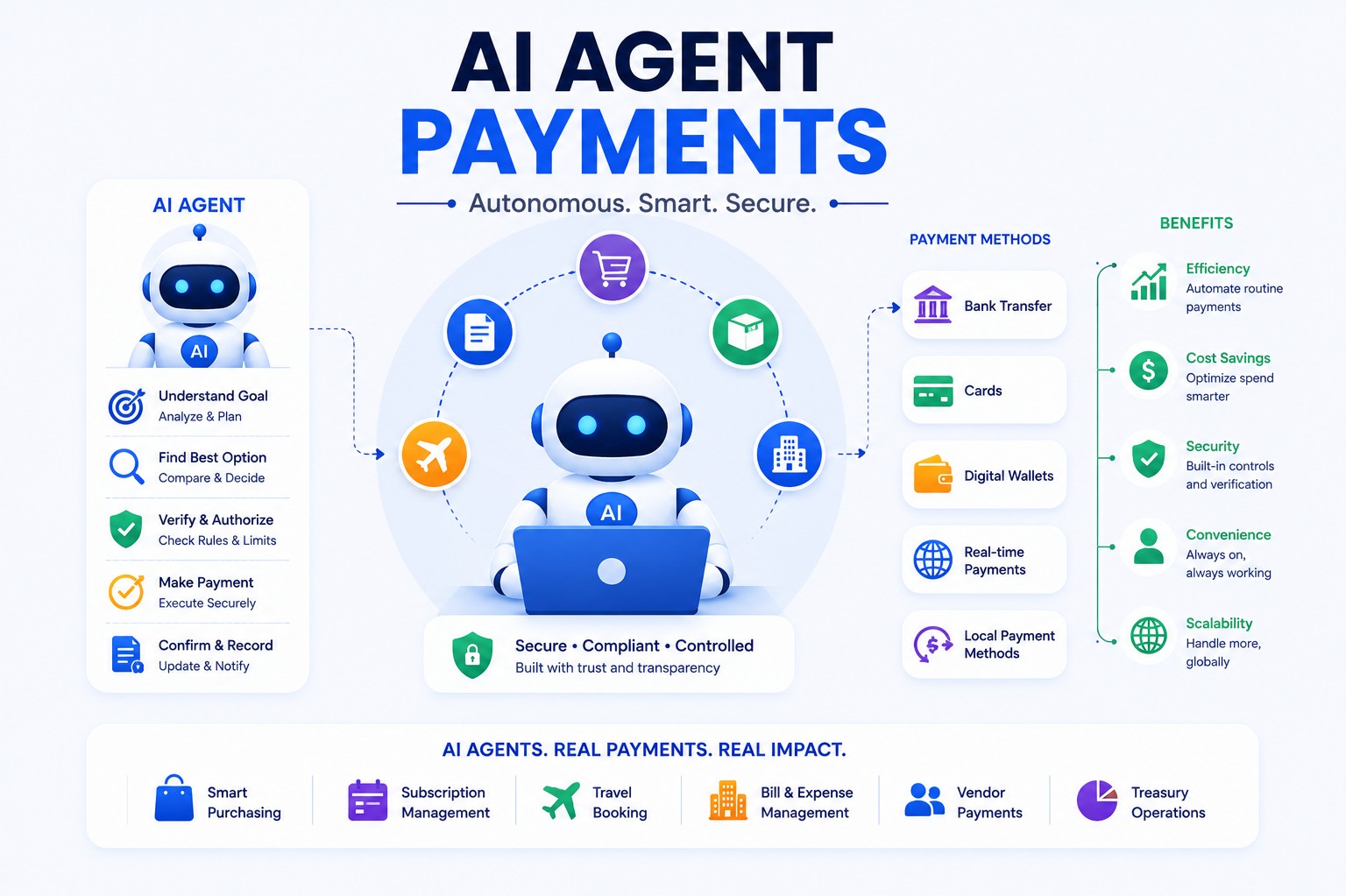
AI Agent Payments rely on a combination of artificial intelligence, payment infrastructure, identity verification, and authorization frameworks. The user first defines spending permissions, objectives, risk thresholds, and operational rules.
The AI agent then monitors relevant data sources and identifies situations requiring financial action. Once the conditions are met, the agent evaluates available options and selects the most appropriate transaction based on predefined criteria.
Before executing the payment, the system verifies authorization parameters and ensures compliance with security requirements. The transaction is then processed through existing payment rails such as bank transfers, cards, digital wallets, or real-time payment networks.
Throughout the process, audit trails and transaction records are maintained to ensure transparency and accountability.
Business Applications of AI Agent Payments
Organizations are expected to be among the earliest adopters of AI Agent Payments. Many business payment processes involve repetitive decisions that can be automated effectively.
Procurement is one of the most obvious use cases. AI agents can monitor inventory levels, identify purchasing needs, compare supplier pricing, and execute payments automatically. This reduces administrative workloads while ensuring operational continuity.
Subscription management represents another important application. AI agents can track software usage, renew essential services, and optimize subscription spending without requiring manual approvals for routine transactions.
Treasury operations may also benefit from autonomous payment systems capable of managing liquidity transfers, vendor settlements, and recurring financial obligations.
Consumer Use Cases
Consumers are likely to experience AI Agent Payments through digital assistants and personal financial management tools. These agents may manage recurring bills, optimize spending decisions, and automate routine purchases.
For example, an AI assistant could automatically pay utility bills, renew insurance policies, or purchase household essentials when supplies run low. The system may also compare providers and identify cost-saving opportunities before completing transactions.
Travel planning provides another compelling use case. An AI agent could manage transportation bookings, accommodation reservations, and local services while ensuring spending remains within a predefined budget.
These capabilities have the potential to make financial management significantly more efficient and personalized.
The Role of Embedded Finance
Embedded finance is expected to play a critical role in the adoption of AI Agent Payments. AI agents require direct access to financial services and payment capabilities to perform transactions autonomously.
Through APIs and Banking-as-a-Service platforms, payment functionality can be integrated directly into AI-driven applications. This allows agents to access accounts, initiate transfers, verify balances, and complete transactions without requiring separate banking interfaces.
The combination of embedded finance and artificial intelligence creates a powerful ecosystem for autonomous financial activity.
As financial services become increasingly programmable, AI agents will gain broader access to payment capabilities.
Security and Trust Considerations
While AI Agent Payments offer significant advantages, they also introduce new security and governance challenges. Allowing autonomous systems to control financial transactions requires robust safeguards and oversight mechanisms.
Organizations must establish spending limits, approval workflows, and monitoring frameworks to prevent unauthorized activity. Multi-layer authentication, transaction verification, and behavioral monitoring will be essential components of secure AI payment systems.
Transparency is equally important. Users must understand how AI agents make decisions and maintain visibility into transaction activity. Clear audit trails help build trust and support regulatory compliance.
The success of AI Agent Payments will depend heavily on balancing automation with accountability.
Regulatory and Compliance Challenges
Financial regulators are closely monitoring the emergence of autonomous financial systems. Existing regulations were largely designed for human decision-makers, creating new questions regarding liability, authorization, and accountability.
Compliance frameworks will need to address issues such as AI governance, consumer protection, fraud prevention, and transaction transparency. Financial institutions must ensure that AI agents operate within clearly defined regulatory boundaries.
Identity verification and consent management will become particularly important as autonomous systems gain greater authority over financial decisions.
As adoption grows, regulatory guidance is expected to evolve rapidly.
Benefits of AI Agent Payments
The primary advantage of AI Agent Payments is efficiency. Routine financial tasks can be completed automatically, reducing manual workloads and accelerating business operations.
AI agents can also improve decision quality by analyzing large volumes of data and identifying optimal transaction opportunities. Businesses may achieve cost savings through smarter procurement, payment optimization, and resource allocation.
For consumers, autonomous payments offer greater convenience and personalized financial management. Tasks that once required ongoing attention can be handled seamlessly in the background.
These benefits position AI Agent Payments as a major driver of future financial innovation.
The Future of AI Agent Payments
The future of payments is increasingly autonomous. As artificial intelligence continues evolving, AI agents will move beyond simple task automation and become active participants in commercial ecosystems.
Future AI agents may negotiate contracts, optimize supply chains, manage financial portfolios, and execute transactions across multiple platforms without human intervention. Real-time payment networks, open banking infrastructure, and embedded finance solutions will accelerate this transformation.
The emergence of autonomous commerce will likely create entirely new business models and payment experiences. Organizations that embrace these innovations early will be better positioned to capitalize on the next generation of digital finance.
Conclusion
AI Agent Payments represent a significant evolution in the way financial transactions are initiated and managed. By enabling intelligent systems to execute payments autonomously within predefined rules and controls, businesses and consumers can automate routine financial activities while improving efficiency and decision-making.
As agentic commerce, embedded finance, and artificial intelligence continue converging, AI Agent Payments will become an increasingly important component of modern financial ecosystems. While challenges related to security, compliance, and trust remain, the potential benefits are substantial.
In the coming years, autonomous payment systems are expected to transform how money moves, creating a future where intelligent agents play a central role in global commerce and financial operations.
Comments
No comments yet. Be the first to share your thoughts.
Leave a comment