
Introduction
The regulatory landscape facing financial institutions has become increasingly complex. Banks, fintech companies, payment providers, and other financial organizations must comply with a growing number of regulations related to anti-money laundering (AML), know your customer (KYC), sanctions screening, fraud prevention, data privacy, and financial reporting. Traditional compliance processes often rely on manual reviews, rule-based monitoring systems, and labor-intensive investigations. While these methods have served the industry for years, they struggle to keep pace with the speed and complexity of modern financial services. This challenge has accelerated the adoption of AI-driven compliance tools. By combining artificial intelligence, machine learning, automation, and advanced analytics, these solutions help organizations strengthen compliance programs while reducing operational burdens. As regulatory expectations continue to evolve, AI is becoming a key driver of smarter and more efficient compliance management.
What Are AI-Driven Compliance Tools?
AI-driven compliance tools are software solutions that use artificial intelligence and machine learning to automate, enhance, and streamline regulatory compliance activities. Rather than relying solely on predefined rules, these systems analyze vast amounts of structured and unstructured data to identify patterns, assess risks, and support compliance decision-making.
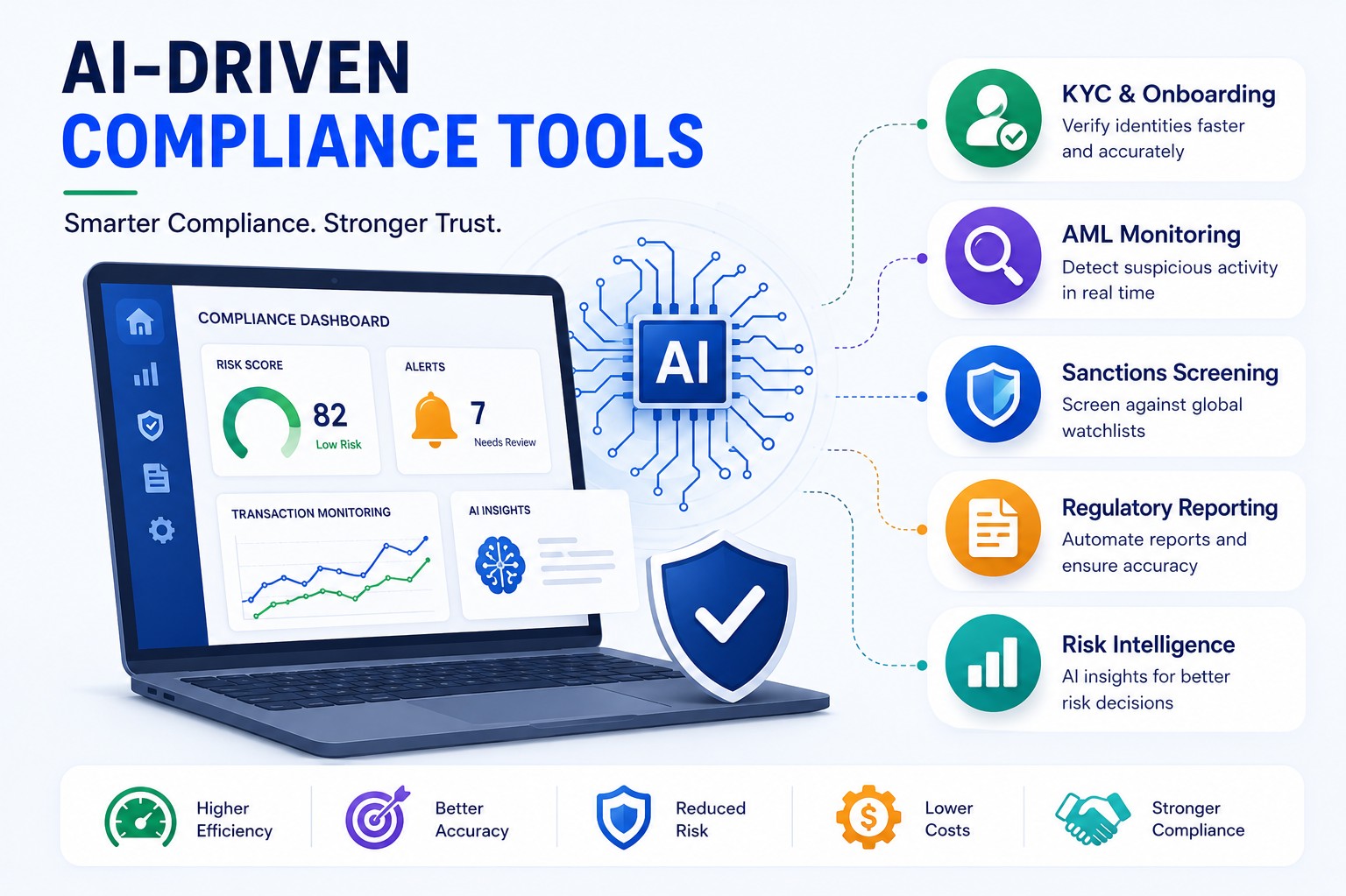
These tools can monitor transactions, verify customer identities, detect suspicious activities, screen against sanctions lists, and generate regulatory reports with minimal human intervention. The result is a more proactive and scalable approach to compliance.
As financial institutions process millions of transactions daily, AI-driven compliance solutions provide the speed and accuracy necessary to identify potential risks in real time.
The Growing Need for Compliance Automation
Financial crime has become increasingly sophisticated. Criminal networks use advanced techniques to evade detection, while regulatory requirements continue expanding across jurisdictions. Organizations that rely solely on manual compliance processes often struggle to maintain efficiency and consistency.
Compliance teams face pressure to review large numbers of alerts while ensuring that legitimate customers experience minimal friction. This balancing act can be difficult when traditional systems generate excessive false positives and require extensive manual investigation.
AI-driven compliance tools address these challenges by automating repetitive tasks and prioritizing genuinely high-risk activities. This allows compliance professionals to focus on strategic analysis and complex investigations rather than routine reviews.
AI in Customer Onboarding and KYC
Customer onboarding represents one of the most important compliance checkpoints within financial services. Before establishing a business relationship, institutions must verify identities, assess risk profiles, and comply with KYC requirements.
AI-powered onboarding tools significantly accelerate this process. They can analyze identity documents, verify biometric information, detect fraudulent submissions, and assess customer risk within seconds. Machine learning algorithms continuously improve their accuracy as they process additional data.
The result is a faster onboarding experience that reduces operational costs while maintaining strong regulatory compliance standards. Customers benefit from quicker account approvals, while institutions gain more reliable identity verification capabilities.
Enhancing Anti-Money Laundering Monitoring
Anti-money laundering compliance remains one of the most resource-intensive areas of financial regulation. Traditional monitoring systems often rely on static rules that generate large numbers of alerts, many of which turn out to be false positives.
AI-driven AML tools improve monitoring effectiveness by analyzing customer behavior, transaction patterns, geographic activity, and account relationships simultaneously. Instead of focusing only on predefined thresholds, machine learning models identify subtle anomalies that may indicate suspicious activity.
By reducing false positives and improving risk detection accuracy, AI enables compliance teams to investigate truly significant cases more efficiently. This improves both regulatory outcomes and operational productivity.
Sanctions Screening and Watchlist Monitoring
Financial institutions must ensure that customers and transactions do not involve sanctioned individuals, organizations, or jurisdictions. Screening processes can be challenging because names often appear in different formats, languages, and spellings.
AI-driven screening solutions use natural language processing and advanced matching algorithms to improve accuracy. These technologies can identify potential matches even when data contains inconsistencies or variations.
This reduces unnecessary investigations while ensuring that genuine risks are identified promptly. As sanctions regulations become more complex, intelligent screening tools are becoming increasingly valuable for compliance operations.
Fraud Detection and Behavioral Analytics
Fraud prevention is closely connected to compliance. Modern AI systems analyze customer behavior, transaction history, device information, and interaction patterns to identify unusual activity.
Unlike traditional rule-based systems, machine learning models adapt continuously as fraud tactics evolve. This enables organizations to identify emerging threats more quickly and respond proactively.
Behavioral analytics adds another layer of protection by establishing normal activity patterns for each customer. When significant deviations occur, the system can trigger alerts for further review. This approach improves detection capabilities while minimizing disruptions for legitimate users.
Regulatory Reporting Made Smarter
Regulatory reporting is often one of the most time-consuming compliance obligations. Financial institutions must collect information from multiple systems, validate data accuracy, and submit reports within strict deadlines.
AI-driven compliance tools automate much of this process by gathering relevant data, identifying inconsistencies, and generating reports automatically. This reduces manual effort and improves reporting accuracy.
Automated reporting also strengthens audit readiness by maintaining comprehensive records and supporting greater transparency. As reporting requirements continue expanding, automation is becoming essential for efficient compliance management.
Benefits of AI-Driven Compliance Tools
The adoption of AI-driven compliance solutions offers advantages beyond regulatory compliance itself. Organizations can improve operational efficiency while enhancing their ability to manage risk.
AI reduces manual workloads, accelerates investigations, improves detection accuracy, and lowers compliance costs. It also enables real-time monitoring capabilities that would be difficult to achieve through traditional approaches.
Perhaps most importantly, AI allows compliance functions to scale alongside business growth. As transaction volumes increase, intelligent systems can continue processing large amounts of data without requiring proportional increases in staffing.
Challenges and Considerations
Despite their benefits, AI-driven compliance tools are not without challenges. Regulatory authorities increasingly expect transparency regarding how AI models reach decisions. Financial institutions must ensure that automated processes remain explainable and auditable.
Data quality also plays a critical role. AI systems are only as effective as the information they receive. Inaccurate or incomplete data can reduce effectiveness and create compliance risks.
Organizations must also establish governance frameworks that address model validation, cybersecurity, privacy requirements, and ongoing performance monitoring. Responsible implementation is essential for achieving long-term success.
The Future of AI-Driven Compliance
The future of compliance is becoming increasingly intelligent. Emerging technologies such as generative AI, predictive analytics, and autonomous risk monitoring systems are expected to further transform compliance operations.
Future compliance platforms may proactively identify regulatory risks, recommend corrective actions, and adapt automatically to changing regulations. Real-time compliance monitoring could become standard across the financial industry, reducing the gap between risk detection and response.
As financial ecosystems become more digital and interconnected, AI-driven compliance tools will play a central role in helping organizations navigate complexity while maintaining trust and regulatory integrity.
Conclusion
AI-driven compliance tools are reshaping how financial institutions manage regulatory obligations, monitor risks, and prevent financial crime. By leveraging artificial intelligence, machine learning, and automation, organizations can improve compliance efficiency, reduce operational costs, and strengthen risk management capabilities.
From customer onboarding and AML monitoring to sanctions screening and regulatory reporting, AI is enabling a smarter and more proactive approach to compliance. As regulatory expectations continue evolving and financial crime becomes increasingly sophisticated, AI-driven compliance solutions will become an essential component of modern financial services.
Organizations that embrace these technologies today will be better positioned to balance innovation, operational efficiency, and regulatory responsibility in the rapidly evolving world of digital finance.
Comments
No comments yet. Be the first to share your thoughts.
Leave a comment