
Introduction
The fintech industry has transformed financial services by making payments, lending, banking, investments, and money transfers faster and more accessible. However, this rapid innovation comes with increasing regulatory responsibilities. Financial institutions and fintech companies must comply with a growing number of regulations related to Anti-Money Laundering (AML), Know Your Customer (KYC), sanctions screening, fraud prevention, data privacy, and financial reporting. Managing these obligations manually is time-consuming, expensive, and prone to human error, especially as transaction volumes continue to rise. AI Compliance Software Fintech is helping organizations overcome these challenges by automating regulatory processes through artificial intelligence and machine learning. These intelligent systems analyze vast amounts of financial data, identify suspicious activities, automate customer due diligence, and generate compliance reports with greater speed and accuracy than traditional methods.
As digital finance expands worldwide, AI-powered compliance software is becoming an essential component of modern fintech infrastructure, enabling businesses to remain compliant while improving operational efficiency.
What Is AI Compliance Software Fintech?
AI Compliance Software Fintech refers to software platforms that use artificial intelligence, machine learning, and advanced analytics to automate regulatory compliance within financial services.
These solutions assist fintech companies in monitoring transactions, verifying customer identities, detecting financial crime, managing regulatory reporting, and maintaining compliance with local and international financial regulations.
Unlike traditional rule-based compliance systems, AI continuously learns from new data, improving its ability to identify emerging risks and evolving fraud patterns.
Why AI Is Transforming Fintech Compliance
Financial regulations are becoming increasingly complex, while digital transactions continue growing in both volume and sophistication.
Manual compliance processes struggle to keep pace with evolving regulations and modern financial crime techniques.
AI enables fintech companies to automate repetitive compliance tasks, reduce false positives, accelerate investigations, and improve decision-making through intelligent data analysis.
This allows compliance teams to focus on higher-risk activities while maintaining stronger regulatory oversight.
How AI Compliance Software Works
AI compliance platforms continuously collect data from banking systems, payment gateways, customer onboarding platforms, transaction records, and external regulatory databases.
Machine learning models analyze customer behavior, transaction history, device information, geographic activity, sanctions databases, and identity verification results.
The system automatically assigns risk scores, identifies unusual patterns, flags suspicious activities, and generates alerts for compliance officers.
Many platforms also automate regulatory reporting and maintain complete audit trails for future reviews.
Key Features of AI Compliance Software
Modern AI compliance platforms offer a comprehensive range of capabilities.
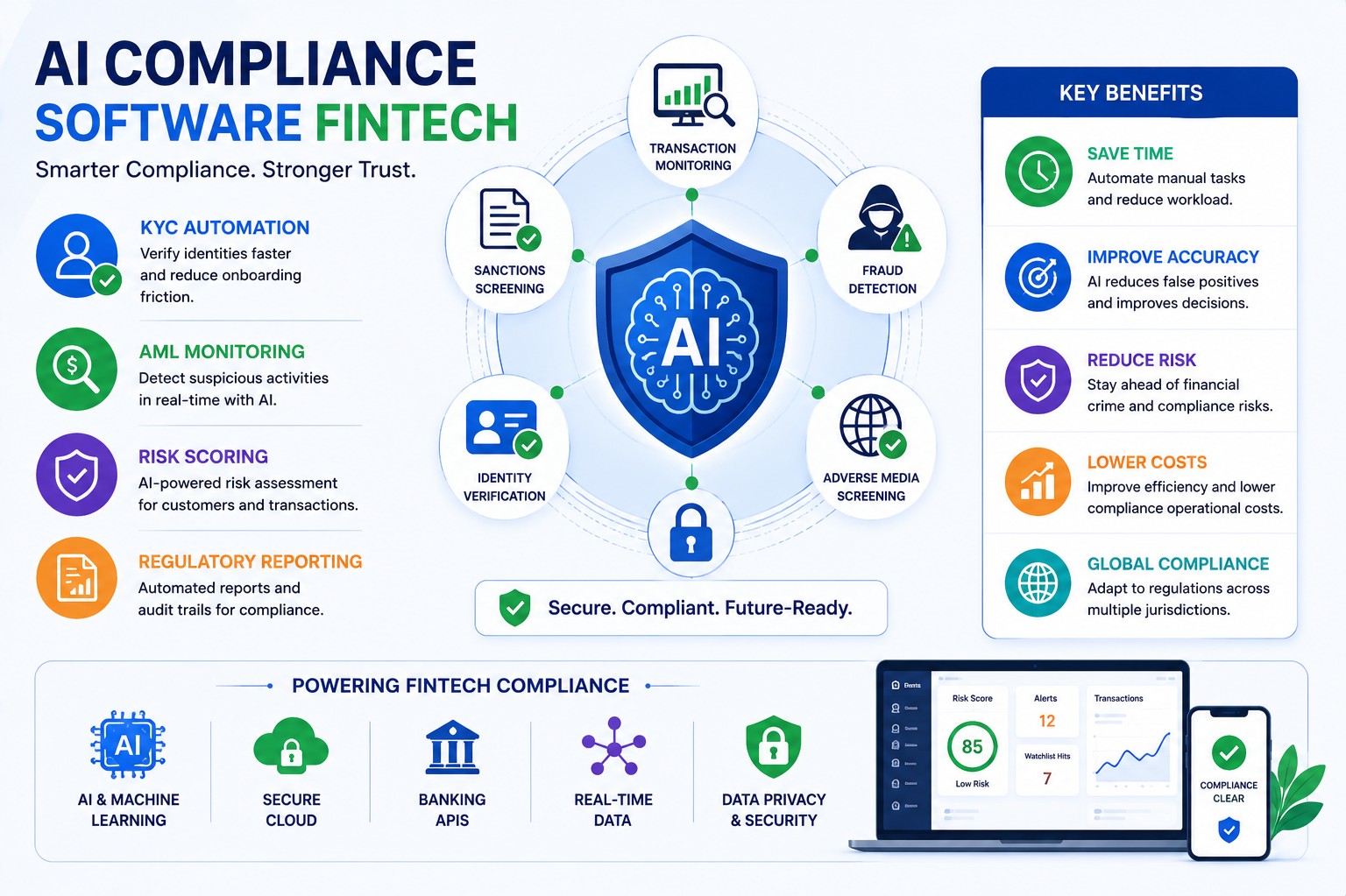
These include automated KYC verification, AML transaction monitoring, sanctions screening, politically exposed person (PEP) checks, customer risk scoring, fraud detection, identity verification, adverse media screening, regulatory reporting, document verification, behavioral analytics, and continuous customer monitoring.
Many solutions also provide dashboards, APIs, workflow automation, and real-time compliance alerts.
AI for AML Monitoring
Anti-Money Laundering compliance is one of the most valuable applications of artificial intelligence.
AI analyzes millions of transactions in real time to identify suspicious money flows, unusual account behavior, structuring activities, rapid fund movements, and potential money laundering schemes.
Machine learning continuously improves detection models by learning from historical investigations and emerging criminal techniques.
This significantly improves detection accuracy while reducing unnecessary investigations.
AI-Powered KYC and Customer Due Diligence
Know Your Customer (KYC) procedures require financial institutions to verify customer identities before providing financial services.
AI simplifies this process through automated identity verification, document authentication, facial recognition, biometric matching, database verification, and ongoing customer monitoring.
Customers experience faster onboarding while businesses maintain strong compliance with regulatory requirements.
Continuous monitoring also ensures customer risk profiles remain up to date throughout the relationship.
Fraud Detection and Risk Management
AI compliance software strengthens fraud prevention by identifying suspicious activities before financial losses occur.
Machine learning models evaluate transaction behavior, login patterns, device usage, geographic locations, and payment history to identify anomalies.
Behavioral analytics helps distinguish legitimate customer activity from potential fraud, reducing both financial risk and false alerts.
This proactive approach improves security while enhancing the customer experience.
Benefits for Fintech Companies
AI-powered compliance delivers significant operational advantages.
Fintech companies can automate repetitive compliance processes, reduce manual workloads, improve regulatory reporting accuracy, accelerate customer onboarding, strengthen fraud detection, and lower operational costs.
Intelligent automation also improves scalability, allowing businesses to handle increasing transaction volumes without proportionally expanding compliance teams.
These efficiencies support sustainable business growth.
Benefits for Customers
Customers benefit from faster, safer, and more convenient financial services.
AI enables quicker account verification, reduces onboarding delays, improves fraud protection, and minimizes unnecessary transaction interruptions.
Because compliance processes become more efficient, customers experience smoother digital banking and payment journeys while maintaining confidence in the security of their financial information.
Regulatory Compliance Across Global Markets
Fintech companies often operate across multiple jurisdictions, each with unique regulatory requirements.
AI compliance platforms help organizations manage compliance with AML regulations, KYC standards, sanctions requirements, data protection laws, payment regulations, and financial reporting obligations across different countries.
Automated rule updates and intelligent policy management simplify regulatory adaptation as compliance requirements evolve.
This flexibility supports international business expansion.
Artificial Intelligence and Explainable Compliance
As AI becomes increasingly involved in regulatory decision-making, explainability has become an important consideration.
Modern compliance platforms increasingly provide transparent reasoning behind risk scores, fraud alerts, and automated decisions.
Explainable AI helps compliance officers understand how conclusions are reached while supporting regulatory audits and governance requirements.
Transparency builds trust among regulators, businesses, and customers alike.
Challenges of AI Compliance
Although AI offers significant advantages, implementation requires careful planning.
Organizations must ensure high-quality data, protect customer privacy, eliminate algorithmic bias, maintain regulatory transparency, and regularly retrain machine learning models.
Human oversight remains essential for complex investigations and final compliance decisions.
Combining AI automation with experienced compliance professionals delivers the most effective results.
Future of AI Compliance Software in Fintech
The future of compliance will become increasingly intelligent and automated.
Generative AI, predictive analytics, real-time risk intelligence, blockchain analytics, digital identity verification, and continuous regulatory monitoring will further strengthen compliance capabilities.
Cloud-native RegTech platforms will integrate seamlessly with banking APIs, payment gateways, and financial ecosystems to deliver end-to-end compliance automation.
Organizations that invest in AI-powered compliance today will be better prepared for tomorrow’s rapidly evolving regulatory landscape.
Choosing the Right AI Compliance Solution
Businesses evaluating AI compliance software should consider AML capabilities, KYC automation, fraud detection accuracy, API integration, reporting features, scalability, explainable AI, cloud deployment, regulatory coverage, security standards, customer support, and implementation flexibility.
A reliable platform should integrate smoothly with existing financial systems while adapting to future regulatory changes and business growth.
Selecting the right solution strengthens compliance while reducing operational complexity.
Conclusion
AI Compliance Software Fintech is transforming the way financial institutions manage regulatory obligations by combining artificial intelligence, machine learning, and intelligent automation. From AML monitoring and KYC verification to fraud detection and regulatory reporting, AI enables fintech companies to improve compliance accuracy while reducing costs and operational effort.
As financial regulations continue to evolve alongside digital innovation, AI-powered compliance software will become increasingly essential for maintaining trust, protecting customers, and supporting sustainable growth. Fintech organizations that embrace intelligent compliance technologies today will be better positioned to succeed in the future of global financial services.
Comments
No comments yet. Be the first to share your thoughts.
Leave a comment