
Introduction
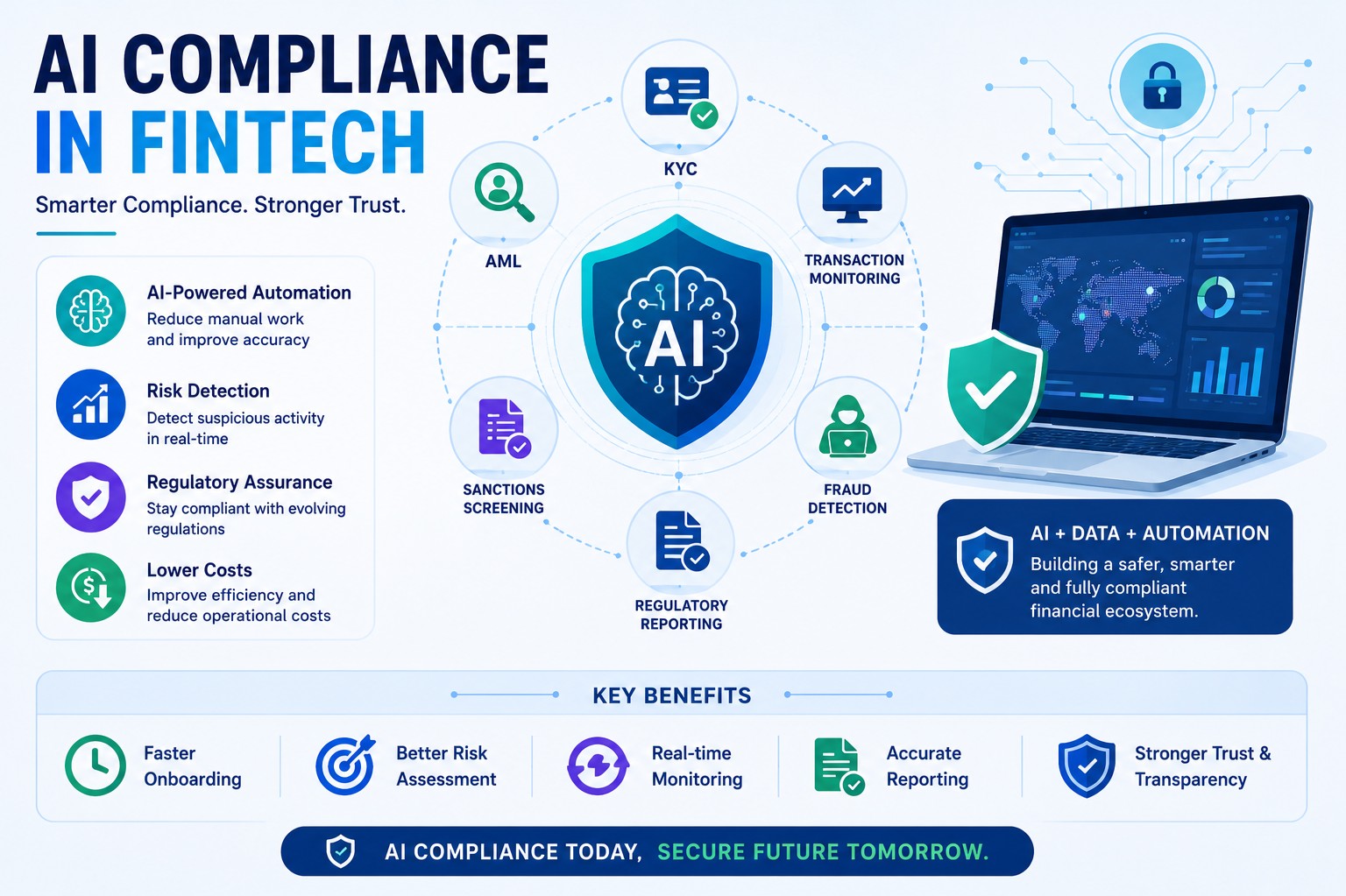
The fintech industry has transformed financial services by delivering faster payments, digital banking experiences, embedded finance solutions, and innovative lending platforms. However, as fintech companies continue to expand, they face an increasingly complex web of regulatory requirements. Compliance obligations related to Anti-Money Laundering (AML), Know Your Customer (KYC), sanctions screening, fraud prevention, transaction monitoring, and data privacy have become more demanding than ever.
Traditional compliance methods often rely heavily on manual reviews, rule-based systems, and extensive documentation. These approaches can be expensive, time-consuming, and difficult to scale in today’s fast-moving digital environment.
This is where Artificial Intelligence (AI) is making a significant impact. AI-powered compliance solutions are helping fintech companies automate regulatory processes, improve accuracy, detect suspicious activity faster, and reduce operational costs.
As financial regulations continue evolving globally, AI compliance is becoming a strategic necessity rather than a competitive advantage.
What Is AI Compliance in Fintech?
AI Compliance in Fintech refers to the use of artificial intelligence, machine learning, natural language processing, and advanced analytics to automate and enhance regulatory compliance activities.
Instead of relying solely on predefined rules and manual investigations, AI systems can analyze vast amounts of data, identify unusual patterns, assess risks, and support compliance teams in real time.
These technologies help fintech companies manage regulatory obligations more effectively while maintaining operational efficiency and customer satisfaction.
AI compliance solutions are increasingly used across areas such as:
- Customer onboarding
- Identity verification
- AML screening
- Transaction monitoring
- Sanctions checks
- Fraud detection
- Regulatory reporting
- Risk assessment
The objective is to create smarter and more scalable compliance operations.
Why Compliance Is a Growing Challenge for Fintechs
Fintech companies operate in one of the most heavily regulated industries in the world.
As digital financial services expand across borders, organizations must comply with multiple regulatory frameworks, each with its own reporting requirements, monitoring standards, and customer protection rules.
Several factors are increasing compliance complexity:
- Rising financial crime threats
- Expanding AML regulations
- Cross-border payment growth
- Open banking adoption
- Cryptocurrency regulation
- Data privacy requirements
- Enhanced consumer protection rules
Managing these obligations manually can significantly increase operational costs and slow business growth.
AI helps address these challenges by automating repetitive tasks and improving decision-making accuracy.
AI-Powered KYC and Customer Onboarding
Customer onboarding is often the first compliance checkpoint for fintech companies.
Traditional onboarding processes can require extensive document reviews, identity verification checks, and risk assessments. These manual procedures frequently create delays and friction for customers.
AI-powered onboarding solutions streamline the process by automatically verifying identities, analyzing submitted documents, and detecting fraudulent applications.
Machine learning algorithms can identify forged documents, compare biometric data, and assess customer risk profiles within seconds.
Benefits include:
- Faster onboarding
- Improved customer experience
- Reduced manual reviews
- Higher verification accuracy
- Stronger fraud prevention
This enables fintech companies to scale customer acquisition while maintaining regulatory compliance.
AI and Anti-Money Laundering (AML)
Anti-Money Laundering compliance remains one of the most resource-intensive areas of financial regulation.
Traditional AML systems often generate large numbers of false positives, forcing compliance teams to investigate alerts that pose little actual risk.
AI significantly improves AML monitoring by analyzing transaction behavior, customer activity, and network relationships more intelligently.
Instead of relying exclusively on fixed rules, machine learning models can detect hidden patterns that may indicate money laundering activities.
AI-powered AML solutions help organizations:
- Detect suspicious transactions faster
- Reduce false positives
- Improve investigation efficiency
- Strengthen risk assessments
- Enhance regulatory reporting
These capabilities allow compliance teams to focus on genuinely high-risk activities.
Transaction Monitoring and Risk Detection
Modern fintech platforms process millions of transactions daily.
Monitoring these transactions manually is virtually impossible. AI enables real-time transaction analysis at scale.
Machine learning systems evaluate transaction characteristics, customer behavior, geographical data, device information, and payment patterns simultaneously.
When unusual activity is detected, alerts can be generated immediately for further review.
AI-driven transaction monitoring provides:
- Real-time risk analysis
- Behavioral anomaly detection
- Enhanced fraud prevention
- Improved compliance efficiency
- Reduced operational burden
As payment volumes continue increasing, these capabilities become increasingly valuable.
Sanctions Screening and Watchlist Monitoring
Financial institutions must ensure that customers and transactions do not involve sanctioned individuals, organizations, or jurisdictions.
Traditional screening systems often struggle with name variations, spelling inconsistencies, and multilingual data.
AI-powered sanctions screening solutions use advanced matching techniques and natural language processing to improve identification accuracy.
This reduces false positives while ensuring that potential risks are identified more effectively.
The result is stronger compliance and improved operational efficiency.
Regulatory Reporting Automation
Regulatory reporting can consume substantial resources within fintech organizations.
Compliance teams must gather information from multiple systems, verify data accuracy, and prepare reports for regulators within strict deadlines.
AI automates much of this process by collecting, validating, and organizing compliance data automatically.
Benefits include:
- Faster reporting
- Improved data accuracy
- Reduced compliance costs
- Enhanced audit readiness
- Lower operational risk
Automated reporting helps organizations maintain compliance while freeing resources for strategic activities.
AI and Fraud Prevention
Fraud prevention and compliance are closely connected.
Many fintech companies use AI to identify fraudulent activities before they result in financial losses or regulatory concerns.
AI systems analyze behavioral patterns, transaction histories, device fingerprints, and customer interactions to identify suspicious activity.
Unlike static fraud rules, machine learning models continuously adapt to new fraud techniques.
This dynamic approach improves fraud detection effectiveness while minimizing disruptions for legitimate customers.
Challenges of AI Compliance
Despite its advantages, AI compliance adoption presents several challenges.
Regulators increasingly require transparency regarding how AI models make decisions. Financial institutions must ensure that AI systems remain explainable, fair, and free from unintended bias.
Additional challenges include:
- Data quality management
- Model governance
- Regulatory oversight
- Cybersecurity risks
- Privacy considerations
- Ongoing model monitoring
Organizations must implement robust governance frameworks to ensure responsible AI usage.
The Future of AI Compliance in Fintech
The future of compliance is becoming increasingly intelligent and automated.
Emerging technologies such as generative AI, predictive analytics, and agentic AI are expected to enhance compliance capabilities even further. Future systems may proactively identify regulatory risks before violations occur and automatically recommend corrective actions.
RegTech platforms powered by AI will likely become standard infrastructure across fintech ecosystems.
As regulations continue evolving and financial crime becomes more sophisticated, AI will play an essential role in helping organizations maintain compliance while supporting innovation.
Conclusion
AI Compliance is rapidly transforming the fintech industry by enabling smarter, faster, and more efficient regulatory management. From customer onboarding and AML monitoring to sanctions screening and fraud prevention, artificial intelligence is helping fintech companies navigate increasingly complex compliance requirements.
As financial institutions seek to balance innovation with regulatory responsibility, AI-powered compliance solutions will become a critical component of modern fintech operations. Organizations that embrace these technologies today will be better equipped to reduce risk, control costs, improve customer experiences, and maintain trust in an increasingly digital financial ecosystem.
Comments
No comments yet. Be the first to share your thoughts.
Leave a comment