
Six months in, an auditor at a card network pulls a file she wasn’t looking for.
She’s not investigating anything dramatic. It’s routine — a periodic review of elevated-dispute merchant IDs, the kind of housekeeping that happens quietly, all the time, in departments most people never think about. One MID on her list has a chargeback ratio that’s crept up a little too fast for its stated business type. She opens the transaction history to see what’s actually been running through it.
It doesn’t match.
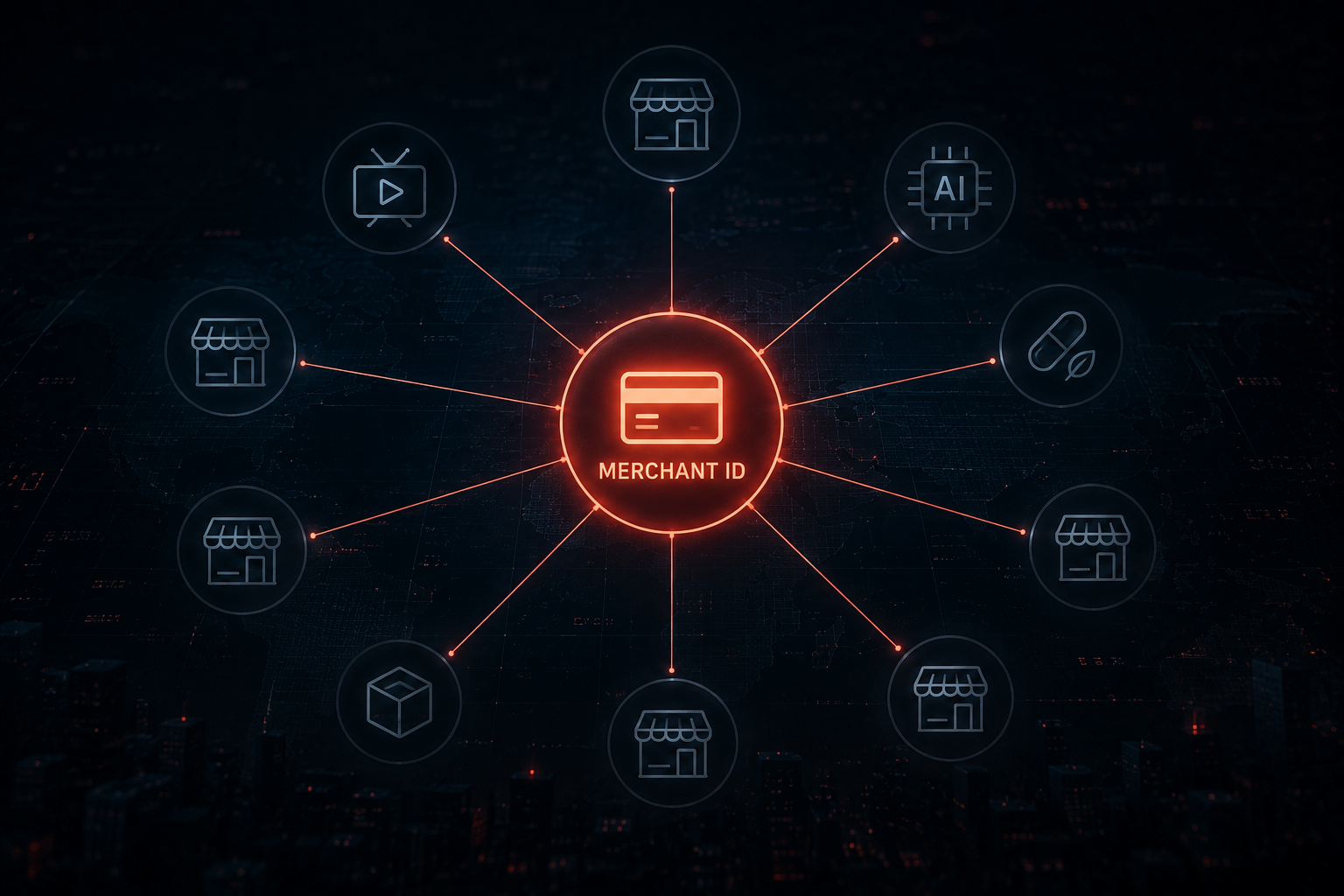
The MID was approved for one thing. What she’s looking at is ten. IPTV subscriptions sitting next to AI software charges sitting next to what looks, on closer inspection, like health supplement recurring billing. Different websites. Different customer bases. Different everything — except the merchant ID field, which says the same four characters, over and over, thousands of times a day.
She pulls the onboarding file to find out who approved this and what they were told. What she finds isn’t a smoking gun. It’s a chat log. And the chat log is almost boring, which is somehow worse.
Six Months Earlier
The conversation starts the way most of these do: a hello, a request for gateway access, a form.
But this prospect asks a different opening question than most. Not “what are your rates,” not “how fast is approval” — instead: what categories can you support? IPTV, AI, and health products. Three unrelated verticals, named in the same breath, before any business has even been described.
The rep’s answer is careful, almost textbook: it depends on a quick review from our compliance team. Which is the right answer. It’s the answer you’d want to hear. It just doesn’t survive contact with what comes next.
Because the prospect isn’t actually asking permission to sell three things. He’s asking permission to be an aggregator — a platform that connects other merchants to the payment rail, merchants who will never speak to the processor directly. The merchants interface with our API, he explains, and the merchants do not directly establish contact with you.
Read that sentence again slowly, because it’s the entire story in one line. What’s being proposed isn’t a merchant account. It’s a payment facilitator arrangement — a business that sits between the processor and an unknown, unbounded number of sub-merchants, none of whom will ever go through the processor’s own KYC. And the entire architecture is disclosed, upfront, in plain language, three messages into a first conversation.
The Form That Doesn’t Ask the Right Question
A merchant application form gets filled out. Nine days pass. It comes back. The processor reviews it, and less than a day later, full commercial terms arrive: 6% card rate, 0.9% crypto, a $3,200 onboarding fee, a 10% reserve held six months, weekly settlement.
Reasonable-looking numbers, for a business that, as far as the paperwork is concerned, is one company selling one thing.
It isn’t. And everyone in the conversation already knows it isn’t, because the aggregation model was explained before the form was even sent. The terms get approved anyway, priced as if a single, knowable business is about to start processing — not as if an unknown number of sub-merchants across three-plus unrelated verticals are about to start running transactions underneath a single four-character label.
This is the moment the auditor, six months later, will keep coming back to. Not the fee stacking. Not the reserve terms — those are unremarkable, industry-standard, nothing worth flagging on their own. The moment that matters is this one: the business model was stated clearly, and the underwriting proceeded as though it hadn’t been.
“You Can Use the Same MID”
The conversation keeps going, and it keeps confirming the same thing, casually, a little at a time.
If I have other product categories, do I need to report them separately, or can I use the same MID?
You can use the same MID. Just make sure to inform us and get approval once before adding or processing new product categories.
Notice the shape of that answer. Not “no, each vertical needs its own MID and its own risk profile assessed independently” — which is what a properly segmented merchant account structure would require, especially across categories as different as IPTV, AI products, and health supplements, each of which carries its own distinct chargeback and regulatory profile. Instead: same MID, just tell us first.
“Just tell us first” is doing an enormous amount of load-bearing work in that sentence, and it’s the kind of promise that’s very easy to keep in spirit and very easy to quietly stop keeping in practice, three months in, once the relationship feels established and nobody’s checking closely.
A few messages later, the question that should have been the biggest flag in the entire file gets asked and answered in nine words:
After starting the cooperation, will I be able to obtain more MID?
Yes, after starting the cooperation, you will be able to obtain more MID.
More MIDs. Plural. For an aggregation platform that’s already told you its merchants will never contact you directly. Every additional MID handed out under this arrangement is another opaque layer between the processor’s actual risk exposure and what its own systems can see.
The Fourteen-Day Sprint
Here’s what the calendar looks like once terms are agreed: contract sent, signed and returned within two days. Payment — in USDT, on the TRC20 network, effectively untraceable to a named financial institution — sent and confirmed the same day the signed contract lands, before a single KYC document has been submitted.
Only after the payment clears does the request for KYC documents go out: certificate of incorporation, UBO identification, bank statements, domain ownership certificate. Standard list. Right list. Wrong order — the money moved first, the identity verification came second, and in a properly risk-managed onboarding, that sequence runs the other way.
Two days after that, the agreement bounces back once, rejected — not for a compliance reason, but because the signature landed outside a designated box on the PDF. It gets fixed. Then it turns out the company doesn’t actually have a corporate seal. Can we just sign instead? Yes. Done. Approved.
A test account goes live eleven days after the first hello.
The Question Asked Almost as an Afterthought
Three days after going live, almost buried between a question about supported card schemes and one about subscription billing, the merchant asks something that reads, at first glance, like idle curiosity:
Does your company have any other names?
Yes.
Is the name [a different registered brand]?
Yes.
The account he’s about to run ten businesses through isn’t going live under the brand name he spent two weeks negotiating with. It’s going live under a different one — disclosed only because he happened to ask, not because anyone volunteered it. Multi-brand acquiring infrastructure isn’t inherently improper; plenty of processors operate under several trading names for entirely legitimate banking-relationship reasons. What’s notable here isn’t the existence of a second name. It’s the fact that discovering it depended entirely on the merchant thinking to ask.
What the Auditor Actually Finds
By the time she closes the file, the picture is complete, and none of it required a single lie. Every individual answer in the chat log was, technically, true. Yes, multiple categories can usually be supported. Yes, the same MID can be reused. Yes, more MIDs become available later. Yes, the company has another name. Every sentence, defensible in isolation.
What’s missing isn’t a lie. It’s a structure. Nobody in this conversation ever registered as a payment facilitator, which is the formal designation card networks require precisely for this situation — a business that onboards its own sub-merchants and needs its own compliance program, its own sub-merchant KYC, its own reporting obligations to the network, specifically because a single processor’s underwriting can’t see through it otherwise. Instead, an entire undisclosed portfolio of unrelated merchants ended up running under one MID, approved in under two weeks, funded before identity verification was complete, and issued under a brand name that only came up because someone asked.
The auditor doesn’t need a confession. She has a transaction log that already looks nothing like what was approved, and an onboarding file that shows, in plain black and white chat text, that everyone involved understood exactly what kind of business this actually was — twelve days before it went live.
Why This Story Matters Even If You’re Not an Underwriter
Most red-flag stories in payments get told from the merchant’s side — the founder who signed something they shouldn’t have. This one’s worth telling from the other direction, because the same pattern shows up on both sides of the table: speed treated as a feature, disclosure treated as optional until asked for directly, and every individual step defensible right up until someone adds them all together.
If you’re building anything that even resembles an aggregation model — sub-merchants, white-label distribution, an API that other businesses will sit behind — the lesson isn’t “don’t do this.” Payment facilitation is a completely legitimate business model, done properly, with the right registration and the right per-sub-merchant risk controls. The lesson is that “same MID, just tell us later” is not that. It’s the shortcut version, and shortcuts in this specific corner of financial infrastructure don’t fail quietly. They fail six months later, in an audit file, all at once.
This piece is a narrative reconstruction based on an anonymized real conversation. No company is named or identified, and the auditor and audit scenario are illustrative, not a report of an actual investigation. It is offered as educational content on payment facilitation risk and is not legal or compliance advice.
Comments
No comments yet. Be the first to share your thoughts.
Leave a comment