
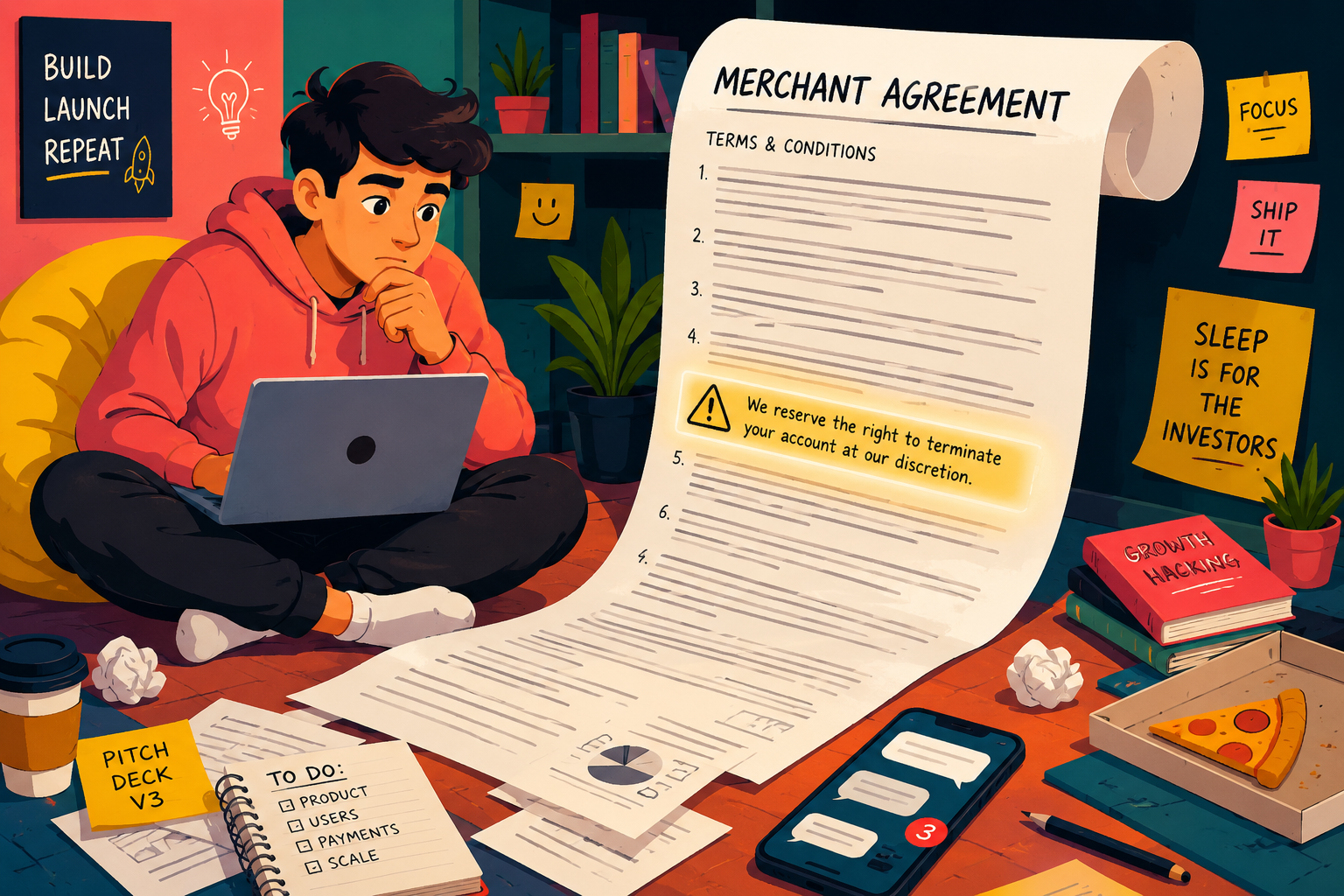
Nobody tells you this in school. Nobody tells you this on TikTok either, which is wild because half of TikTok is people trying to get paid for something. You build the thing — the app, the store, the platform, the OnlyFans-but-make-it-legal creator site — and you think the hard part is done. The hard part was never done. The hard part was hiding the whole time, wearing a blazer, calling itself a “merchant account.”
Here’s everything I wish someone had sat me down and explained before I opened my laptop and said yes to the first person who said yes to me.
1. “High-risk” isn’t an insult, it’s a price tag
The first time someone told me my business was “high-risk,” I got defensive. Like — excuse me? My business is legit. I have a license. I have a legal team. I have a spreadsheet.
Turns out “high-risk” has nothing to do with whether your business is sketchy. It’s a category. Forex, gaming, adult content, subscriptions, crypto, nutraceuticals, CBD, travel — literally just a list of industries where card networks have decided chargebacks happen more, disputes happen more, and regulation is messier. You could be the most compliant, most licensed, most buttoned-up founder alive and you’ll still get sorted into the “high-risk” bucket the second someone hears your MCC.
What that actually means for you: higher fees, rolling reserves, and a much smaller pool of processors who’ll even talk to you. That’s it. It’s not a vibe check on your character. It’s just math the card networks did a long time ago and never updated.
2. The quote you get on day one is not the price you pay
This one hurt. You’ll get a number early — “expect around 6%” or “7%, all in” — and it feels like a real answer, so you build your whole model around it.
Then the actual contract shows up and there’s a second fee. A “settlement fee.” An “onboarding fee.” Sometimes both, sometimes stacked on top of the number you already had in your head. Nobody’s necessarily lying to you — they’re just answering the exact question you asked, which was “what’s the rate,” not “what’s every single fee in this relationship.”
The fix: ask for the number that includes literally everything, in writing, and ask them to confirm nothing else gets added later. Say the words “is this the total, all-in cost, with nothing else stacked on top” out loud, in a message, so it’s on record.
3. Reserves are not a scam, but the fine print around them can be
A rolling reserve — where the processor holds back like 10% of your money for a while — sounds terrifying the first time you hear it. It’s actually pretty normal in high-risk world. It exists because if a customer disputes a charge months later, the processor needs money sitting around to cover it. Fine. Reasonable. Whatever.
Here’s the part that isn’t reasonable and that nobody warns you about: it’s not just the percentage that matters, it’s the combo. A 10% reserve for six months is annoying but survivable. A 10% reserve for six months plus a 10-business-day manual settlement cycle on whatever’s left? That’s basically your cash flow getting choked from two directions at once, and if you run a business where you owe money to other people on a schedule — creators, affiliates, vendors, whoever — that combo can actually break you, not just annoy you.
The fix: don’t evaluate reserve % and settlement speed separately. Multiply the pain. Ask what your actual cash-in-hand looks like on day 45, not just what the percentages say on paper.
4. “We’ll review it after 45 days” means literally nothing until it’s in writing
You will hear some version of this sentence a thousand times: “these terms aren’t rigid, we can revisit once we have some processing history.” It sounds like a promise. It is not a promise. It’s a sentence. Sentences said in a chat window are not the same as clauses in a contract, and the number one thing you can do to protect yourself is to stop treating them the same way.
If a rep tells you something will change later, ask them to put it in an addendum, an email, anything with their name attached that isn’t a disappearing message. If they won’t, that tells you something too.
5. Watch how a company treats its OWN money
This is the detail that should be a whole genre of red flag on its own. If a payment company ever asks you to pay them via bank wire or crypto instead of a card — and especially if they explain that away by saying something like “we don’t have a merchant ID set up for our own internal payments” — sit with that for a second.
A company whose entire business is processing card payments… can’t process a card payment for its own invoice? That’s not a technicality. That’s the company telling you, out loud, exactly how annoying and risky card compliance actually is — while asking you to trust them with yours.
6. “MCC” is a boring acronym that can ruin your whole year
Merchant Category Code. Sounds like nothing. It’s the little label attached to every transaction that tells banks and card networks what kind of business you actually are. Restaurant, retail, gaming, forex, whatever.
If anyone — anyone — offers to make your transactions look like a different, lower-risk category than what you actually do, that is not a discount. That’s not a hack. That’s a practice with an actual name (transaction laundering, sometimes called “miscoding”), and it’s explicitly against Visa and Mastercard‘s own rules. If it ever gets caught by a network audit, it’s your account that freezes, your funds that get held, your business that gets blacklisted — not theirs. They’ll have moved on to the next founder by then.
If a sales rep ever explains that miscoding “protects you from compliance,” that’s not protection. That’s you agreeing to hold a bag you didn’t know existed.
7. Reviews saying “it gets worse after you sign” are not just disgruntled randoms
Every high-risk processor has some bad reviews. That’s normal, that’s every industry. But there’s a very specific complaint pattern worth actually paying attention to: people saying the good terms were front-loaded and things tightened up after they were already live, already dependent, already unable to easily switch.
If you see that exact shape of complaint — not “bad customer service,” specifically “it was great until I was locked in, then it changed” — across multiple reviews, from multiple people, about the same company? That’s not noise. That’s a pattern describing exactly how the relationship is designed to work.
8. The person you’re negotiating with is not your friend, even when they’re being genuinely nice
This one’s less about scams and more about psychology. A good account manager will feel like an ally. They’ll say “let me fight for you,” “I got the team to bend on this,” “you’re one of our best clients, that’s why I’m doing this for you.” Some of that might even be true.
But they work for the processor, not for you. Every “win” they hand you is still a term the processor was fine giving away. Treat every concession as information about how much room actually existed — not as a personal favor you now owe loyalty for.
9. You will feel pressure to just sign because you’ve already waited so long
This is the sneaky one. You’ll spend weeks, sometimes months, going back and forth — licensing, documents, forms, more forms. By the time a contract actually lands in front of you, you’re tired, you’re behind schedule, your marketing budget is sitting there burning a hole, and every day you don’t sign feels like money on fire.
That exhaustion is exactly the moment you’re most likely to skim past the one clause that actually matters. The fix isn’t “don’t get tired” — you will get tired, that’s unavoidable. The fix is deciding, before you’re tired, what your actual dealbreakers are (reserve terms, settlement speed, anything resembling miscoding) so future-you doesn’t have to make that judgment call while running on fumes and adrenaline.
The one-line version of all of this
A merchant account is not a formality you check off before the “real” business starts. It IS the business, in the sense that if it goes wrong, nothing else you built matters. Read slower than feels natural. Ask the annoying follow-up question. Get the good news in writing. And if anyone ever offers to make your business look like something it’s not — that’s not the deal of a lifetime. That’s the exit sign, and you should take it.
This post reflects general patterns seen across high-risk merchant account experiences and is meant as educational content for founders, creators, and operators evaluating payment providers. It’s not legal or financial advice — talk to an actual payments attorney before signing anything with real money attached.
Comments
No comments yet. Be the first to share your thoughts.
Leave a comment