
Introduction
The global payments industry operates on a foundation of trust, security, and compliance. Every day, billions of card transactions are processed through payment networks that connect consumers, merchants, banks, and payment service providers. To maintain the integrity of this ecosystem, card schemes establish strict operational and security standards that all participants must follow.When these rules are violated, payment networks may impose card scheme fines. These financial penalties are designed to encourage compliance, protect consumers, and maintain the stability of the payments ecosystem.
For merchants, payment processors, acquiring banks, fintech companies, and other payment participants, understanding card scheme fines is critical. Non-compliance can result in significant financial losses, reputational damage, increased scrutiny, and operational disruption.
As digital payments continue to expand globally, card scheme compliance has become a strategic priority rather than simply a regulatory requirement.
What Are Card Scheme Fines?
Card scheme fines are financial penalties imposed by payment card networks when merchants, acquiring institutions, processors, or other participants fail to comply with established rules and standards.
Card networks maintain extensive operating regulations covering transaction processing, fraud prevention, security requirements, chargeback management, data protection, and merchant conduct.
When violations occur, the responsible organization may face penalties that vary depending on the severity, duration, and impact of the non-compliance.
These fines are intended to promote accountability and ensure all participants contribute to a secure and reliable payment environment.
Why Card Schemes Impose Fines
Payment networks process enormous transaction volumes involving consumers and businesses across multiple countries.
To maintain trust in the payment system, card schemes must ensure participants follow consistent standards. Failure to enforce these standards could increase fraud, compromise cardholder data, and undermine confidence in electronic payments.
Card scheme fines serve several purposes.
First, they encourage organizations to maintain strong compliance programs.
Second, they help reduce risks associated with fraud, security breaches, and operational failures.
Third, they protect consumers by ensuring payment providers implement appropriate safeguards.
By enforcing compliance through financial penalties, card networks help maintain the stability and security of the global payments ecosystem.
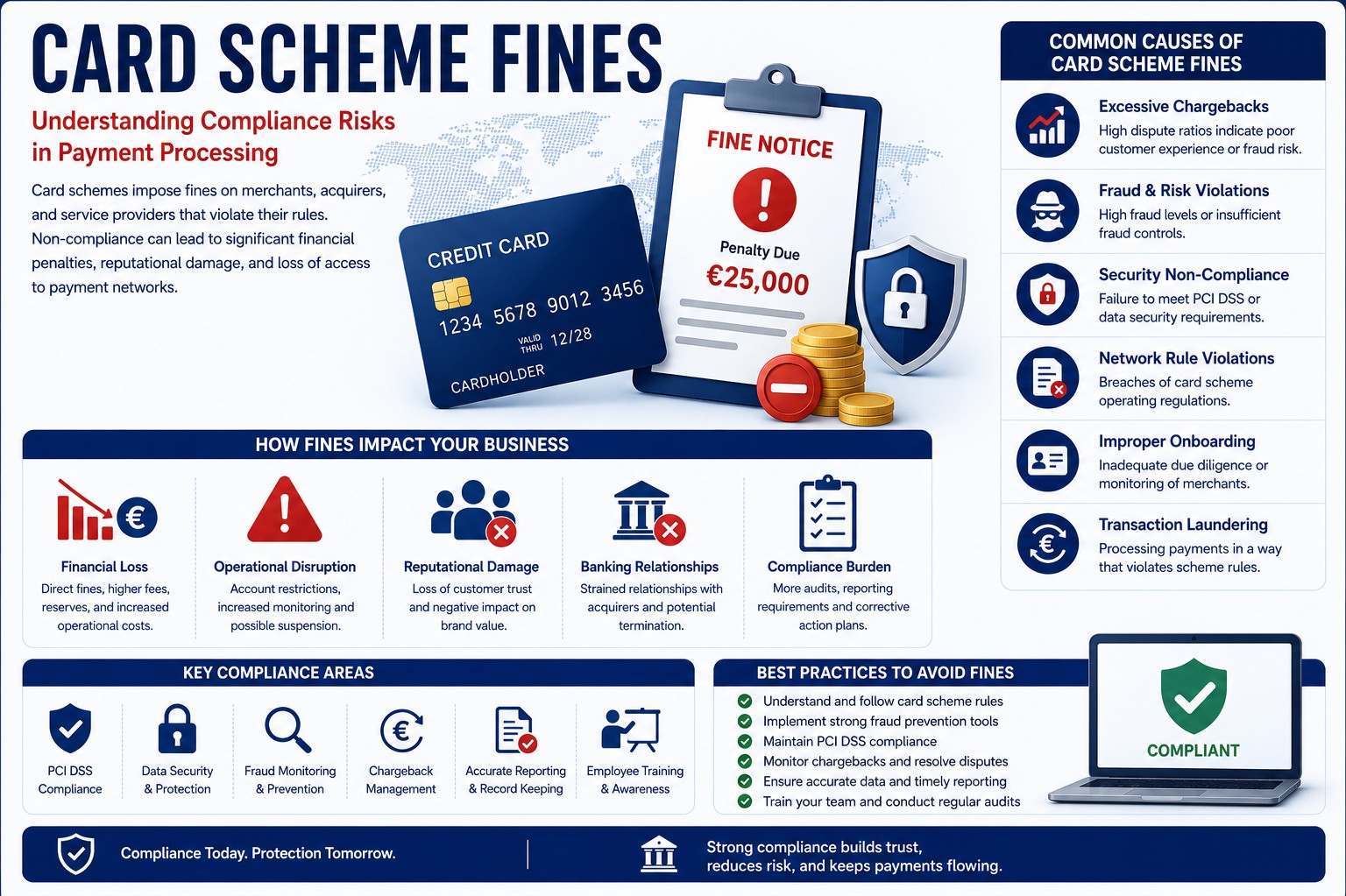
Common Causes of Card Scheme Fines
There are numerous reasons why organizations may incur card scheme fines.
One of the most common causes is excessive chargeback activity. Merchants with unusually high dispute rates may be viewed as presenting elevated risks to the payment ecosystem.
Fraud-related issues can also trigger penalties. If a business experiences excessive fraudulent transactions or fails to implement adequate fraud controls, card networks may take enforcement action.
Security compliance failures represent another major category. Organizations that fail to maintain required security standards or properly protect cardholder data may face significant fines.
Other causes may include transaction laundering, improper merchant onboarding practices, inaccurate reporting, non-compliant payment processing activities, and violations of network operating rules.
The Role of PCI DSS Compliance
Payment Card Industry Data Security Standard (PCI DSS) compliance is closely linked to card scheme enforcement.
PCI DSS establishes security requirements designed to protect payment card information from unauthorized access and cyber threats.
Organizations that store, process, or transmit cardholder data must comply with these standards.
Failure to maintain PCI DSS compliance can expose businesses to security incidents and increase the likelihood of card scheme penalties.
In cases involving data breaches, fines can become particularly severe due to the potential impact on consumers and financial institutions.
Strong PCI DSS compliance programs are therefore essential for minimizing regulatory and operational risks.
Chargebacks and Card Scheme Fines
Chargebacks remain one of the leading causes of card scheme enforcement actions.
A chargeback occurs when a cardholder disputes a transaction and requests a reversal through their issuing bank.
While chargebacks serve an important consumer protection function, excessive dispute rates can indicate underlying operational issues.
Common causes include misleading product descriptions, poor customer service, recurring billing confusion, fulfillment failures, and fraudulent activity.
Card schemes monitor chargeback ratios closely. Businesses that exceed established thresholds may enter monitoring programs and become subject to escalating fines if performance does not improve.
Effective chargeback management is therefore critical for maintaining payment ecosystem health.
Fraud Monitoring Programs
Card schemes operate sophisticated fraud monitoring programs designed to identify participants generating unusually high levels of fraudulent activity.
These programs track transaction patterns, fraud rates, and merchant performance across payment networks.
Organizations that exceed fraud thresholds may receive warnings, remediation requirements, and financial penalties.
In severe cases, continued non-compliance can lead to restrictions on payment processing activities.
To avoid these outcomes, businesses should invest in advanced fraud detection technologies, transaction monitoring systems, and customer authentication mechanisms.
Proactive fraud prevention remains one of the most effective ways to reduce compliance exposure.
Impact on Merchants and Businesses
Card scheme fines can have significant financial consequences.
Direct penalties may range from modest amounts to substantial sums depending on the nature and duration of the violation. However, the indirect costs are often equally important.
Organizations facing compliance issues may experience increased processing fees, additional monitoring requirements, reserve obligations, and reputational damage.
Customer trust can also suffer if security incidents or compliance failures become public.
For businesses operating on thin margins, repeated enforcement actions can create meaningful operational challenges.
Maintaining compliance is therefore both a risk management and business continuity priority.
The Role of Acquiring Banks
Acquiring banks play a critical role in card scheme compliance.
Because acquiring institutions sponsor merchants into payment networks, they share responsibility for ensuring merchant compliance with card scheme rules.
Acquirers conduct merchant due diligence, monitor transaction activity, review chargeback performance, and oversee risk management practices.
When merchants violate network standards, acquiring banks may also face consequences from card schemes.
As a result, acquirers often work closely with merchants to identify risks and implement corrective actions before violations escalate.
Strong collaboration between merchants and acquiring institutions contributes to more effective compliance outcomes.
Technology and Compliance Management
Modern technology is transforming how organizations manage payment compliance.
Artificial intelligence, machine learning, and advanced analytics are improving fraud detection and transaction monitoring capabilities.
Automated compliance platforms can identify potential violations, generate alerts, and support regulatory reporting requirements.
Real-time risk assessment tools help organizations detect emerging threats before they result in enforcement actions.
By leveraging technology effectively, businesses can reduce operational risks and improve compliance performance across payment operations.
Best Practices for Avoiding Card Scheme Fines
Organizations seeking to minimize compliance risks should adopt a proactive approach.
Regular compliance audits help identify potential weaknesses before they become significant problems. Maintaining strong PCI DSS compliance is essential for protecting cardholder data.
Businesses should implement comprehensive fraud prevention strategies and monitor chargeback activity closely.
Employee training is also important. Staff involved in payment operations should understand card scheme requirements and recognize potential compliance issues.
Strong governance, effective risk management, and continuous monitoring create a foundation for long-term compliance success.
Future Trends in Card Scheme Compliance
The payments industry continues to evolve rapidly.
New payment technologies, digital wallets, real-time payments, and embedded finance solutions are creating both opportunities and compliance challenges.
Card schemes are expected to increase focus on cybersecurity, fraud prevention, digital identity verification, and transaction transparency.
Artificial intelligence will likely play a larger role in identifying non-compliant behavior and detecting emerging risks.
Organizations that invest in compliance innovation today will be better prepared for future regulatory expectations.
Conclusion
Card scheme fines are a critical enforcement mechanism that helps maintain the integrity, security, and reliability of the global payments ecosystem. While penalties can create significant financial and operational challenges, they also encourage organizations to adopt stronger compliance practices and risk management frameworks.
From PCI DSS compliance and fraud prevention to chargeback management and transaction monitoring, businesses must take a comprehensive approach to payment compliance.
As digital payments continue to expand, organizations that prioritize compliance will be better positioned to protect customers, maintain strong banking relationships, and achieve sustainable growth in an increasingly regulated financial landscape.
Comments
No comments yet. Be the first to share your thoughts.
Leave a comment