
Introduction
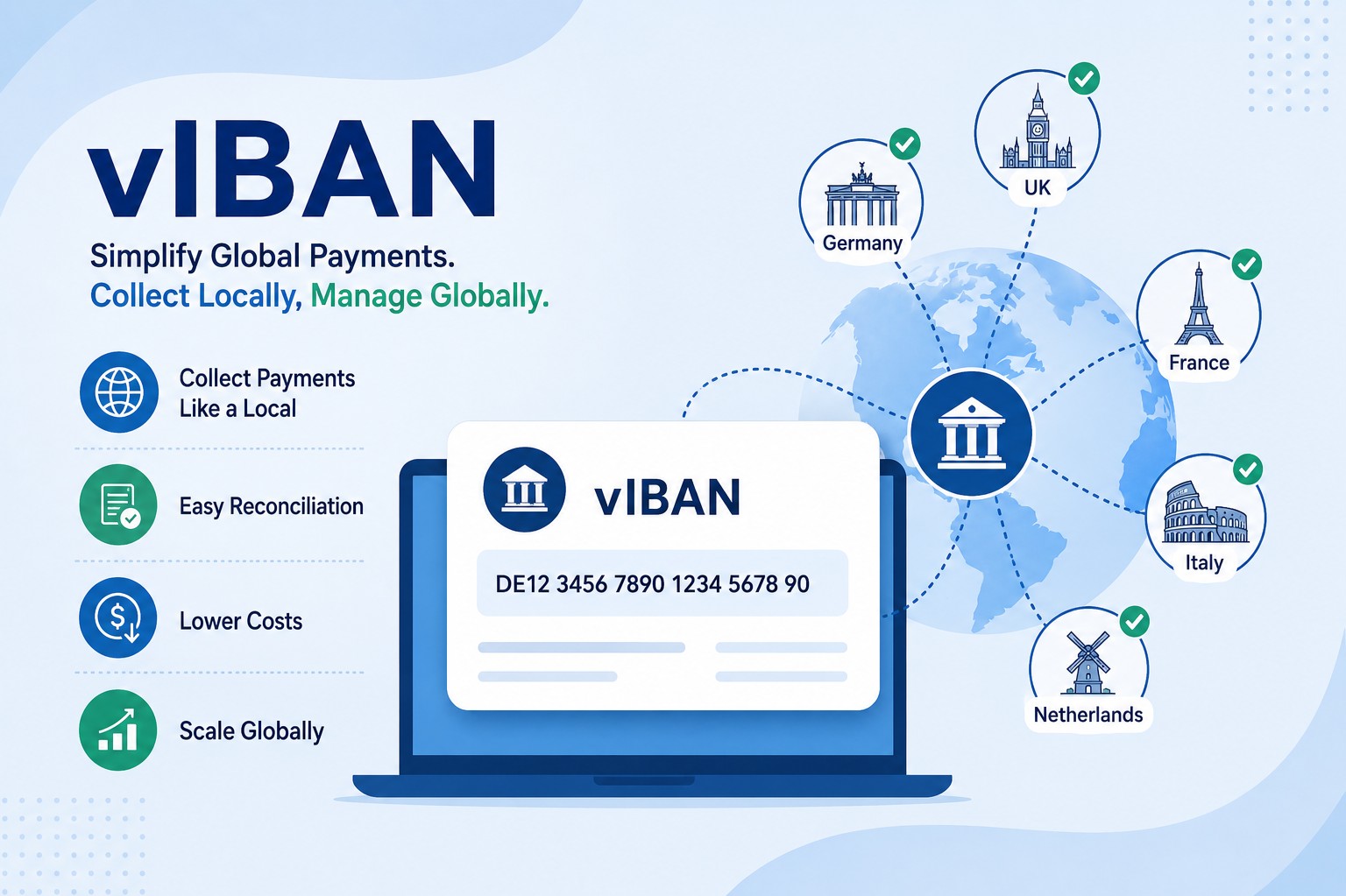
As global commerce continues to expand, businesses are increasingly faced with the challenge of managing payments across multiple countries, currencies, and banking systems. Traditional banking infrastructure, while reliable, often struggles to meet the demands of modern international businesses that require faster transactions, streamlined reconciliation, and greater operational flexibility.This growing need for efficient payment management has fueled the adoption of Virtual International Bank Account Numbers, commonly known as vIBANs. Once considered a niche financial tool, they have rapidly become a critical component of modern payment infrastructure, enabling businesses to simplify cross-border transactions while improving visibility and control over incoming funds.
For fintech companies, payment service providers, marketplaces, e-commerce businesses, and multinational enterprises, vIBANs are helping bridge the gap between traditional banking systems and the digital economy.
What Is a vIBAN?
A Virtual International Bank Account Number (vIBAN) is a unique IBAN assigned to a specific customer, transaction stream, region, or business unit for payment collection purposes.
Unlike a traditional bank account, it does not hold funds independently. Instead, it acts as a virtual payment identifier linked to a master account maintained by a financial institution or payment provider.
When a payment is sent to a account, the funds are automatically routed to the associated master account while preserving detailed payment information. This allows businesses to track, identify, and reconcile incoming transactions with greater efficiency.
In simple terms, a vIBAN functions like a dedicated payment address that helps businesses receive and manage funds without the need to open multiple physical bank accounts.
Why vIBANs Are Becoming Increasingly Popular
The growth of international trade, digital marketplaces, and cross-border payment services has exposed several inefficiencies in traditional banking models.
Businesses operating globally often face challenges such as:
- Managing multiple bank accounts across different countries
- Complex payment reconciliation processes
- High banking and transaction costs
- Limited visibility into incoming payments
- Delays in international fund transfers
vIBANs address these challenges by providing a more flexible and scalable payment collection framework.
Instead of maintaining numerous accounts across multiple jurisdictions, organizations can use vIBANs to create local payment experiences while centralizing fund management through a single account structure.
This approach simplifies operations and improves financial transparency.
How vIBANs Work
A vIBAN is linked to an underlying master account that ultimately receives the funds.
For example, a company operating in multiple European countries may assign separate vIBANs to customers in Germany, France, Italy, and Spain.
Customers make payments using their designated vIBAN, often through local banking channels. The payments are then automatically directed to the company’s central account.
The business gains several advantages:
- Easy identification of the payer
- Automated reconciliation
- Consolidated cash management
- Reduced administrative burden
- Enhanced transaction tracking
This structure enables businesses to manage large payment volumes more efficiently while maintaining a local presence in multiple markets.
Key Benefits of vIBANs
Improved Payment Reconciliation
One of the most significant advantages of vIBANs is their ability to simplify reconciliation.
Traditional payment collection methods often require finance teams to manually match incoming payments with invoices and customer records.
With dedicated vIBANs assigned to individual customers or payment categories, incoming transactions can be automatically identified and processed.
This reduces errors, minimizes manual work, and accelerates financial reporting.
Enhanced Customer Experience
Customers prefer making payments using familiar local banking methods.
vIBANs enable businesses to offer local account details in multiple regions without maintaining separate bank accounts in each country.
This creates a smoother payment experience and can improve payment completion rates.
Faster Market Expansion
Expanding into new markets traditionally requires opening local bank accounts, which can involve lengthy onboarding processes and regulatory requirements.
vIBANs provide businesses with a faster and more efficient way to establish payment collection capabilities in new regions.
This flexibility is particularly valuable for fast-growing fintech companies and digital platforms.
Centralized Cash Management
Managing multiple international accounts can create operational complexity.
vIBANs allow organizations to centralize incoming funds into a master account while maintaining detailed visibility into transaction sources.
This improves liquidity management and simplifies treasury operations.
Reduced Banking Costs
Maintaining multiple bank accounts often involves account fees, compliance costs, and administrative expenses.
By consolidating payment collection through vIBAN infrastructure, businesses can reduce operational costs while improving efficiency.
Industries Benefiting from vIBAN Adoption
Fintech Companies
Fintech firms use vIBANs to facilitate payment collection, client fund segregation, and cross-border transaction management.
They also leverage vIBANs to support innovative financial products and services.
E-Commerce Platforms
Online merchants selling internationally can provide local payment options to customers while consolidating funds into a central account.
This improves payment efficiency and customer satisfaction.
Marketplaces
Digital marketplaces often need to manage payments from thousands of buyers and sellers.
vIBANs help streamline fund allocation, reconciliation, and reporting processes.
Payment Service Providers
Payment providers use vIBANs to enhance transaction transparency and simplify merchant onboarding.
Multinational Corporations
Large enterprises benefit from centralized payment collection and improved visibility across global operations.
vIBANs and Regulatory Compliance
Compliance remains a critical consideration in financial services.
Reputable vIBAN providers typically implement robust compliance frameworks that support:
- Know Your Customer (KYC) requirements
- Anti-Money Laundering (AML) regulations
- Transaction monitoring
- Fraud prevention measures
- Data protection standards
Businesses evaluating vIBAN solutions should carefully assess their provider’s regulatory capabilities and licensing framework.
Working with a compliant provider helps reduce risk and ensures adherence to local and international financial regulations.
Challenges and Considerations
While vIBANs offer substantial benefits, organizations should also understand potential limitations.
Dependency on Service Providers
Because vIBANs are linked to a master account maintained by a provider, businesses rely on the provider’s infrastructure and operational stability.
Jurisdictional Variations
Availability and functionality of vIBANs can differ across countries and regulatory environments.
Businesses should evaluate regional requirements before implementation.
Limited Banking Services
vIBANs primarily focus on payment collection and transaction management.
Organizations may still require traditional banking relationships for lending, treasury services, and broader financial operations.
Provider Selection
Not all vIBAN providers offer the same capabilities.
Businesses should evaluate providers based on:
- Regulatory status
- Geographic coverage
- Currency support
- API capabilities
- Security standards
- Customer support
Selecting the right partner is crucial for maximizing the benefits of vIBAN adoption.
The Future of vIBANs
As global payment ecosystems become increasingly interconnected, vIBANs are expected to play an even larger role in international finance.
Several trends are driving adoption:
Growth of Cross-Border Commerce
International trade and digital commerce continue to expand, increasing demand for efficient payment collection solutions.
Open Banking Innovation
Open banking initiatives are creating new opportunities for integrated payment services that leverage vIBAN infrastructure.
Embedded Finance
Businesses are increasingly embedding financial services into their platforms, making flexible payment collection tools more important than ever.
Real-Time Payments
The rise of instant payment networks is encouraging organizations to modernize their payment infrastructure.
vIBANs complement these developments by providing enhanced transaction visibility and streamlined reconciliation.
Digital Transformation
Organizations seeking greater operational efficiency are increasingly replacing fragmented banking structures with centralized financial management solutions.
vIBANs align perfectly with this transformation.
Conclusion
The Virtual International Bank Account Number, or vIBAN, is rapidly becoming a cornerstone of modern payment infrastructure. By enabling businesses to collect payments globally without maintaining multiple physical bank accounts, simplify international operations, improve reconciliation, reduce costs, and enhance customer experiences.
As cross-border commerce, fintech innovation, and digital payments continue to evolve, businesses that embrace technology will be better positioned to operate efficiently in an increasingly interconnected financial world.
Rather than replacing traditional banking, vIBANs complement existing financial infrastructure by providing the flexibility and scalability that modern organizations need to compete globally. For businesses seeking smarter payment collection strategies, vIBANs represent a powerful step toward the future of international finance.
Comments
No comments yet. Be the first to share your thoughts.
Leave a comment