
Introduction
The payments industry has become increasingly sophisticated as merchants seek better transaction success rates, lower processing costs, and improved customer experiences. Every online payment involves multiple participants, including cardholders, issuing banks, acquiring banks, payment gateways, and card networks. Managing these interactions efficiently is essential for maximizing payment performance.
One technology that plays a crucial role in modern payment optimization is BIN Routing. By using information contained within a card’s Bank Identification Number (BIN), merchants and payment providers can intelligently direct transactions through the most appropriate processing path.
As businesses process higher transaction volumes and expand internationally, BIN Routing has become an important tool for improving payment efficiency, reducing declines, and enhancing overall revenue performance.
What Is BIN Routing?
BIN Routing is the process of using a card’s Bank Identification Number to determine the best route for processing a payment transaction.
The BIN is the first six to eight digits of a payment card and contains valuable information about:
- The issuing bank
- Card type
- Card brand
- Country of issuance
- Funding source
Payment providers use this information to make routing decisions that increase the likelihood of successful transaction approval.
Rather than treating every transaction the same way, BIN Routing allows payment systems to apply intelligent processing strategies.
Understanding the Bank Identification Number
Every payment card contains a unique sequence of numbers.
The Bank Identification Number helps identify important card characteristics before authorization occurs.
This information allows payment processors to determine:
- Which institution issued the card
- Whether the card is debit or credit
- Geographic origin of the card
- Applicable payment network
These insights form the foundation of effective routing decisions.
Why BIN Routing Matters
Transaction declines can negatively impact revenue, customer satisfaction, and business growth.
Many declines occur because transactions are not routed through the most effective acquiring bank or payment channel.
BIN Routing helps address this challenge by selecting optimal processing paths based on card-specific information.
Benefits include:
- Higher authorization rates
- Reduced payment failures
- Improved customer experiences
- Better payment performance
- Increased revenue opportunities
These advantages make BIN Routing a valuable component of modern payment strategies.
How BIN Routing Works
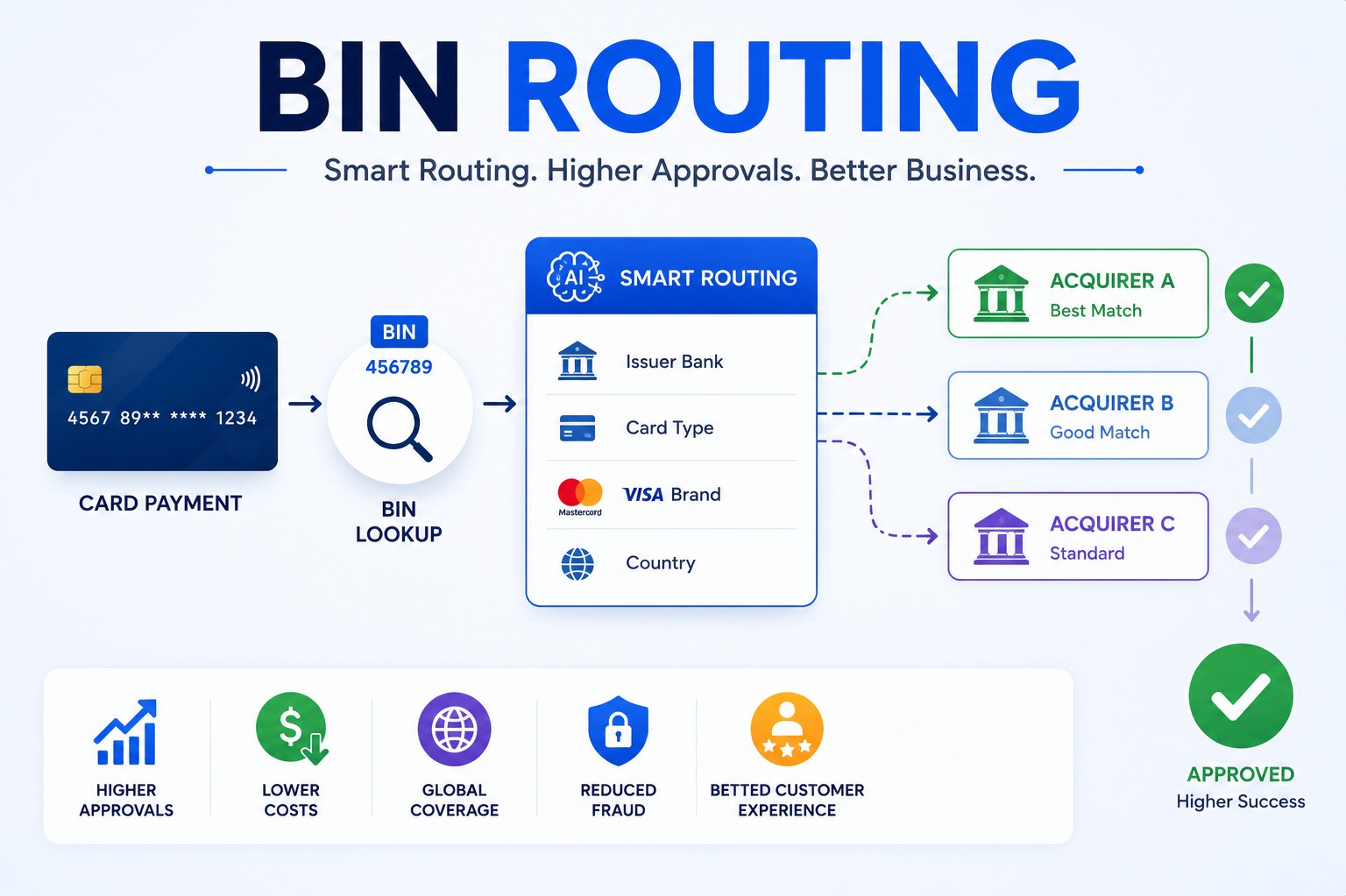
When a customer submits a card payment, the payment system analyzes the card’s BIN data.
The routing engine evaluates factors such as:
- Issuing bank location
- Card type
- Payment network
- Merchant configuration
- Acquirer performance
Based on these factors, the system selects the most appropriate processing route.
The transaction is then forwarded to the chosen acquiring bank or processor for authorization.
This process occurs within seconds and is typically invisible to the customer.
Improving Authorization Rates
One of the primary goals of BIN Routing is increasing payment approval rates.
Different issuing banks may respond differently depending on the acquiring institution handling the transaction.
By selecting the most compatible processing route, merchants can improve authorization outcomes.
Higher approval rates lead to:
- Increased sales
- Reduced customer frustration
- Better checkout experiences
- Higher conversion rates
Even small improvements in authorization performance can significantly impact revenue.
Supporting International Payments
Global businesses often process transactions from customers located in multiple countries.
International payments can face challenges related to:
- Currency differences
- Regional regulations
- Acquirer performance
- Cross-border processing fees
BIN Routing helps optimize international transactions by directing payments through locally advantageous acquiring partners whenever possible.
This approach often improves both authorization rates and cost efficiency.
Cost Optimization Benefits
Payment processing costs can vary depending on routing decisions.
Certain acquiring banks may offer:
- Lower interchange expenses
- Better processing fees
- Improved regional performance
By leveraging BIN data, businesses can optimize transaction routing to reduce overall payment costs.
This creates additional value beyond authorization improvements.
BIN Routing and Multi-Acquirer Strategies
Many large merchants use multiple acquiring banks to improve payment resilience and performance.
BIN Routing plays an important role in these strategies.
The system can dynamically choose among multiple acquirers based on:
- Geographic location
- Historical success rates
- Card issuer preferences
- Processing costs
This flexibility helps maximize transaction efficiency.
Multi-acquirer environments often rely heavily on intelligent routing capabilities.
Enhancing Customer Experience
Customers expect payments to be processed quickly and successfully.
Failed transactions often lead to:
- Cart abandonment
- Lost sales
- Reduced trust
- Customer dissatisfaction
BIN Routing helps reduce these issues by increasing transaction success rates.
A smoother checkout experience contributes to stronger customer relationships and improved retention.
Risk Management and Fraud Prevention
BIN information can also support risk management efforts.
Payment providers may use BIN data to:
- Identify unusual transaction patterns
- Detect geographic anomalies
- Enhance fraud screening
- Improve transaction monitoring
While BIN Routing primarily focuses on optimization, it can complement broader fraud prevention strategies.
This additional visibility strengthens payment security.
Challenges of BIN Routing
Although BIN Routing offers significant benefits, implementation requires careful planning.
Common challenges include:
Data Accuracy
Routing decisions depend on reliable BIN databases.
Integration Complexity
Businesses must connect routing systems with payment infrastructure.
Regulatory Requirements
Payment regulations vary across markets and jurisdictions.
Dynamic Market Conditions
Issuer and acquirer performance can change over time.
Organizations must continuously monitor and optimize routing strategies.
The Role of Artificial Intelligence
Artificial intelligence is increasingly being integrated into payment optimization systems.
AI-powered routing engines can:
- Analyze transaction data in real time
- Predict approval outcomes
- Adapt routing strategies automatically
- Optimize processing performance
These capabilities help businesses maximize payment efficiency while reducing manual intervention.
AI is expected to become a key driver of future routing innovation.
Future Trends in BIN Routing
Several developments are shaping the future of payment optimization.
These include:
- AI-driven routing decisions
- Real-time payment intelligence
- Enhanced transaction analytics
- Global payment orchestration
- Automated optimization platforms
As payment ecosystems become more complex, intelligent routing solutions will continue growing in importance.
Businesses that invest in advanced routing technologies will gain competitive advantages in payment performance.
Conclusion
BIN Routing has become an essential tool for modern payment optimization. By leveraging card-specific information to direct transactions through the most effective processing paths, businesses can improve authorization rates, reduce costs, enhance customer experiences, and support international growth.
As digital commerce continues expanding and payment ecosystems evolve, intelligent routing strategies will play an increasingly important role in maximizing transaction success. Organizations that effectively implement BIN Routing can strengthen their payment infrastructure and create a more efficient, scalable, and profitable payment operation.
Comments
No comments yet. Be the first to share your thoughts.
Leave a comment