
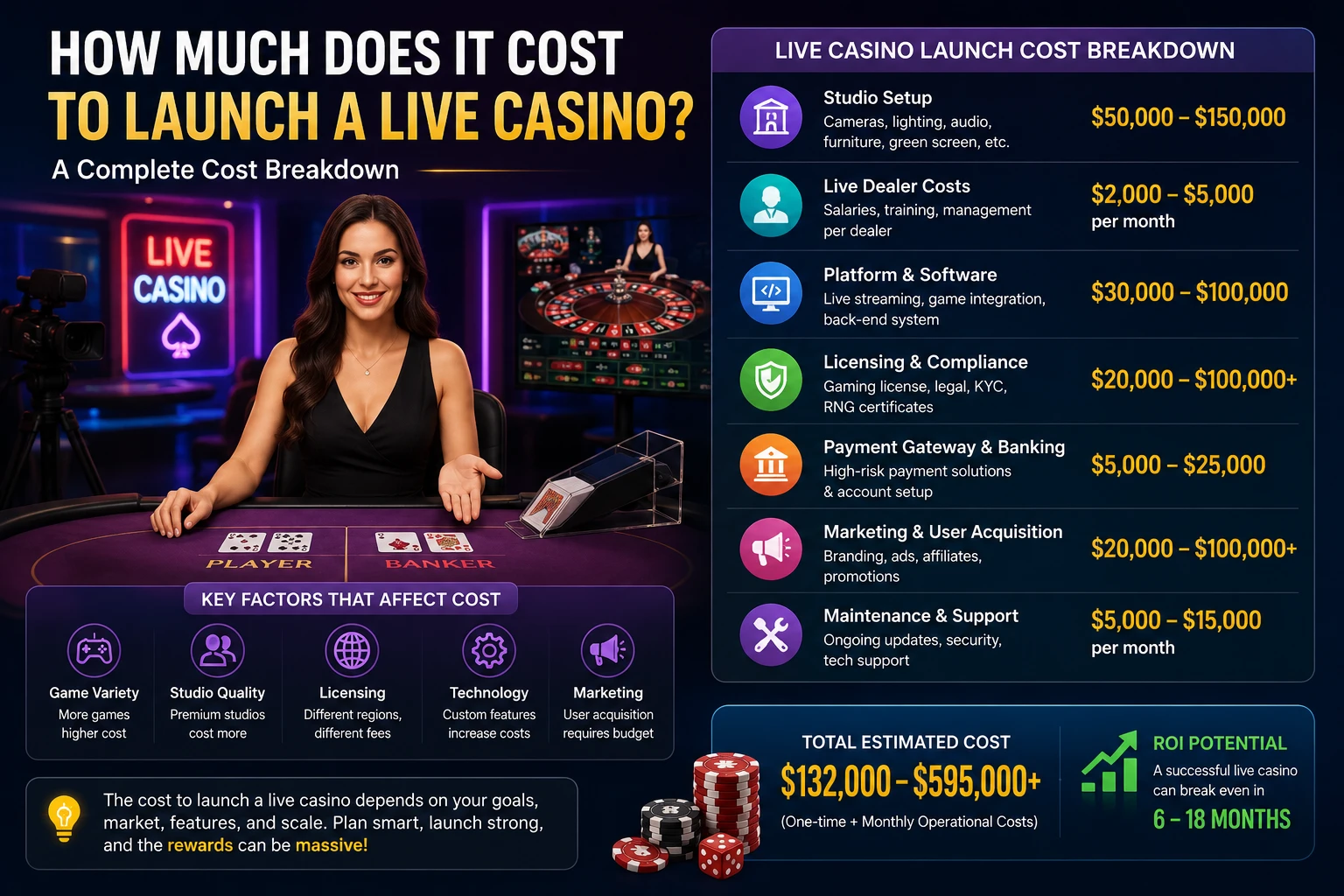
If you’re researching this, you’re likely trying to answer a very specific budgeting question: is this a $20,000 launch or a $2 million one, and what actually determines which side of that gap your business falls on? The honest answer is that both figures are accurate, for completely different business models, and the real skill in budgeting a live casino launch is understanding which cost drivers push you toward one end or the other.
The Three Launch Models, and Why the Price Gap Is So Wide
Launching a live casino isn’t a single product with a fixed price, it’s a choice between three fundamentally different architectures, each with its own cost and control trade-off:
- White label: you rent everything: the software, the game library, the payment infrastructure, and critically, the operating license itself. Setup costs typically run $10,000 to $150,000, with the ability to go live in as little as two to six weeks. The trade-off is minimal operational control and a revenue share paid to the platform provider indefinitely.
- Turnkey: you own the brand and hold your own license, but still rent the underlying technology. Setup costs run higher, roughly $25,000 to $50,000 in technology fees alone before licensing and compliance, with a launch timeline of one to three months.
- Custom build: you own the code, the brand, and the license outright, with full control and full revenue retention. This is where costs escalate sharply, from $400,000 to $2.5 million or more, with a build timeline of six to eighteen months.
The pattern across nearly every 2026 industry cost breakdown is consistent: white label is the accessible entry point, but it comes with the highest long-term revenue share; custom builds cost dramatically more upfront but retain 100% of revenue and full control over the player experience, including your casino payment setup.
What Actually Goes Into the Number
Licensing and legal formation
Licensing costs vary enormously by jurisdiction, and this is often where operators get their first real budget surprise. Anjouan licensing starts around $8,000-$25,000 per year at the low end, while a mid-tier jurisdiction like Curaçao runs higher, and a premium jurisdiction like Malta pushes licensing, legal structuring, and compliance setup into the $50,000-$115,000+ range combined. Worth flagging directly: Curaçao’s framework changed under a new National Ordinance on Games of Chance (LOK), and industry commentary now describes “the era of the cheap Curaçao license” as ending, compliance costs there have risen meaningfully compared to a few years ago, which matters if your budget assumptions are based on older figures.
Platform and software
Software development costs in 2026 typically start around $30,000 for a lean, single-market white-label launch and move past $300,000 for a custom, multi-market build. This range covers platform setup, KYC integration, compliance implementation, QA, and year-one hosting, but notably excludes licensing fees, legal formation, staffing, and marketing, which is exactly why so many operators underestimate their real first-year number by focusing on the software quote alone.
Game integration, including live dealer content
Game integration costs separately from the core platform, typically running $5,000 to $20,000 depending on the number and type of games. Live dealer content specifically adds complexity here: unlike RNG slots, live tables require licensing agreements with major studio operators (Evolution, Pragmatic Play Live, Playtech Live) rather than a simple software license, and studio-hosted live content generally costs more to integrate than standard RNG titles due to the additional streaming and real-time infrastructure involved.
Payment infrastructure – the line item most budgets underestimate
Payment gateway setup is often quoted at a deceptively modest $2,000 to $10,000 for initial integration, but that figure covers only the technical setup, not the ongoing cost of running payment processing for a high-risk vertical. Live casino operators need a high-risk payment gateway relationship specifically, since gambling sits under MCC 7995 and most mainstream merchant accounts decline the category outright. Budget for this realistically:
- Elevated processing fees: typically 2.5% to 6.5%, well above standard retail rates, reflecting gambling’s genuinely higher chargeback profile.
- Rolling reserves: 5% to 20% of processing volume held back for 90 to 180 days, which affects working capital planning directly, not just the headline setup cost.
- Multi-currency and cross-border payments support: if you’re targeting an international player base, budget for payment providers offering genuine multi-currency settlement, not just a single-currency card gateway.
- Alternative payment methods: payment wallets like Skrill and Neteller, local bank-transfer rails, and increasingly crypto payments, each of which may involve separate integration costs beyond your core card-acquiring relationship.
- Offshore merchant account setup: if your primary banking relationship can’t support gambling, a genuinely common need, and one that adds its own setup and ongoing cost layer many first-time operators don’t budget for until they hit the mainstream-bank decline wall.
Compliance, KYC/AML, and hosting
Compliance setup runs roughly $10,000 to $25,000 as a standalone line item in most jurisdiction cost breakdowns, on top of licensing itself. Ongoing monthly costs, hosting, security, software maintenance, and licensing renewal fees, typically add $1,000 to $5,000+ per month, a recurring burn rate that needs to be planned for well beyond the initial launch budget.
Realistic Total Budgets by Tier
Pulling these pieces together, most 2026 industry cost breakdowns converge on a few realistic tiers:
- Minimal viable white-label launch: roughly $50,000-$115,000 total, combining a budget licensing jurisdiction, a white-label platform, and lean payment integration.
- Serious, regulated single-market launch: roughly $200,000-$500,000, reflecting a stronger jurisdiction, broader payment method coverage, and more robust compliance infrastructure.
- Enterprise custom build with EU-grade licensing: $1.5 million or more: covering custom platform development, premium licensing (Malta-tier), full live dealer content licensing, and enterprise-grade merchant services infrastructure across multiple currencies and jurisdictions.
Why Launch Cost Isn’t the Real Number to Watch
Every serious cost breakdown converges on the same warning: launch costs are secondary to operating expenditure. Getting live is the easy part, surviving the first twelve months is what actually determines whether the launch budget was well spent. Monthly burn from hosting, compliance, payment processing fees, rolling reserves tying up working capital, and marketing spend will dictate your real runway far more than the initial setup number. Budgeting a live casino launch around the platform quote alone, without stress-testing the ongoing payment and compliance costs against realistic revenue timelines, is one of the most common ways a well-funded launch still runs out of runway before it reaches profitability.
Practical Takeaway
If you’re planning a live casino launch, treat the software and licensing quotes as the starting point of your budget, not the total. Payment infrastructure specifically, high-risk underwriting, rolling reserves, multi-currency and cross-border payments support, and potentially an offshore merchants account relationship, deserves its own detailed line item, since it’s consistently the piece first-time operators underestimate most. Match your launch model (white label, turnkey, or custom) to your actual capital and risk tolerance, and build your first-year operating budget around realistic monthly burn, not just the number it takes to go live.
Comments
No comments yet. Be the first to share your thoughts.
Leave a comment