
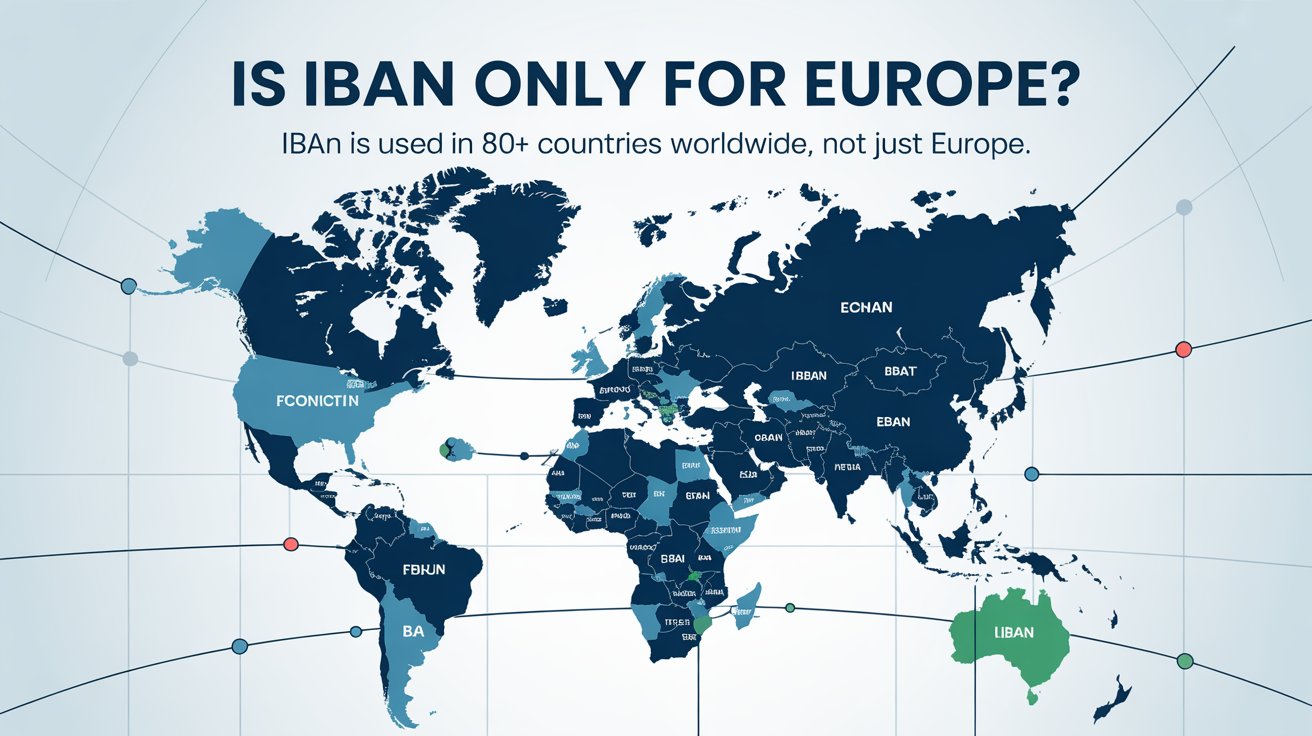
A Complete Global Guide to IBAN Usage for International Businesses
The question “Is IBAN only for Europe?” is one of the most searched—and most misunderstood—topics in global banking. Founders, CFOs, fintech operators, forex brokers, eCommerce merchants, and international businesses frequently assume that IBANs are a Europe-only concept, inaccessible or irrelevant outside the EU.
In reality, IBAN has evolved far beyond its European roots. Today, IBANs function as a global banking identifier, widely used by non-European companies, offshore entities, PSPs, EMIs, and international platforms operating across borders.
This in-depth guide by TheFinRate breaks down:
- Where IBANs originated and why
- Which countries officially use IBAN
- How non-European businesses legally use EU IBANs
- The role of EMIs and fintechs in global IBAN issuance
- Why IBANs are becoming the preferred account structure worldwide
This is not a surface-level explanation. It is a global infrastructure perspective on IBAN banking.
Understanding What an IBAN Really Is
An IBAN (International Bank Account Number) is a standardized international format used to identify bank accounts across borders. It was created to reduce payment errors, delays, and failed international transfers.
An IBAN contains:
- Country code
- Check digits
- Bank identifier
- Account number
Its primary purpose is payment accuracy and interoperability, not geographic restriction.
Contrary to popular belief, IBAN is not a currency, not a bank type, and not a region-locked account. It is simply a globally recognized account-numbering standard.
The Origins of IBAN: European, But Not Exclusive
IBAN was introduced by the European Committee for Banking Standards (ECBS) and later adopted as an international standard under ISO 13616.
The original motivation was simple:
- Europe had dozens of countries
- Each used different account number formats
- Cross-border payments were slow, expensive, and error-prone
IBAN solved this problem by creating a single standardized format.
While Europe was the first large-scale adopter, the system was never restricted to Europe.
Countries That Officially Use IBAN
As of today, over 80 countries have adopted IBAN or IBAN-compatible formats.
European IBAN Countries
All EU and EEA countries use IBAN, including:
- Germany
- France
- Italy
- Spain
- Netherlands
- Ireland
- Lithuania
- Luxembourg
Non-European Countries That Use IBAN
Many non-European jurisdictions officially use IBAN, including:
- United Kingdom
- Switzerland
- Norway
- Iceland
- Liechtenstein
- Turkey
- United Arab Emirates
- Saudi Arabia
- Qatar
- Bahrain
- Kuwait
- Pakistan
- Kazakhstan
This alone answers the question clearly:
IBAN is not only for Europe.
Why Many Countries Do NOT Use IBAN (Yet)
Countries like the United States, Canada, Australia, and parts of Asia do not officially use IBAN. Instead, they rely on:
- ABA routing numbers
- ACH
- Sort codes
- SWIFT/BIC
However, this does not mean businesses in these countries cannot use IBAN accounts.
It only means their domestic banking systems evolved differently.
How Non-European Businesses Use IBAN Accounts
This is where modern banking changes everything.
A US LLC, UAE company, Hong Kong startup, or offshore entity can legally hold and operate an EU-issued IBAN account through:
- European banks
- Licensed EMIs
- Fintech payment institutions
The IBAN does not belong to the company’s country—it belongs to the issuing institution’s jurisdiction.
This is why IBANs are now a global business tool.
The Role of EMIs in Global IBAN Adoption
Electronic Money Institutions (EMIs) have completely reshaped IBAN accessibility.
Unlike traditional banks, EMIs:
- Onboard non-resident founders
- Support cross-border businesses
- Offer faster approvals
- Provide API-based IBAN infrastructure
- Issue multi-currency and virtual IBANs
Most global IBAN usage today is driven by EMI-issued IBAN accounts, not traditional banks.
Why Global Businesses Prefer EU IBANs
Even when companies operate outside Europe, they often intentionally choose EU IBANs.
Key reasons include:
- Access to SEPA payments
- Lower transfer costs
- Faster settlements
- Higher acceptance by PSPs
- Better compliance perception
- Multi-currency support
For fintechs, marketplaces, forex brokers, and gaming platforms, EU IBANs act as a credibility layer.
IBAN vs SWIFT: Clearing the Confusion
One of the biggest misconceptions is that IBAN replaces SWIFT.
In reality:
- IBAN identifies the account
- SWIFT identifies the bank
They work together, not against each other.
This is why IBANs are widely used even in non-IBAN countries for international transfers.
IBAN for Offshore and High-Risk Businesses
Another myth is that offshore or high-risk businesses cannot access IBANs.
In practice:
- Many EU EMIs specialize in high-risk IBAN issuance
- Gaming, forex, crypto, and adult businesses commonly operate with IBANs
- Risk acceptance depends on provider alignment, not geography
This is where directories like TheFinRate play a critical role.
Virtual IBANs vs Dedicated IBANs (Global Use Case)
Dedicated IBAN
- One account per business
- Higher trust
- Higher cost
Virtual IBAN
- Sub-accounts mapped to a master account
- Ideal for PSPs and marketplaces
- Used globally for collections
Both structures are used far beyond Europe.
Common Myths About IBANs (Debunked)
Myth 1: IBAN is only for EU residents
Myth 2: US companies cannot have IBANs
Myth 3: IBANs are only for euro payments
Myth 4: Offshore companies are banned from IBANs
All of these are false.
The Future of IBAN: A Global Standard
As cross-border commerce grows, standardization becomes essential.
IBAN is increasingly viewed as:
- A global account identifier
- A trust signal for payments
- A compliance-friendly structure
More countries are aligning with IBAN frameworks rather than reinventing new systems.
How TheFinRate Helps Businesses Access IBAN Accounts
TheFinRate does not issue IBANs.
Instead, we provide:
- A global directory of IBAN providers
- Side-by-side comparisons
- Risk-aligned matching
- One application → multiple provider quotes
This saves businesses months of trial-and-error.
Final Verdict: Is IBAN Only for Europe?
No.
IBAN started in Europe, but today it functions as a global banking standard used by companies worldwide.
For modern businesses, the real question is not where you are located, but which IBAN provider aligns with your business model, volume, and risk profile.
That is exactly where TheFinRate helps you make the right decision.
Comments
No comments yet. Be the first to share your thoughts.
Leave a comment