
Introduction
In today’s interconnected economy, businesses are no longer confined by geographical boundaries. Companies source materials from international suppliers, sell products across continents, manage remote workforces, and establish partnerships in multiple countries. While globalization has created tremendous growth opportunities, it has also increased the complexity of moving money across borders.This is where B2B cross-border payments play a critical role.
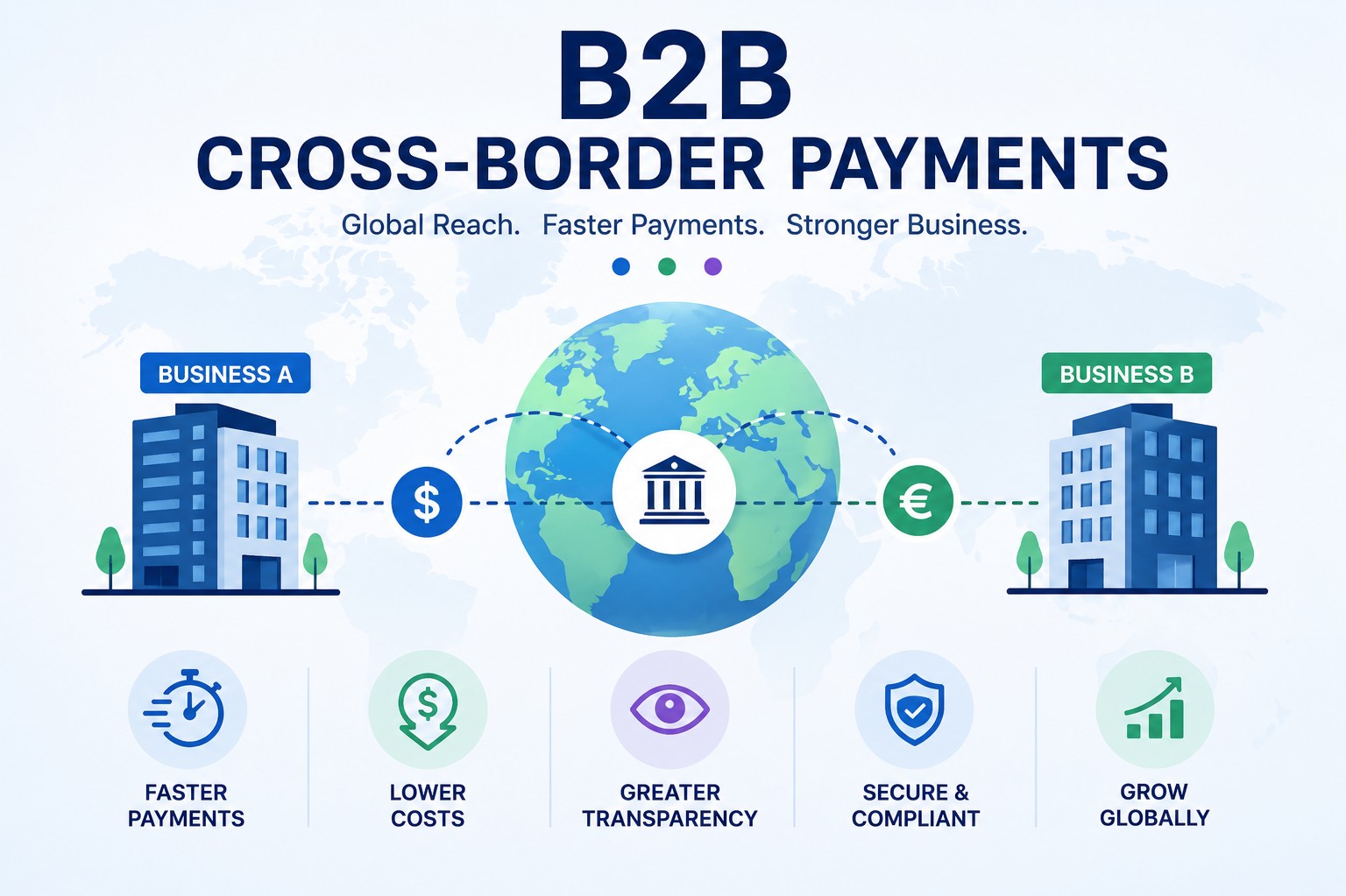
B2B cross-border payments refer to financial transactions made between businesses located in different countries. These payments support international trade, supplier settlements, payroll processing, marketplace payouts, and a wide range of commercial activities that drive the global economy.
As global trade continues to expand, businesses are demanding faster, more transparent, and cost-effective payment solutions. Traditional banking systems, once the primary method for international transactions, are now being challenged by fintech innovation, real-time payment technologies, and digital financial infrastructure.
The evolution of B2B cross-border payments is transforming how businesses operate internationally and shaping the future of global commerce.
Understanding B2B Cross-Border Payments
A B2B cross-border payment occurs whenever one business transfers funds to another business in a different country.
Common examples include:
- Paying international suppliers
- Settling invoices with overseas partners
- Processing global payroll
- Managing marketplace vendor payouts
- Funding international subsidiaries
- Supporting import and export activities
Unlike consumer payments, B2B transactions are often larger in value, involve multiple stakeholders, and require greater compliance oversight.
Accuracy, security, speed, and transparency are essential because payment delays can disrupt supply chains, affect cash flow, and damage business relationships.
Why Cross-Border Payments Matter
Global trade relies heavily on efficient payment infrastructure.
According to industry estimates, trillions of dollars move through cross-border payment networks every year, supporting businesses of all sizes.
Effective cross-border payment systems help businesses:
- Expand into new markets
- Strengthen supplier relationships
- Improve operational efficiency
- Enhance customer experiences
- Access global opportunities
- Support international growth strategies
As businesses become increasingly global, the ability to move money efficiently across borders has become a competitive advantage.
Challenges Facing Traditional B2B Cross-Border Payments
Despite technological progress, international payments still face several challenges.
High Transaction Costs
Traditional international transfers often involve multiple intermediary banks.
Each intermediary may charge processing fees, resulting in higher transaction costs for businesses.
For organizations handling large payment volumes, these expenses can significantly impact profitability.
Slow Settlement Times
Cross-border payments may take several business days to settle.
Delays are often caused by:
- Multiple banking intermediaries
- Different operating hours
- Regulatory reviews
- Currency conversion processes
Slow settlements can create cash flow challenges and operational inefficiencies.
Limited Transparency
Businesses frequently struggle to track payment status throughout the transaction lifecycle.
Limited visibility can make it difficult to identify delays, predict settlement timelines, or manage supplier expectations.
Foreign Exchange Complexity
Currency conversion introduces additional risks and costs.
Exchange rate fluctuations can affect payment values and complicate financial planning.
Compliance Requirements
International payments must comply with various regulations, including:
- Anti-Money Laundering (AML)
- Know Your Customer (KYC)
- Sanctions screening
- Tax reporting requirements
Compliance obligations add complexity to cross-border transactions.
The Rise of Modern Payment Infrastructure
Fintech innovation is reshaping the cross-border payments landscape.
New technologies are helping businesses overcome traditional limitations while improving speed, transparency, and efficiency.
Payment Networks and APIs
Modern payment providers use APIs and integrated platforms to streamline payment processing.
Businesses can automate payment workflows, improve reporting, and reduce manual intervention.
Virtual IBANs
Virtual IBANs provide businesses with local payment collection capabilities across multiple regions while centralizing funds into a single account structure.
This improves reconciliation and simplifies international cash management.
Real-Time Payment Systems
Many countries are introducing instant payment networks that enable near real-time fund transfers.
As interoperability improves, businesses can expect faster international transactions and enhanced payment experiences.
Multi-Currency Accounts
Businesses increasingly use multi-currency accounts to hold, manage, and transfer funds in various currencies.
This reduces foreign exchange costs and improves cash flow flexibility.
Key Benefits of Modern B2B Cross-Border Payments
Faster Transactions
Advanced payment infrastructure significantly reduces settlement times compared to traditional banking methods.
Faster payments improve liquidity and strengthen business relationships.
Improved Transparency
Modern platforms provide real-time payment tracking and detailed transaction reporting.
Businesses gain greater visibility into payment status and processing timelines.
Lower Costs
Fintech providers often reduce reliance on intermediary banks, helping businesses minimize transaction fees and currency conversion expenses.
Enhanced Automation
Automation reduces manual payment processing and administrative workloads.
Organizations can streamline accounts payable and accounts receivable operations.
Better Customer and Supplier Experiences
Reliable and predictable payments strengthen trust with international partners.
Businesses can improve relationships by ensuring timely and accurate transactions.
Industries Driving Cross-Border Payment Growth
E-Commerce
Global online retailers process payments from customers and suppliers around the world.
Cross-border payment solutions support international expansion and localized payment experiences.
Manufacturing
Manufacturers frequently pay overseas suppliers and manage international procurement operations.
Efficient payment infrastructure helps maintain supply chain stability.
SaaS and Technology Companies
Software businesses often serve customers globally and require flexible payment collection and payout capabilities.
Marketplaces
Digital marketplaces facilitate transactions between buyers and sellers across multiple countries.
Cross-border payment solutions enable seamless fund distribution.
Financial Services
Banks, fintech companies, and payment providers continue investing heavily in modern payment technologies to meet growing market demand.
The Role of Artificial Intelligence
Artificial intelligence is becoming increasingly important in cross-border payment operations.
AI-powered systems help organizations:
- Detect fraudulent transactions
- Monitor compliance risks
- Improve payment routing
- Predict settlement delays
- Optimize foreign exchange management
As payment volumes continue to increase, AI will play a larger role in improving efficiency and reducing operational risks.
Regulatory Evolution
Governments and regulators worldwide recognize the importance of improving international payment systems.
Initiatives focus on:
- Faster settlements
- Greater transparency
- Reduced costs
- Enhanced interoperability
- Improved financial inclusion
Global regulatory cooperation is expected to accelerate modernization efforts and support the growth of digital payment ecosystems.
Future Trends in B2B Cross-Border Payments
Several trends are shaping the future of international business payments.
Embedded Finance
Businesses increasingly integrate payment capabilities directly into software platforms and business applications.
Blockchain and Digital Assets
Distributed ledger technology is being explored as a way to improve payment speed and transparency.
Open Banking
Open banking frameworks are enabling greater connectivity between financial institutions and payment providers.
Real-Time Global Payments
The industry is moving toward faster and more interconnected payment networks capable of supporting near-instant international transfers.
Data-Driven Payments
Businesses are leveraging payment data to improve forecasting, optimize cash flow, and enhance decision-making.
Conclusion
B2B cross-border payments are a fundamental component of global commerce. As businesses continue expanding beyond domestic markets, the demand for efficient, transparent, and cost-effective international payment solutions will only increase.
Traditional payment systems, while still important, are evolving alongside fintech innovation, real-time payment networks, Virtual IBAN infrastructure, and AI-powered financial technology. Together, these advancements are creating a more connected and efficient global payments ecosystem.
Organizations that invest in modern cross-border payment strategies will be better positioned to reduce costs, improve operational efficiency, strengthen international relationships, and compete successfully in an increasingly global economy.
Comments
No comments yet. Be the first to share your thoughts.
Leave a comment