
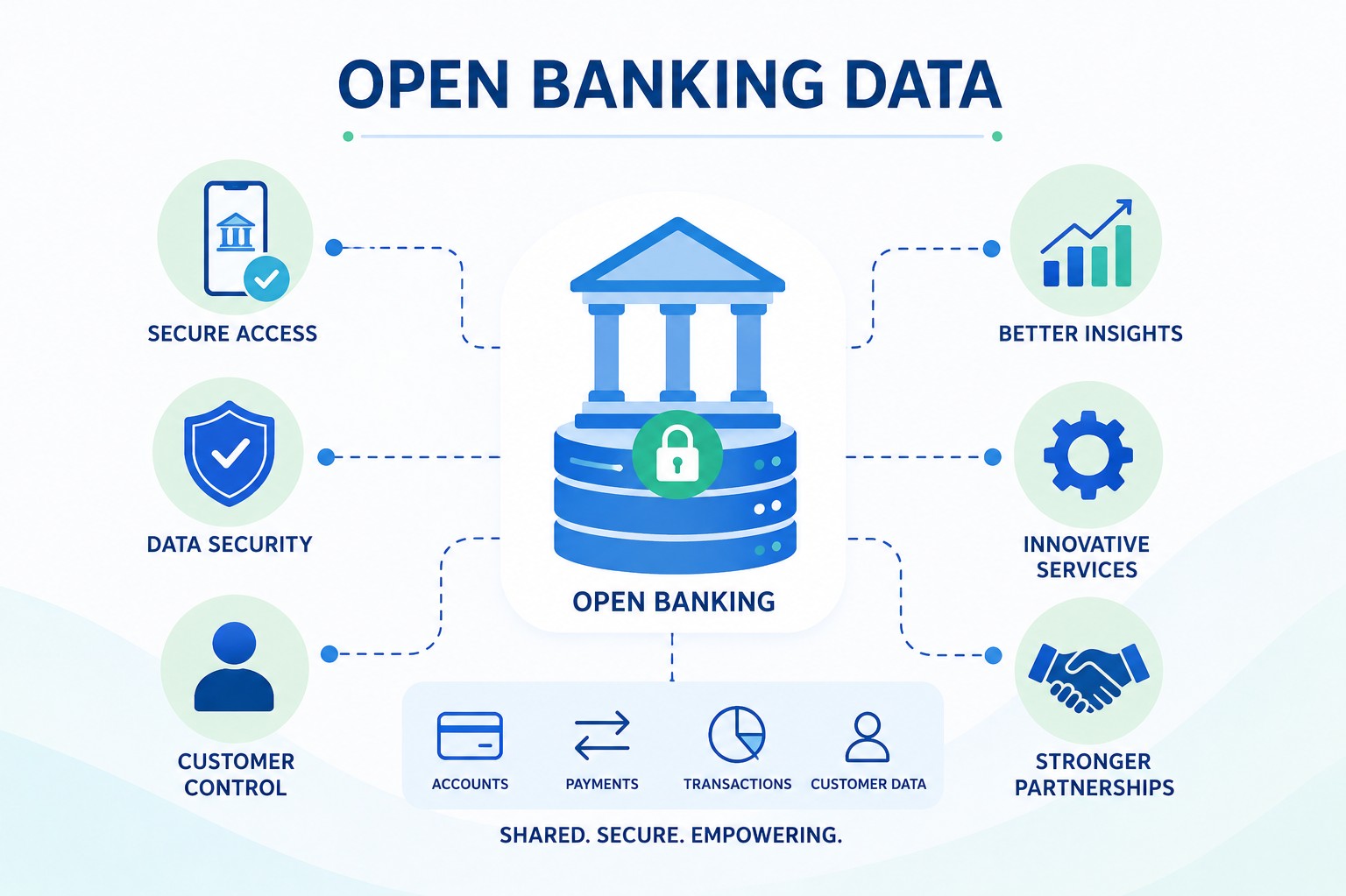
The global banking ecosystem is undergoing a profound architectural shift. We have officially moved past the introductory phase of Open Banking data where standard compliance was the primary goal and entered a sophisticated era of Open Data and embedded finance. Traditional, closed banking infrastructure is rapidly being replaced by data-driven, experience-led, and API-first platforms.
For a modern financial technology platform like TheFinRate, analyzing this evolution requires looking beyond basic customer interfaces. The true commercial value lies in the data architecture itself. “Open banking data” is no longer just a regulatory checkbox; it is a highly monetization-ready, real-time asset class that alters credit scoring, payments infrastructure, and corporate treasury management.
The Open Banking Data Framework: From Silos to Orchestration
Historically, financial institutions treated transactional data as proprietary intellectual property locked inside legacy core ledgers. Open Banking dismantles these silos by utilizing standardized Application Programming Interfaces (APIs). This mechanism securely exposes account structures, transaction histories, and payment initiation pathways to authorized third-party providers (TPPs), contingent entirely upon explicit customer consent.
The data framework is stratified into two primary operational dimensions:
1. Account Information Service Providers (AISP)
This is the read-only layer of the data ecosystem. It grants licensed applications permission to retrieve historical ledgers, balance statements, and customer profile registries.
Advanced machine learning engines can parse this unstructured metadata to build predictive cash flow models, run automated credit underwriting assessments, and execute instant Know Your Customer (KYC) identity cross-references.
2. Payment Service Initiation Providers (PISP)
This is the transactional write-layer. Rather than simply pulling data, a PISP initiates authorized push payments directly from the consumer’s bank ledger to a merchant’s settlement account.
By eliminating credit card networks and traditional processing gateways, PISP rails enable direct, real-time Account-to-Account (A2A) transactions that drastically reduce card-interchange friction.
Technical Composition of the Open Banking Data Stream
Open banking data does not travel as a flat file export; it functions as a highly standardized, structured payload. Under leading international frameworks such as Europe’s PSD2/PSD3, the UK’s Open Banking Standard v4, and the US Consumer Financial Protection Bureau’s (CFPB) Section 1033 rulings the telemetry stream is categorized into four specific data types:
| Data Category | Core Components | Primary Corporate Use Case |
| Transactional Data | Chronological deposits, cleared withdrawals, directional card clearings, automated clearing house (ACH) merchant tags. | Real-time algorithmic credit scoring and automated B2B invoice reconciliation. |
| Identity & Profile Data | Full legal name, verified physical addresses, phone metadata, tax entity identifiers, corporate registry mappings. | Instant digital onboarding and automated AML/KYC orchestration loops. |
| Account Attributes | Structural IBAN or routing numbers, current balance ledgers, available credit limits, interest rate profiles. | Smart liquidity sweeping and automated multi-bank corporate treasury pooling. |
| Behavioral Telemetry | Session login frequencies, device authentication tokens, historical API interaction patterns, channel preference indicators. | Dynamic fraud mitigation systems and real-time AI risk assessment modeling. |
Strategic Commercial Advantages
For enterprise platforms and scaling financial technology apps, deploying an architecture that aggressively leverages open banking APIs delivers massive structural advantages.
-
Elimination of Credit Data Asymmetry: Legacy underwriting relies on backward-looking, static credit bureau files that are often 30 to 90 days out of date. Open banking endpoints provide a live, raw feed of a business or consumer’s actual cash flow. This enables lenders to calculate debt-service coverage ratios (DSCR) in real time, increasing thin-file loan approvals while lowering non-performing loan (NPL) exposure.
-
Drastic Processing Fee Compression: Credit card transactions carry interchange, acquiring, and network assessment fees that can scale up to 3.5% per swipe. PISP-driven A2A instant payments bypass these intermediary tollbooths entirely, routing money directly across native clearings (like SEPA Instant or FedNow) for a flat, predictable API processing fee.
-
Hyper-Automated Treasury Operations: For B2B enterprises handling thousands of cross-border supplier invoices, matching inbound funds to open accounts receivable ledger entries is an operational bottleneck. Open banking APIs inject live statement updates directly into corporate ERP software, enabling instantaneous automated matching and reconciliation.
The Strategic Trade-Offs: Real-World Pros and Cons
While transitioning to an open-loop data environment drives innovation, the decentralization of financial records presents deep technical and commercial challenges that risk officers must closely monitor.
The Pros
-
Frictionless User Journeys: Users no longer need to upload paper bank statements or undergo manual identity verification. One-click cryptographic consent securely streams their financial history into an application in seconds.
-
Interoperable Product Ecosystems: Financial institutions can form deep partnerships with fintech builders, turning standard banking products into modular components that fit smoothly into third-party non-financial apps (embedded finance).
-
Granular Customer Consent Portability: Consumers gain absolute ownership over their financial information, holding the explicit right to grant, review, or instantly revoke access to their financial profiles at any time.
The Cons
-
Expanded Cyber Attack Surface: Moving from isolated, closed banking systems to an interconnected network of thousands of third-party fintech APIs introduces new security vulnerabilities. Every external API endpoint represents a potential point of entry for sophisticated data breaches or credential harvesting.
-
Severe Regulatory Disparity and Fragmentation: There is no single, unified global standard for open banking data. The European Union relies on highly prescriptive, compliance-driven regulations (PSD2/PSD3), while the United States favors a market-led model that is still actively formalizing its rules under CFPB frameworks. Managing compliance across borders requires navigating a complex web of varying regional data laws.
-
High Upkeep and Maintenance of Data Pipelines: Bank APIs are notoriously variable in performance, uptime, and data cleanliness. Minor changes to a major bank’s API structure can instantly disrupt downstream analytics engines, requiring continuous investment in complex middleware data orchestration layers.
Conclusion: Preparing for the Global Open Data Economy
Open Banking is merely the foundation for a much larger structural shift: the realization of a comprehensive global Open Data Economy. Over the coming cycles, this data-sharing infrastructure will expand far beyond simple checking and savings accounts. The next frontier involves pulling unified streams from insurance records, investment portfolios, tax filings, and energy utility consumption files—a framework known collectively as Open Finance.
For platforms looking to capture long-term enterprise value, the path forward requires building robust infrastructure designed to aggregate, clean, and monetize these diverse data streams.
The organizations that win this transition will not be those that simply hold raw access to data connections. Success will belong to the platforms that build the finest data-refining engines—the ones capable of converting fragmented API responses into actionable credit decisions, frictionless payment paths, and highly personalized financial experiences.
Comments
No comments yet. Be the first to share your thoughts.
Leave a comment