
Introduction
The financial services industry is constantly evolving to meet growing demands for security, convenience, and speed. As digital payments become increasingly common, traditional authentication methods such as passwords, PINs, and one-time passcodes are proving insufficient against sophisticated cyber threats and fraud attempts.To address these challenges, financial institutions and fintech companies are embracing biometric payment accounts, a technology-driven solution that uses unique physical or behavioral characteristics to authenticate users and authorize transactions.From fingerprint scans and facial recognition to voice authentication and iris verification, biometric technology is reshaping how consumers access accounts and make payments. As businesses and consumers seek safer and more seamless payment experiences, biometric payment accounts are emerging as a key component of the future financial ecosystem.
What Is a Biometric Payments Account?
A biometric payments account is a financial account that uses biometric identifiers to verify a user’s identity and authorize transactions.
Instead of relying solely on passwords or PIN codes, users can access their accounts and approve payments through unique biological characteristics such as:
- Fingerprints
- Facial recognition
- Iris scans
- Voice recognition
- Palm vein authentication
- Behavioral biometrics
These identifiers are difficult to replicate, making biometric authentication significantly more secure than traditional credentials.
Biometric payment accounts can be linked to bank accounts, digital wallets, payment cards, mobile banking applications, and other financial platforms.
Why Biometric Payments Are Gaining Popularity
Digital payment adoption has increased dramatically over the past decade. At the same time, fraudsters have developed increasingly sophisticated methods to compromise user credentials.
Traditional security methods face several challenges:
- Password theft
- Phishing attacks
- Credential stuffing
- SIM swap fraud
- Account takeover attempts
Consumers are also frustrated with complex authentication processes that require remembering multiple passwords and verification codes.
Biometric payment accounts solve both problems by offering stronger security and a more convenient user experience.
Instead of entering passwords, users can simply verify their identity using their fingerprint or face, completing transactions within seconds.
How Biometric Payment Accounts Work
The process begins when a user enrolls their biometric information with a financial institution or payment provider.
The system captures and converts biometric data into encrypted digital templates rather than storing actual images or recordings.
When a user attempts to access an account or authorize a payment:
- A biometric scan is performed.
- The captured data is compared with the stored template.
- The system verifies the match.
- The transaction is approved or denied.
Modern biometric systems use advanced encryption and artificial intelligence to improve accuracy while protecting user privacy.
This process typically takes only a few seconds.
Types of Biometric Authentication Used in Payments
Fingerprint Recognition
Fingerprint authentication remains one of the most widely used biometric technologies.
Consumers can unlock banking applications, access digital wallets, and authorize payments using built-in fingerprint sensors on smartphones and payment devices.
Benefits include:
- Fast authentication
- High accuracy
- User familiarity
- Wide device compatibility
Facial Recognition
Facial recognition technology analyzes unique facial features to verify identity.
Many mobile banking applications and digital payment platforms now support facial authentication.
The technology offers:
- Contactless verification
- Enhanced convenience
- Quick transaction approval
- Strong fraud prevention
Voice Authentication
Voice biometrics analyze speech patterns, tone, and vocal characteristics.
Financial institutions increasingly use voice authentication in customer support channels and telephone banking services.
Iris and Retina Scanning
Iris recognition offers extremely high accuracy because every person’s iris pattern is unique.
Although less common than fingerprint or facial recognition, iris authentication is gaining adoption in high-security financial environments.
Behavioral Biometrics
Behavioral biometrics analyze how users interact with devices.
Examples include:
- Typing patterns
- Touchscreen behavior
- Mouse movements
- Device handling habits
These behavioral characteristics provide an additional layer of fraud detection and account security.
Benefits of Biometric Payment Accounts
Enhanced Security
Biometric identifiers are significantly harder to steal or duplicate than passwords.
Even if login credentials are compromised, unauthorized users typically cannot replicate biometric characteristics.
This helps reduce:
- Account takeovers
- Identity theft
- Payment fraud
- Unauthorized transactions
Faster Transactions
Consumers can authenticate payments instantly without entering passwords or security codes.
This improves checkout experiences and reduces transaction friction.
Improved User Experience
Convenience has become a major factor in payment adoption.
Biometric authentication eliminates the need to remember multiple passwords while providing seamless access to financial services.
Reduced Fraud Losses
Financial institutions can reduce fraud-related expenses by implementing stronger identity verification methods.
Advanced biometric systems can detect suspicious activity and prevent unauthorized account access before transactions occur.
Support for Digital Banking
As mobile banking and digital wallets continue to grow, biometric authentication aligns perfectly with the demand for fast and secure digital experiences.
Biometric Payment Cards
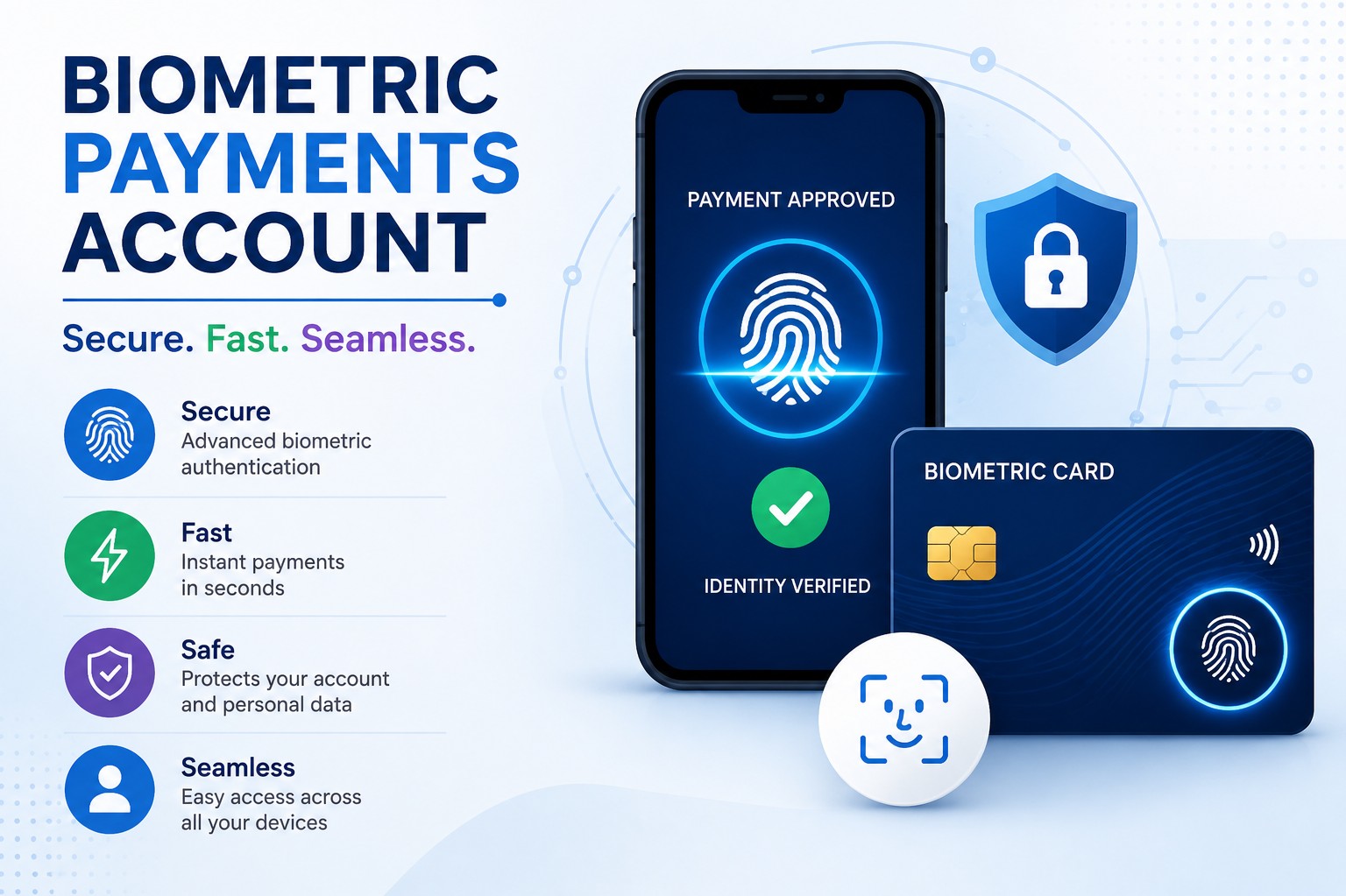
One of the most innovative developments in this space is the rise of biometric payment cards.
These cards contain built-in fingerprint sensors that verify the cardholder’s identity during transactions.
Benefits include:
- Enhanced card security
- Contactless payment support
- Reduced card fraud
- Improved customer confidence
Several banks and payment providers are actively piloting biometric card programs as part of their digital transformation strategies.
Challenges Facing Biometric Payments
Despite their advantages, biometric payment accounts are not without challenges.
Privacy Concerns
Consumers often worry about how their biometric data is collected, stored, and used.
Financial institutions must maintain transparency and comply with data protection regulations.
Data Security
Although biometric templates are encrypted, protecting sensitive identity information remains a top priority.
Organizations must invest in robust cybersecurity frameworks.
Technology Costs
Implementing biometric authentication infrastructure can require significant investment, particularly for large-scale deployments.
False Positives and False Negatives
While modern biometric systems are highly accurate, occasional authentication errors can occur.
Continuous improvements in artificial intelligence are helping address these limitations.
Regulatory Considerations
As biometric adoption increases, regulators are developing frameworks to ensure responsible use.
Financial institutions must comply with requirements related to:
- Data privacy
- Customer consent
- Cybersecurity
- Identity verification
- Fraud prevention
Compliance with regulations such as GDPR and other regional privacy laws is essential for maintaining consumer trust.
The Future of Biometric Payment Accounts
Biometric authentication is expected to become a standard feature of digital banking and payment ecosystems.
Several trends are driving future growth:
AI-Powered Authentication
Artificial intelligence is improving biometric accuracy while detecting fraudulent behavior in real time.
Multi-Factor Biometrics
Future systems may combine multiple biometric methods, such as fingerprint and facial recognition, for stronger security.
Contactless Payments Expansion
As contactless payment adoption continues to grow globally, biometric authentication will play a larger role in securing transactions.
Digital Identity Integration
Governments and financial institutions are increasingly exploring biometric digital identity frameworks that can simplify account onboarding and verification.
Embedded Finance Applications
Biometric authentication will become increasingly integrated into embedded finance platforms, digital wallets, and next-generation payment solutions.
Conclusion
Biometric payment accounts represent a major advancement in the evolution of secure and convenient financial services. By replacing traditional passwords and PINs with unique biological identifiers, these accounts offer stronger protection against fraud while delivering faster and more seamless payment experiences.
As digital banking, mobile payments, and financial technology continue to evolve, biometric authentication is likely to become a cornerstone of modern payment infrastructure. Financial institutions that embrace biometric payment solutions will be better positioned to enhance security, improve customer experiences, and meet the growing demands of a digital-first economy.
Comments
No comments yet. Be the first to share your thoughts.
Leave a comment