
Introduction
Online shopping has become an essential part of everyday life, but lengthy checkout forms and repeated card entry often lead to abandoned carts and frustrated customers. Consumers expect payment experiences that are fast, secure, and convenient across every device. Businesses, meanwhile, seek solutions that improve conversion rates while protecting sensitive payment information. Click to Pay addresses both needs by providing a streamlined online checkout experience backed by advanced security technologies.
Developed using the Secure Remote Commerce (SRC) framework, Click to Pay allows customers to complete online purchases without manually entering card details for every transaction. Instead, registered payment cards are securely recognized, enabling a quick and seamless checkout with just a few clicks.
As e-commerce continues to expand globally, Click to Pay is becoming an important payment innovation that enhances customer convenience, strengthens security, and helps merchants reduce checkout friction.
What Is Click to Pay?
Click to Pay is a secure online payment solution that enables shoppers to complete purchases using their saved payment cards without repeatedly entering card numbers, expiration dates, or security codes.
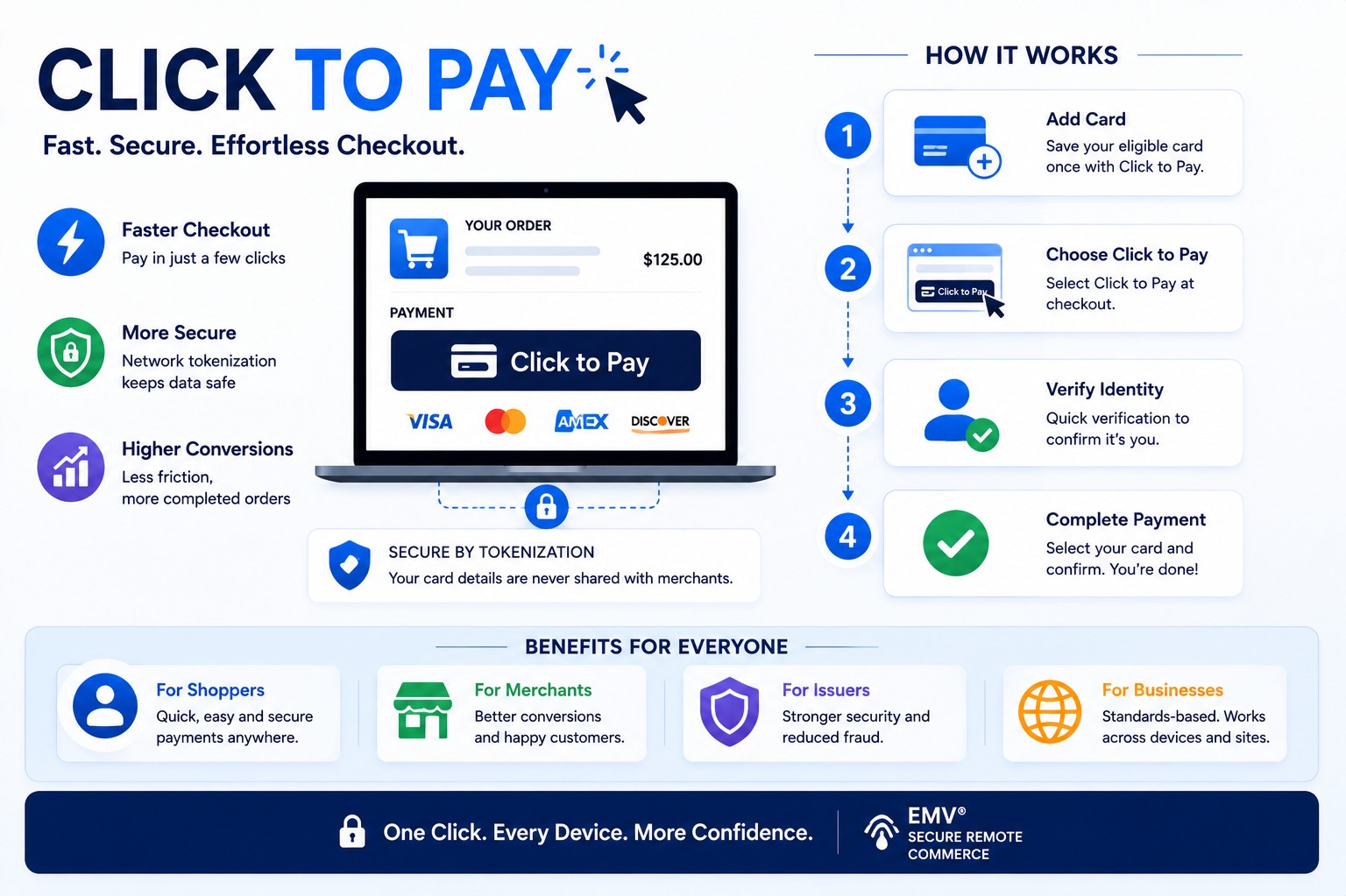
The service securely stores payment credentials through network tokenization and recognizes eligible users during checkout. Customers simply verify their identity, choose a stored card, and authorize the payment.
It delivers a consistent checkout experience across websites, mobile devices, and supported applications.
How Click to Pay Works
When customers register an eligible payment card with Click to Pay, the card information is securely stored using network tokenization rather than being shared with individual merchants.
During checkout, participating merchants display the Click to Pay option. After the customer is recognized and authenticated, available payment cards appear automatically. The customer selects the preferred card, confirms the purchase, and the payment is securely authorized through the payment network.
The entire process takes only a few moments while reducing manual data entry.
Why Businesses Are Adopting Click to Pay
Modern consumers expect checkout experiences that are simple and secure.
Long payment forms often increase cart abandonment and reduce completed purchases. Click to Pay shortens the payment journey, making online transactions faster and more convenient.
Businesses benefit from improved customer satisfaction, higher conversion rates, reduced payment friction, and stronger payment security.
Key Features of Click to Pay
Click to Pay combines convenience with advanced payment technology.
It supports secure credential storage through network tokenization, provides a consistent checkout experience across multiple merchants, enables fast card selection, supports multiple eligible payment cards, and works across desktop, mobile, and tablet devices.
Its standardized approach simplifies online payments while maintaining strong security protections.
Benefits for Consumers
Consumers no longer need to remember or repeatedly type payment card information during online purchases.
Checkout becomes significantly faster, especially when shopping across multiple websites. Since payment credentials are protected using tokenization, customers also gain greater confidence that their sensitive information is secure.
The result is a smoother, safer, and more convenient shopping experience.
Benefits for Merchants
Merchants can improve customer conversion by reducing unnecessary checkout steps.
Faster payments help decrease abandoned carts, while secure payment processing reduces fraud risks. Click to Pay also simplifies customer experiences across devices without requiring merchants to build proprietary payment storage systems.
For businesses, this means higher sales potential and lower operational complexity.
Security and Network Tokenization
Security is one of Click to Pay’s strongest advantages.
Instead of transmitting the actual card number during transactions, the system uses network tokenization to replace sensitive card information with secure digital tokens. These tokens have no value outside authorized payment environments, making them far less attractive to cybercriminals.
Additional authentication methods and fraud monitoring further strengthen payment protection.
Click to Pay vs Digital Wallets
Although Click to Pay and digital wallets both simplify online payments, they operate differently.
Digital wallets often require a dedicated mobile application or ecosystem, while Click to Pay works directly within participating merchant checkout pages using eligible payment cards.
This allows customers to enjoy a familiar and consistent checkout experience without relying on a specific device or wallet platform.
Integration with Payment Gateways
Most modern payment gateways and payment service providers support Click to Pay integration through APIs and updated checkout solutions.
Merchants can add the feature without redesigning their entire payment infrastructure, making implementation faster and more cost-effective.
Integration also allows businesses to benefit from ongoing security improvements and payment network innovations.
Artificial Intelligence and Payment Optimization
Artificial intelligence enhances Click to Pay by helping identify fraudulent activity, improving payment authorization rates, and optimizing transaction routing.
Machine learning analyzes payment behavior in real time to detect suspicious patterns while minimizing unnecessary payment declines.
These technologies improve both security and the overall customer payment experience.
Future of Click to Pay
As online commerce continues to grow, Click to Pay is expected to become a standard feature of digital checkout experiences.
Increasing adoption of network tokenization, biometric authentication, real-time payments, Open Banking, and AI-powered fraud prevention will further improve its speed, security, and reliability.
Businesses that adopt modern checkout technologies today will be better positioned to meet evolving customer expectations.
Choosing a Payment Provider That Supports Click to Pay
When selecting a payment provider, businesses should consider support for Click to Pay, network tokenization, global card acceptance, fraud prevention tools, API integration, recurring billing, reporting capabilities, and compliance with industry security standards.
A provider offering seamless Click to Pay integration can help improve customer satisfaction while increasing payment success rates.
Conclusion
Click to Pay is transforming online payments by combining convenience, speed, and advanced security into a single checkout experience. By eliminating repeated card entry and protecting payment credentials through network tokenization, it helps consumers complete purchases more quickly while reducing fraud risks.
For merchants, Click to Pay offers improved conversion rates, lower checkout abandonment, and stronger payment security without adding unnecessary complexity. As digital commerce continues to evolve, adopting Click to Pay will play an increasingly important role in delivering fast, secure, and seamless online payment experiences.
Comments
No comments yet. Be the first to share your thoughts.
Leave a comment