
Introduction
In today’s highly competitive digital economy, payment performance can directly impact revenue, customer satisfaction, and business growth. Consumers expect transactions to be completed instantly, securely, and without interruptions. Even a minor payment failure can result in abandoned purchases, lost customers, and reduced profitability.To address these challenges, many businesses are adopting a multi-acquirer strategy. Instead of relying on a single acquiring bank or payment processor, organizations connect with multiple acquirers to improve transaction success rates, increase resilience, and optimize payment operations.
As global commerce continues to expand and payment ecosystems become increasingly complex, multi-acquiring has emerged as a critical component of modern payment infrastructure. Businesses ranging from e-commerce merchants to multinational enterprises are leveraging this approach to improve payment performance and strengthen their competitive advantage.
What Is a Multi-Acquirer Strategy?
A multi-acquirer strategy involves partnering with more than one acquiring bank or payment acquirer to process payment transactions.
An acquirer is the financial institution responsible for processing card payments on behalf of merchants. Traditionally, businesses relied on a single acquirer to handle all transaction activity. While this model remains common, it can create operational risks and performance limitations.
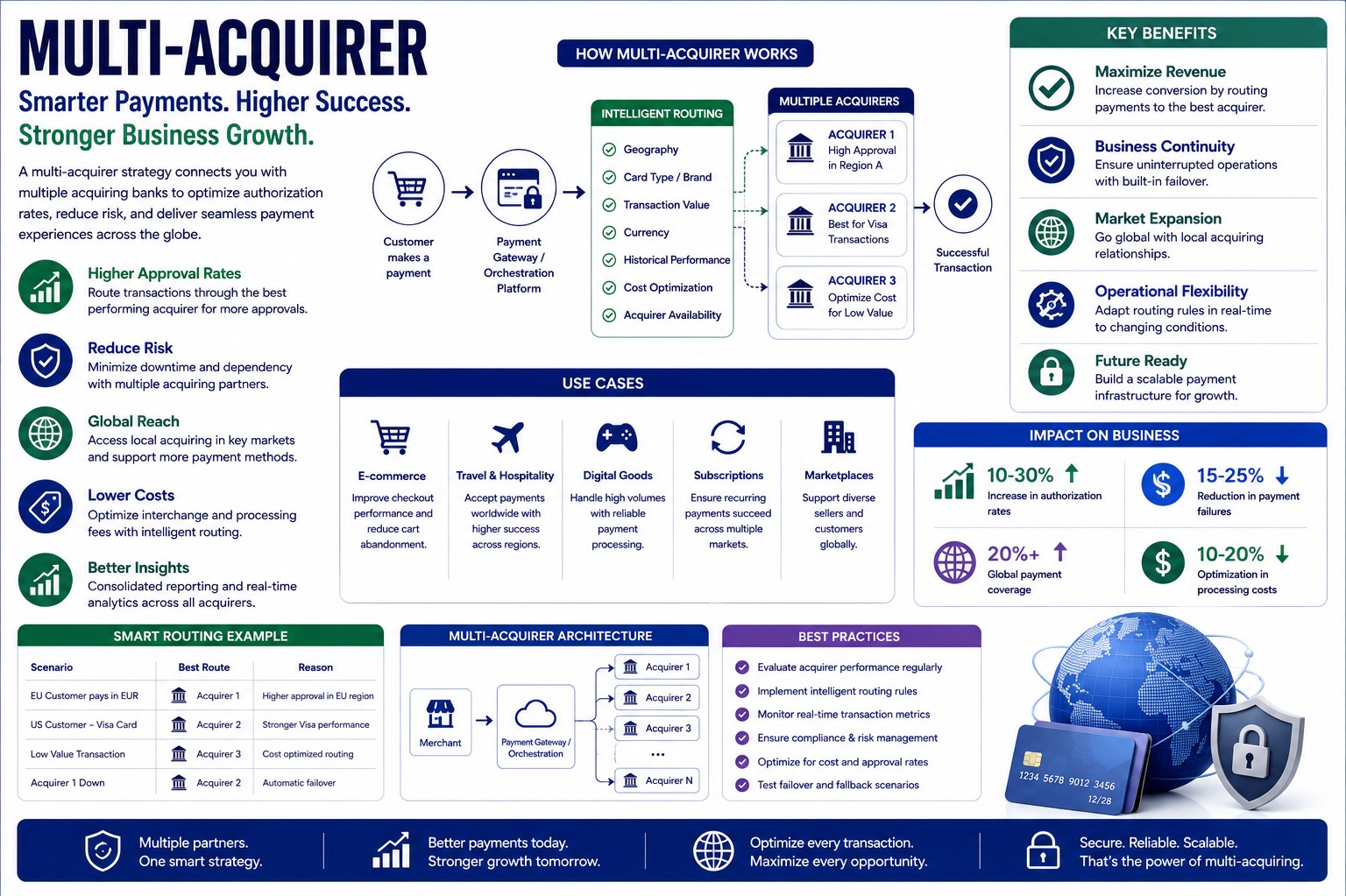
Under a multi-acquirer model, transactions can be routed through different acquiring partners based on predefined rules, geographic locations, card types, transaction values, or performance metrics.
This approach provides greater flexibility and improves overall payment efficiency.
Why Businesses Are Moving Toward Multi-Acquiring
The global payments landscape has changed dramatically over the last decade.
Businesses now serve customers across multiple countries, accept numerous payment methods, and process transactions through a variety of digital channels. A single acquiring relationship may not always provide the flexibility required to support these demands.
Organizations increasingly adopt multi-acquirer strategies to:
- Improve authorization rates
- Reduce payment failures
- Support international expansion
- Minimize operational risk
- Enhance customer experiences
- Improve transaction routing
- Increase payment resilience
These benefits have made multi-acquiring an important part of payment optimization strategies worldwide.
How Multi-Acquirer Models Work
In a multi-acquirer environment, merchants establish relationships with multiple acquiring institutions.
When a customer initiates a payment, routing technology determines which acquirer should process the transaction. Routing decisions may be based on factors such as:
- Geographic location
- Card issuer location
- Payment method
- Currency
- Historical performance
- Transaction value
- Acquirer availability
Advanced payment orchestration platforms often automate these decisions in real time.
This intelligent routing capability allows businesses to maximize approval rates while maintaining operational efficiency.
Improving Authorization Rates
One of the most significant advantages of a multi-acquirer strategy is improved transaction approval performance.
Different acquiring banks may have varying relationships with card issuers, regional payment networks, and local banking systems. As a result, some acquirers may achieve higher authorization rates for specific transaction types or geographic markets.
By routing transactions strategically, merchants can increase successful payment approvals and reduce revenue loss caused by declines.
Even small improvements in authorization rates can generate substantial financial benefits for businesses processing large transaction volumes.
Enhancing Global Payment Capabilities
International expansion presents unique payment challenges.
Customers often prefer local payment methods, local currencies, and domestic transaction processing. Cross-border transactions may experience higher decline rates due to issuer risk assessments and regulatory considerations.
A multi-acquirer strategy allows businesses to partner with acquiring institutions in different regions and optimize payment processing for local markets.
Local acquiring relationships can improve customer experiences, reduce transaction costs, and increase payment acceptance rates.
For global merchants, this localization capability is particularly valuable.
Reducing Operational Risk
Reliance on a single acquirer creates concentration risk.
If an acquiring bank experiences technical issues, regulatory challenges, network outages, or operational disruptions, a merchant’s ability to process payments may be affected.
Multi-acquiring provides redundancy and business continuity.
Should one acquiring partner become unavailable, transactions can be redirected to alternative providers with minimal disruption.
This resilience helps protect revenue streams and maintain customer trust during unexpected events.
Supporting Payment Routing Optimization
Payment routing has become increasingly sophisticated.
Modern payment platforms use real-time analytics and machine learning algorithms to determine the optimal processing path for each transaction.
A multi-acquirer environment provides greater flexibility for intelligent routing decisions.
Transactions can be directed toward acquirers with stronger historical approval rates, lower processing costs, or better performance in specific regions.
This optimization improves both payment efficiency and financial outcomes.
Multi-Acquirer Strategies and E-Commerce
E-commerce businesses are among the largest adopters of multi-acquiring.
Online merchants often serve customers across multiple countries and encounter diverse payment preferences. Transaction declines can significantly impact conversion rates and revenue.
By leveraging multiple acquiring relationships, e-commerce companies can improve checkout performance and create more reliable payment experiences.
The ability to route transactions dynamically helps merchants maximize successful purchases while reducing cart abandonment.
In highly competitive online markets, payment optimization can become a meaningful competitive advantage.
The Role of Payment Orchestration
Payment orchestration platforms play an important role in enabling multi-acquirer strategies.
These platforms connect merchants with multiple payment providers through a unified integration layer.
Rather than managing separate integrations for each acquirer, businesses can centralize payment management through a single platform.
Payment orchestration solutions often provide:
- Intelligent routing
- Real-time analytics
- Fraud management
- Performance monitoring
- Reporting tools
- Provider management
These capabilities simplify multi-acquirer implementation and ongoing optimization.
Challenges of Multi-Acquiring
Despite its advantages, multi-acquiring introduces additional complexity.
Managing multiple acquiring relationships requires coordination across technical, operational, financial, and compliance functions.
Settlement processes may become more complicated, and reporting structures can require additional reconciliation efforts.
Businesses must also ensure consistent customer experiences across all payment pathways.
Technology infrastructure, payment expertise, and ongoing monitoring are essential for successful implementation.
Organizations should carefully evaluate whether the benefits justify the increased operational complexity.
Security and Compliance Considerations
Payment security remains a critical priority regardless of the acquiring model.
Businesses using multiple acquirers must maintain compliance with payment industry regulations, data protection requirements, and security standards such as PCI DSS.
Consistent security controls should be applied across all payment providers and processing channels.
Organizations should also evaluate the compliance capabilities of potential acquiring partners before establishing relationships.
Strong governance frameworks help ensure secure and compliant payment operations.
Future Trends in Multi-Acquiring
The future of multi-acquiring is closely connected to broader payment innovation.
Artificial intelligence, machine learning, open banking, and real-time payments are enhancing transaction routing capabilities and payment intelligence.
Dynamic routing engines are becoming increasingly sophisticated, allowing businesses to optimize transactions based on real-time performance data.
Payment orchestration platforms are also expanding their functionality to support more complex global payment ecosystems.
As digital commerce continues to grow, multi-acquirer strategies are expected to become increasingly common among businesses seeking to maximize payment performance.
Conclusion
A multi-acquirer strategy has become an essential tool for businesses seeking to optimize payment performance, improve authorization rates, and support international growth. By leveraging multiple acquiring partners, organizations can reduce operational risks, enhance payment resilience, and create better customer experiences.
While implementation requires careful planning and ongoing management, the benefits often outweigh the challenges, particularly for businesses processing significant transaction volumes or operating across multiple markets.
As payment technology continues to evolve, multi-acquiring will play an increasingly important role in helping businesses build flexible, scalable, and high-performing payment infrastructures.
Comments
No comments yet. Be the first to share your thoughts.
Leave a comment