
Introduction
Expanding into international markets offers tremendous growth opportunities, but it also introduces significant operational challenges. Businesses must manage payment processing, sales tax, VAT, fraud prevention, chargebacks, regulatory compliance, and customer billing across multiple countries. Handling these responsibilities internally can be expensive, time-consuming, and difficult to scale.A Merchant of Record (MoR) helps solve these challenges by becoming the legal seller of record for customer transactions. Instead of the business managing every aspect of the payment process, the Merchant of Record takes responsibility for payment collection, tax calculation, regulatory compliance, fraud management, refunds, and chargeback handling.
This model has become increasingly popular among SaaS companies, software providers, digital product businesses, subscription platforms, online marketplaces, and global e-commerce brands looking to expand internationally without building complex payment and compliance infrastructure.
What Is a Merchant of Record?
A Merchant of Record (MoR) is a third-party organization that legally processes customer transactions on behalf of a business.
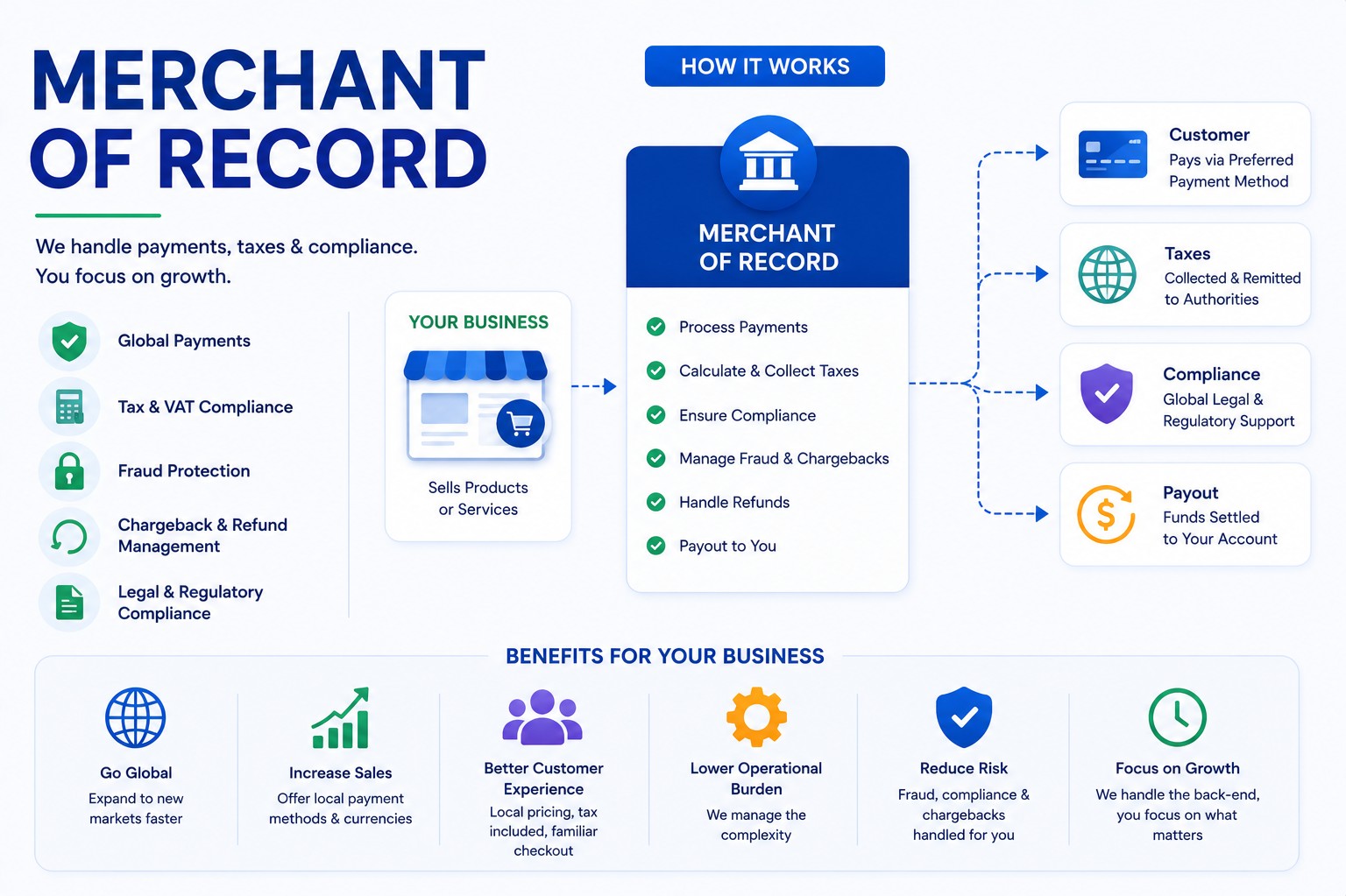
The Merchant of Record becomes responsible for collecting payments, calculating and remitting applicable taxes, ensuring regulatory compliance, managing fraud prevention, handling refunds, and resolving chargebacks.
While customers purchase products or services from the business, the Merchant of Record assumes many of the financial and legal responsibilities associated with the transaction.
This allows businesses to focus on product development, marketing, and customer growth rather than payment operations.
How a Merchant of Record Works
When a customer places an order, the payment is processed through the Merchant of Record instead of directly through the business.
The MoR securely collects payment information, authorizes the transaction, calculates applicable taxes based on the customer’s location, and processes the payment using supported payment methods.
After deducting agreed service fees, the Merchant of Record transfers the remaining funds to the business according to the payout schedule.
Throughout the transaction lifecycle, the MoR manages compliance, financial reporting, and payment-related customer issues.
Why Businesses Use a Merchant of Record
Selling globally involves far more than simply accepting payments.
Businesses often need to register for taxes in multiple countries, comply with local consumer protection laws, manage currency conversion, prevent fraud, and support various payment methods.
A Merchant of Record centralizes these responsibilities into one service, allowing businesses to expand internationally without establishing legal entities or tax registrations in every market.
This significantly reduces operational complexity while accelerating market expansion.
Merchant of Record vs Payment Gateway
A Merchant of Record and a payment gateway serve different purposes.
A payment gateway securely processes payment information and connects merchants with payment networks. The business remains responsible for taxes, compliance, fraud management, refunds, and chargebacks.
A Merchant of Record provides payment processing while also assuming many legal, financial, and compliance responsibilities associated with the sale.
For businesses selling internationally, the Merchant of Record model offers a more comprehensive solution than payment processing alone.
Key Responsibilities of a Merchant of Record
Merchant of Record providers perform numerous critical business functions.
They process customer payments, calculate indirect taxes such as VAT and sales tax, remit taxes to relevant authorities, monitor fraudulent transactions, manage chargebacks, issue refunds, support multiple currencies, and maintain compliance with financial regulations.
Many providers also generate invoices, maintain financial records, and simplify regulatory reporting.
These services allow businesses to scale without significantly expanding internal finance and compliance teams.
Benefits of Using a Merchant of Record
One of the biggest advantages of the Merchant of Record model is simplified international expansion.
Businesses gain access to global payment infrastructure without needing extensive regulatory expertise. Tax compliance becomes easier because the MoR manages tax collection and remittance.
Fraud prevention systems improve payment security, while chargeback management reduces financial risk.
Businesses also benefit from faster market entry, reduced administrative costs, improved payment acceptance rates, and better customer experiences.
For many digital businesses, these operational efficiencies provide a significant competitive advantage.
Tax and Regulatory Compliance
Managing international tax obligations can be one of the most complex aspects of global commerce.
Merchant of Record providers automatically calculate applicable VAT, GST, sales tax, and other indirect taxes based on customer location.
They also manage tax reporting, registration requirements, and regulatory compliance across multiple jurisdictions.
This reduces legal risks while ensuring businesses remain compliant with constantly changing international tax regulations.
Payment Methods and Multi-Currency Support
Modern Merchant of Record providers support a wide variety of payment methods.
Customers can pay using credit cards, debit cards, digital wallets, bank transfers, Buy Now Pay Later (BNPL) solutions, and local payment methods depending on their country.
Multi-currency processing allows customers to pay in their preferred currency while businesses receive settlements according to their financial preferences.
Localized payment experiences improve customer trust and increase conversion rates.
Fraud Prevention and Chargeback Management
Fraud remains a major concern for online businesses.
Merchant of Record providers use artificial intelligence, machine learning, transaction monitoring, device fingerprinting, and behavioral analytics to detect suspicious activity in real time.
When disputes occur, the MoR manages chargeback investigations, communicates with payment networks, and handles dispute resolution.
These capabilities help reduce financial losses while protecting business revenue.
Businesses That Benefit from Merchant of Record Services
Many industries benefit from the Merchant of Record model.
Software companies use MoR services to manage global subscription payments. SaaS providers simplify recurring billing and tax compliance across multiple countries.
E-commerce businesses, online education platforms, gaming companies, digital marketplaces, content creators, mobile app developers, and digital service providers also use Merchant of Record solutions to streamline international operations.
Any business selling digital products or services globally can benefit from outsourced payment and compliance management.
Artificial Intelligence in Merchant of Record Services
Artificial intelligence is improving Merchant of Record platforms in several important ways.
AI-powered systems optimize payment routing, detect fraudulent transactions, automate tax calculations, improve compliance monitoring, and predict payment failures before they occur.
Machine learning continuously analyzes customer behavior to improve payment approval rates while reducing false fraud alerts.
These intelligent capabilities increase efficiency while enhancing customer satisfaction.
Future of Merchant of Record Solutions
As cross-border digital commerce continues growing, Merchant of Record services are becoming increasingly sophisticated.
Open Banking, embedded finance, real-time payments, digital identity verification, and AI-driven compliance automation are transforming global payment operations.
Businesses increasingly seek unified platforms capable of managing payments, taxes, compliance, subscriptions, and financial reporting through a single provider.
Merchant of Record services will continue evolving to support the growing complexity of international digital commerce.
Choosing the Right Merchant of Record Provider
Selecting the right Merchant of Record partner requires careful evaluation.
Businesses should consider global geographic coverage, supported payment methods, tax expertise, compliance capabilities, security standards, fraud prevention tools, payout flexibility, API integration, reporting features, customer support, and pricing.
A reliable provider should support both current business operations and future international expansion.
Choosing the right partner can significantly reduce operational complexity while improving global customer experiences.
Conclusion
A Merchant of Record enables businesses to sell internationally without managing the full complexity of global payments, taxes, compliance, and financial regulations. By assuming legal responsibility for customer transactions, the MoR simplifies payment operations while reducing administrative burdens and regulatory risks.
For SaaS providers, e-commerce businesses, subscription platforms, marketplaces, and digital product companies, Merchant of Record services provide a scalable foundation for global growth.
As international commerce continues to expand, businesses that leverage Merchant of Record solutions will be better equipped to deliver seamless customer experiences while focusing on innovation, growth, and long-term success.
Comments
No comments yet. Be the first to share your thoughts.
Leave a comment