
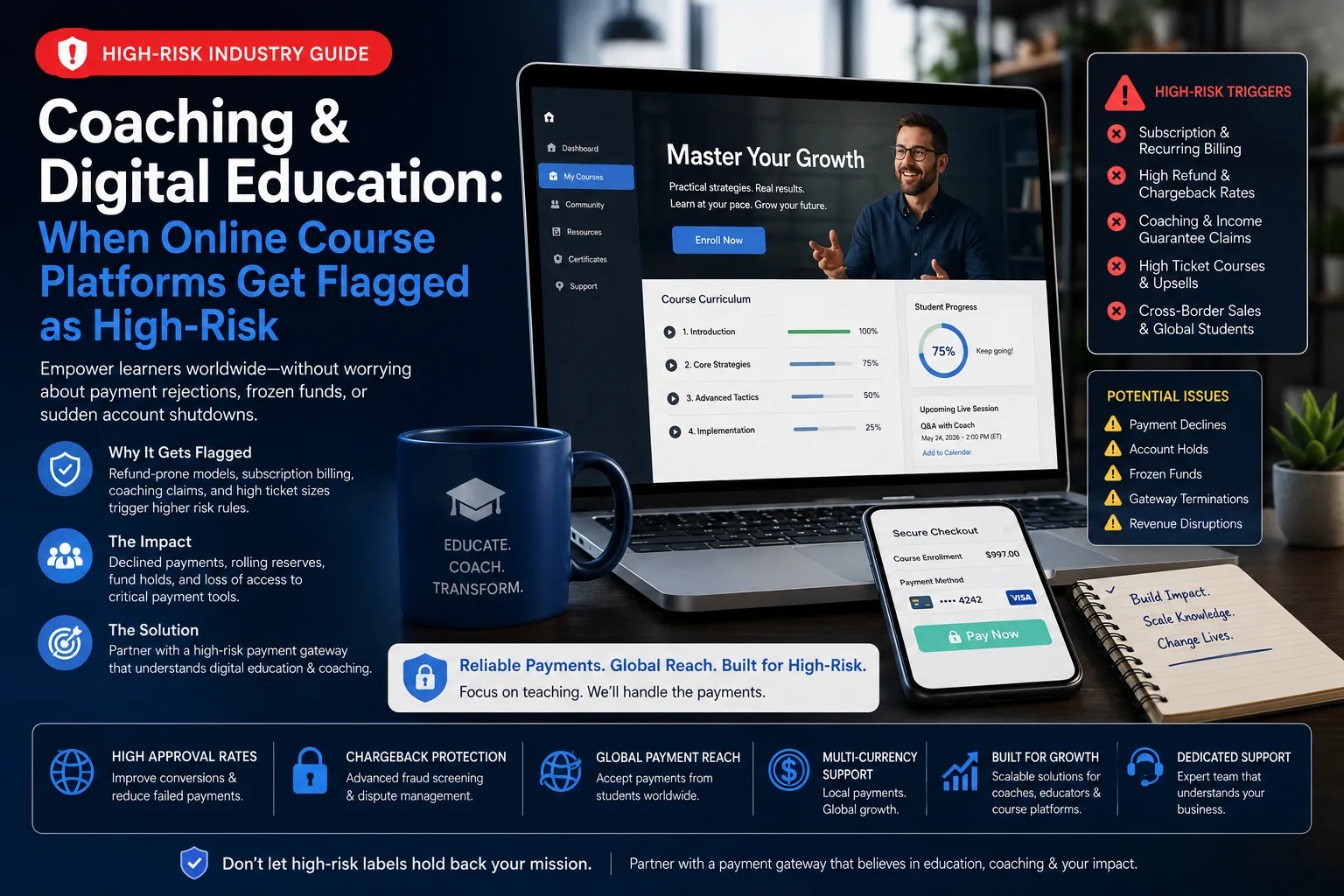
The global e-learning market reached $399.3 billion in 2025, and the coaching industry alone generates over $20 billion annually, yet thousands of operators in these verticals discover mid-operation that their payment processing has been flagged, restricted, or terminated by providers who consider online education and coaching programmes high-risk. The reasons are specific and structural, and most founders only learn them after receiving a termination notice. This guide explains exactly why coaching and digital education platforms get flagged, who will process for them, and how to build a payment stack that doesn’t collapse under a chargeback dispute or an FTC inquiry.
TL;DR
- The e-learning market reached $399.3 billion in 2025 at 14.2% CAGR, coaching and course platforms face merchant account decline rates of 45-60% from standard acquirers
- The primary risk triggers are high-ticket pricing ($997-$10,000 programmes), income and result claims that violate FTC guidelines, and refund dispute chargeback rates of 2-4%
- 40-60% of coaching platform chargebacks originate from friendly fraud, customers claiming non-delivery or misrepresentation on promises that were technically delivered
- Processing fees for coaching and digital education run 3.0-5.5%, with rolling reserves of 6-10%
- FTC-compliant earnings disclaimers, a clear refund policy, and delivery evidence documentation are the three elements that most directly affect both approval outcomes and chargeback dispute wins
- Platforms selling high-ticket programmes should structure payments through instalment plans with ACH options to reduce per-transaction chargeback exposure
Why Coaching and Online Course Platforms Get Flagged
Coaching and digital education businesses look low-risk on the surface, they are legal, in-demand, and often run by credentialled professionals. The problem is not the business itself. It is the combination of ticket size, the nature of the product, and the specific types of disputes these businesses generate.
High average ticket size: is the first trigger. Coaching programmes priced at $997, $2,997, $5,000, or $10,000+ create exactly the chargeback risk profile that acquiring banks are most sensitive to. A single chargeback on a $5,000 coaching programme costs the processor between $5,000 and $20,000 in total liability when fees and operational overhead are factored in. Payment providers apply heightened scrutiny to any business where individual transaction amounts regularly exceed $500.
Result claims and income promises: are the second trigger, and the most damaging one for underwriting. Coaches and course creators who promise specific income levels, transformation outcomes, or guaranteed results are flagged by payment providers because those claims generate predictable chargeback patterns. Customers who pay $5,000 for a business coaching programme and fail to generate the promised results frequently dispute the charge as misrepresentation. Processors see this pattern across the category and price it in.
Refund policy ambiguity: compounds the dispute rate. Coaching programmes that offer no refunds, or refunds only under specific conditional criteria, generate elevated chargebacks because dissatisfied customers have no voluntary refund path and go directly to their card issuer instead. The card issuer, working from the cardholder’s description, typically sides with the customer, and the merchant account absorbs the chargeback.
The Friendly Fraud Problem in Digital Education
Between 40% and 60% of chargebacks on coaching and online course platforms are friendly fraud, disputes filed by customers who received the product or service but claim otherwise, or who received access to a course but dispute the charge after consuming the content. This is one of the highest friendly fraud rates of any digital vertical.
The dispute reason most commonly cited is “product not as described”, which in coaching contexts typically means the customer felt the programme did not deliver the transformation or income outcome they expected. From the card network’s perspective, this is indistinguishable from genuine non-delivery without strong evidence documentation. The coach or platform operator loses the dispute if they cannot demonstrate that the specific marketing claims are supported by documented results or by clearly qualified earnings disclaimers.
Chargeback rates across the coaching and digital education segment typically run 2-4%, well above the 1% Visa monitoring threshold that triggers formal programme review. Platforms that breach this threshold face fines, mandatory remediation plans, and eventual merchant account termination if the rate is not brought below threshold within the card network’s prescribed window.
What Payment Providers Specifically Assess at Onboarding
Payment providers underwriting coaching and digital education merchant accounts focus on a specific set of risk signals that differ from other high-risk verticals. Understanding what they look for is directly actionable for operators seeking approval.
Marketing claims and landing page language: processors review the merchant’s website, landing pages, and sales materials as part of underwriting. Income claims like “make $10,000 in 30 days” or “guaranteed results” without qualifying disclaimers are red flags that frequently result in declined applications or restrictive terms on approval.
Refund policy: a minimum 30-day refund policy for digital products is the baseline expectation. Providers with no-refund policies face automatic higher reserve requirements. A clearly accessible, clearly worded refund policy reduces both the chargeback rate and the underwriting friction simultaneously.
Delivery mechanism documentation: the processor wants to see how the course or coaching service is delivered, how access is confirmed (login records, session recordings, completion tracking), and how delivery evidence is stored for potential dispute use.
Prior processing history: platforms with existing merchant processing statements showing transaction volume, refund rates, and chargeback rates receive faster approvals and better initial terms. New platforms without processing history are assessed primarily on the risk signals above and face higher initial reserves as a result.
Which Processors Accept Coaching and Digital Education Accounts
Coaching & Digital Education Processor Comparison
| Provider | Coaching | Online Courses | Avg Fee | Reserve Rate | Instalment Plans | High Ticket |
|---|---|---|---|---|---|---|
| PaymentCloud | ✓ | ✓ | 3.5-5.0% | 6-10% | Via integration | Up to $10K |
| Durango Merchant Services | ✓ | ✓ | 3.5-5.5% | 6-10% | ✓ | Up to $10K |
| eMerchantBroker (EMB) | ✓ | ✓ | 3.9-5.5% | 8-10% | ✓ ACH | Up to $15K |
| Soar Payments | ✓ | ✓ | 3.5-5.0% | 6-8% | ✓ | Up to $7.5K |
| Stripe | Conditional | ✓ | 2.9%+ | None | ✓ | Case by case |
| Paddle | ✓ | ✓ | 5.0% flat | None | Limited | Up to $5K |
| Thrivecart | ✓ | ✓ | Custom | None | ✓ Native | Up to $10K |
Stripe remains accessible for coaching and online course platforms that do not make aggressive income claims and maintain low chargeback rates, but it offers no tolerance for elevated dispute rates and will terminate accounts without warning at its risk team’s discretion. For platforms with any volume of high-ticket sales or result-oriented marketing language, dedicated high-risk payment providers provide the underwriting stability that Stripe cannot.
Paddle and ThriveCart function as merchant-of-record platforms, they accept legal liability for the transaction and handle tax compliance globally, which simplifies the compliance overhead for course operators selling across multiple jurisdictions. The trade-off is higher flat fees and less flexibility in payment structure.
For coaching operators with international client bases, offshore merchant accounts through European or Asia-Pacific acquirers provide multi-currency payment processing that reduces cross-border decline rates and currency conversion costs for non-USD clients.
Structuring Payments to Reduce High-Ticket Risk
How a coaching or digital education business structures its payment options directly affects both its chargeback rate and its processing approval terms.
Instalment plans: break high-ticket programme fees into multiple smaller payments, typically 3, 6, or 12 monthly instalments. A $3,000 coaching programme paid in three monthly instalments of $1,000 presents a significantly lower per-transaction risk profile than a single $3,000 charge. Instalment plans also reduce the magnitude of individual chargeback disputes when they do occur.
ACH and bank transfer options: for high-ticket payment plans reduce the chargeback risk further, ACH disputes are harder to initiate than card chargebacks and carry longer resolution windows, giving the merchant more time to provide delivery evidence. EMB and Durango both offer ACH processing for coaching instalment plans alongside card payment gateway access.
Deposit + balance structures: collecting a 30-50% deposit at registration with the balance due at a later milestone (session one, module completion, or 30 days post-enrolment) distributes the dispute risk across time and creates a natural checkpoint for addressing any early client dissatisfaction before it becomes a chargeback.
FTC Compliance: The Non-Negotiable for Business and Income Coaching
Coaching and business education platforms making income, financial, or lifestyle claims face specific FTC requirements that directly affect their payment processing stability. The FTC’s 2023 Income Disclosure guidance and the revised 2024 Endorsement Guides require that:
Any income or result claim must be substantiated by actual results data representative of what buyers typically achieve, not exceptional outlier outcomes. “Most customers” earnings or result claims require documented evidence of median customer outcomes, not simply the top performer case study.
Earnings disclaimers must be clear, prominent, and proximate to the claim, not buried in fine print or visible only on a separate terms page. A disclaimer that requires the customer to click through to find it does not meet the FTC’s “clear and conspicuous” standard.
Payment providers that conduct a website review during underwriting will decline applications that contain unqualified income or result claims. Bringing your marketing language into FTC compliance before applying, not after, is the single highest-impact step most coaching operators can take to improve their approval outcomes.
Pros and Cons of Coaching & Digital Education Payment Processing
Pros
- Growing market with consistent demand: specialist payment providers actively seek well-managed coaching and education accounts
- Instalment plan infrastructure: through dedicated processors reduces per-transaction chargeback exposure on high-ticket programmes
- FTC-compliant marketing: and clear refund policies simultaneously reduce chargebacks and improve underwriting outcomes
- Merchant-of-record platforms: (Paddle, ThriveCart) eliminate tax and compliance overhead for global course sales
- ACH processing availability: reduces dispute risk on high-value recurring instalment payments
Cons
- 45-60% application decline rate from standard acquirers, Stripe, PayPal, and Square are unreliable at any meaningful volume
- 2-4% chargeback rate is structurally elevated by friendly fraud that requires active dispute management to contain
- FTC compliance requirements for income claims add marketing constraints that operators find commercially restrictive
- High-ticket transaction caps vary significantly by provider, confirm before onboarding that your programme pricing fits within the processor’s approved limits
- No-refund or conditional-refund policies generate more chargebacks than they save, liberal refund policies are both better for customers and better for processing stability
FAQ: Coaching and Digital Education Payment Processing
Why does Stripe terminate coaching and course platform accounts?
Stripe terminates coaching and course accounts when chargeback rates exceed acceptable thresholds, when marketing claims generate dispute patterns flagged by their risk monitoring systems, or when the account profile changes materially from what was disclosed at onboarding. Stripe’s risk team operates with significant discretion and limited advance warning, which is why established platforms supplement Stripe with a dedicated high-risk payment provider as a backup.
What chargeback rate triggers a Visa monitoring programme for coaching platforms?
Visa’s Dispute Monitoring Programme (VDMP) is triggered when monthly chargebacks exceed 100 disputes and 1% of transactions simultaneously. Mastercard’s Excessive Chargeback Programme triggers at 1.5%. Most high-volume coaching platforms operating without active dispute management breach one or both thresholds within 6-12 months of scale.
Can online course platforms use PayPal?
PayPal accepts online course platforms in most jurisdictions, but applies its standard high-dispute-rate monitoring to these accounts. Platforms with chargeback rates above 1.5% risk account limitation or termination. PayPal’s dispute resolution process also tends to favour buyers on digital product disputes, making it a less favourable processing environment for high-ticket course sales than a dedicated merchant account.
Is a 30-day refund policy legally required for digital products?
Not universally, but most EU consumer protection frameworks require a 14-day cooling-off period for digital goods purchased online, and several US states have consumer protection laws that effectively require accessible refunds on subscription and digital product sales. Beyond legal requirements, a 30-day refund window is a strong chargeback prevention mechanism because it gives dissatisfied customers a voluntary resolution path before they go to their card issuer.
How do coaching platforms win chargeback disputes?
The strongest evidence packages include: a signed or click-confirmed enrolment agreement with programme terms, login records showing the customer accessed the content, session attendance records for live coaching calls, and email correspondence demonstrating ongoing service delivery. Platforms with this documentation readily exportable from their LMS or CRM consistently win a higher proportion of representment disputes than those assembling evidence reactively.
Comments
No comments yet. Be the first to share your thoughts.
Leave a comment