
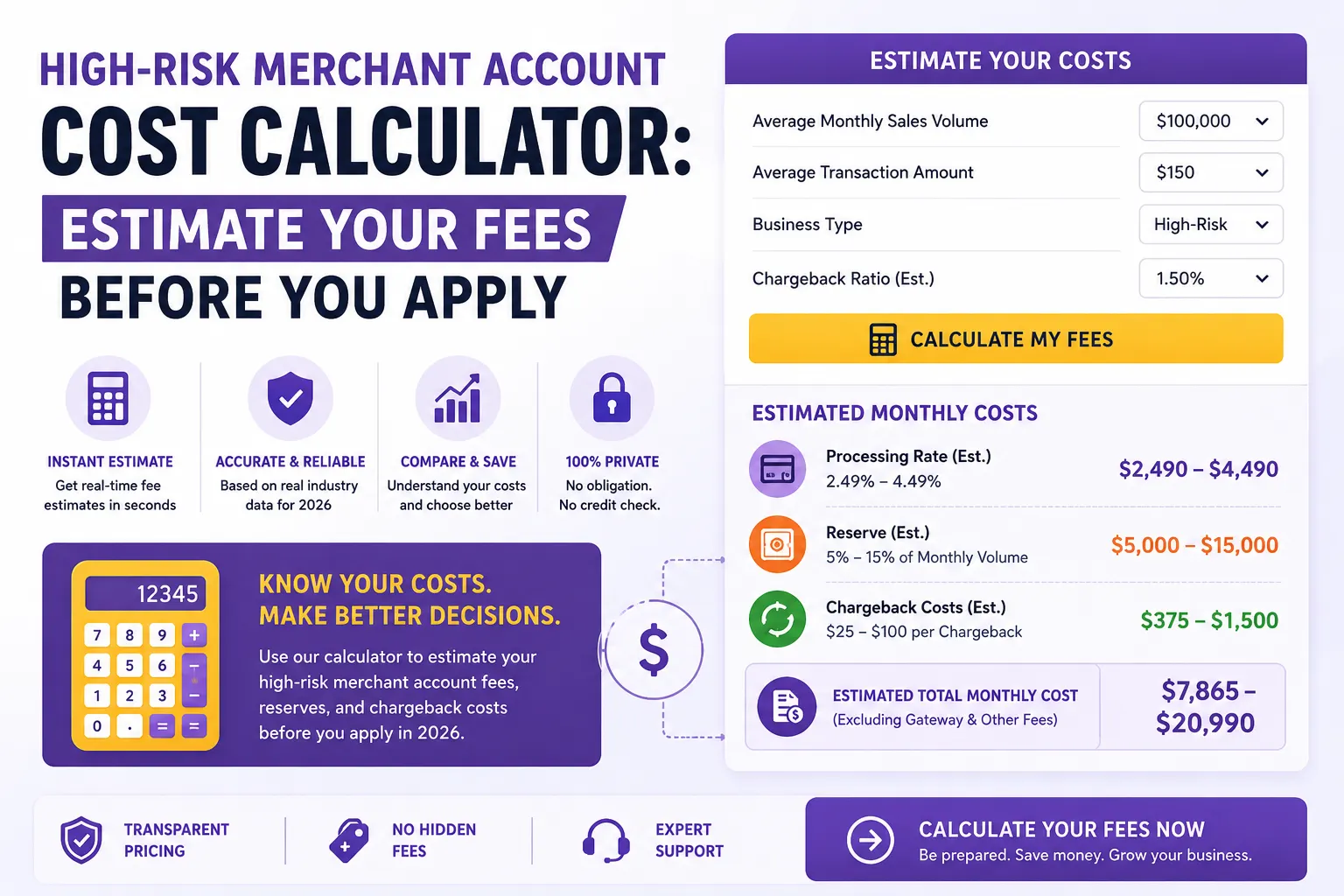
High-risk merchant account fees rarely match what gets advertised on a provider’s homepage. Between transaction rates, rolling reserves, and chargeback charges, two businesses in the same industry can end up paying very different effective costs for the same sales volume. A high-risk merchant account fee calculator lets you model these costs before you sign anything, so you’re comparing payment providers on real numbers instead of marketing copy. This guide breaks down every component that feeds into the calculation and shows you how to run it yourself.
TL;DR
- High-risk merchant accounts typically carry transaction rates of 3.5%-6.5%, versus 1.5%-2.9% for standard merchant accounts.
- Total effective cost, rate plus fixed fee plus monthly charges plus reserves, usually lands between 3.5% and 7% per transaction in 2026.
- Rolling reserves can hold back 5%-10% of monthly revenue for 90-180 days at a time.
- Chargeback fees range from roughly $15 to $100 per dispute depending on the processor and industry.
- Running the numbers through a fee calculator before you apply helps you avoid signing with a high-risk payment provider whose true cost structure doesn’t match your margins.
Why High-Risk Merchant Account Fees Are So Hard to Predict
Unlike standard merchant services, high-risk pricing isn’t a single published number. Your industry vertical, chargeback history, processing volume, and whether you’re classified as an offshore merchant all move the final rate up or down. A nutraceutical subscription business and a travel agency can both be labeled “high-risk merchants,” yet land on opposite ends of the fee spectrum.
Pricing models add another layer of unpredictability. Some payment gateways quote flat-rate pricing, others use tiered buckets that route most transactions into the most expensive category, and a smaller group offers interchange-plus pricing that separates the actual card network cost from the processor’s markup. Without breaking out each line item, it’s nearly impossible to know what you’re really paying until the first statement arrives.
High-Risk Payment Processing: 2026 Industry Update
The high-risk payments market isn’t a niche corner of fintech anymore, it’s one of the fastest-growing segments in global payment processing. Industry market research values the global high-risk payments market at roughly $62.4 billion in 2025, with projections putting it near $148.7 billion by 2034 as e-commerce, online gambling, and subscription-based business models keep expanding into new regions.
Three shifts are shaping how high-risk merchant accounts get priced and underwritten in 2026:
- AI-driven underwriting: More acquiring banks now use machine-learning risk scoring during onboarding, which is shortening approval timelines for merchants with clean processing histories while tightening scrutiny on thin or inconsistent transaction data.
- Crypto and alternative payment growth: With more than 560 million unique crypto wallet holders recorded in early 2026, a growing number of high-risk payment providers now offer cryptocurrency settlement as a hedge against card-network restrictions in certain verticals.
- Tighter chargeback thresholds: Visa and Mastercard’s fraud and dispute monitoring programs continue to lower the chargeback ratio that triggers enhanced monitoring, pushing high-risk merchants to invest more heavily in dispute prevention tools rather than absorbing fees after the fact.
For merchants and fintech buyers evaluating payment providers this year, these trends mean fee calculators need to account for more than static rate ranges, underwriting speed, settlement flexibility, and dispute-monitoring exposure are all becoming part of the real cost equation.
What Goes Into a High-Risk Merchant Account Fee Calculator
A reliable calculator pulls together six cost components. Each one needs its own input field, because lumping them into a single “rate” hides where your money is actually going.
Transaction (Discount) Rate
This is the percentage charged on every sale. For high-risk merchant accounts in 2026, this typically runs 3.5% to 6.5% of transaction value, compared with 1.5% to 2.9% for standard payment processing. Adult entertainment and online gambling tend to sit at the top of that range, while travel and subscription boxes often land closer to the bottom.
Per-Transaction Fee
On top of the percentage rate, most processors add a fixed fee per transaction, usually $0.20 to $0.35. On high-ticket businesses this fee barely registers; on high-volume, low-ticket merchants it can meaningfully change the effective rate.
Monthly Account and Gateway Fees
Expect a monthly account fee of $10-$50 and a separate payment gateway fee of $10-$30 if your processor and gateway are billed separately. Some providers bundle these; others itemize every line.
Setup Fees
Onboarding a high-risk account often costs $100-$500 upfront, reflecting the deeper underwriting review high-risk merchants go through. A growing number of providers waive this fee to win competitive deals, so it’s worth negotiating.
Chargeback Fees
Every disputed transaction triggers a fee, typically $15-$100 depending on the processor and your industry’s baseline dispute rate. High-risk merchants with chargeback ratios above 1% should expect to pay toward the higher end, and ratios above roughly 2% put the account at risk of binding network fraud or excessive-chargeback programs.
Rolling Reserves
Many high-risk payment providers hold back 5%-10% of your processing volume in a reserve account, releasing it after a set period, commonly 90 to 180 days. This isn’t a fee in the traditional sense, but it’s a real cash-flow cost that any serious calculator has to account for.
2026 High-Risk Merchant Account Fee Benchmarks
| Fee Component | Typical 2026 Range | Notes |
|---|---|---|
| Transaction rate | 3.5% – 6.5% | Varies heavily by vertical and chargeback history |
| Per-transaction fee | $0.20 – $0.35 | Added on top of the percentage rate |
| Monthly account fee | $10 – $50 | Sometimes bundled with gateway fee |
| Gateway fee | $10 – $30 | Separate from account fee on many platforms |
| Setup fee | $100 – $500 | Increasingly negotiable or waived |
| Chargeback fee | $15 – $100 | Higher end applies to adult, gambling, forex |
| Rolling reserve | 5% – 10% of volume | Held for 90-180 days |
| Effective total cost | 3.5% – 7% | Combined real-world cost per transaction |
How the Calculator Works: A Sample Calculation
To see how these inputs combine, take a nutraceutical merchant processing $50,000 a month at an average ticket of $65.
That’s roughly 770 transactions per month. At a 4.5% transaction rate plus $0.25 per transaction, the variable processing cost alone comes to $2,250 plus $192.50, or $2,442.50. Add a $25 monthly account fee and a $20 gateway fee, and the monthly total reaches $2,487.50, an effective rate of about 4.97% before reserves are factored in.
If the processor also holds a 7% rolling reserve, an additional $3,500 of that month’s revenue becomes temporarily inaccessible cash, even though it isn’t a fee the merchant loses outright. Running this math against three different payment providers, rather than comparing headline rates alone, usually reveals a 1-2 percentage point spread in real cost, often the difference between a profitable month and a break-even one.
High-Risk vs. Standard Merchant Accounts: Side-by-Side
| Factor | Standard Merchant Account | High-Risk Merchant Account |
|---|---|---|
| Transaction rate | 1.5% – 2.9% | 3.5% – 6.5% |
| Approval speed | Often instant or same-day | 2-10 business days |
| Rolling reserve | Rare | Common, 5%-10% of volume |
| Contract length | Month-to-month common | Often 1-3 year terms |
| Chargeback tolerance | Low threshold before termination | Higher tolerance, closer monitoring |
| Provider pool | Stripe, Square, PayPal, traditional banks | Specialized high-risk payment providers and acquiring banks |
Pros of high-risk merchant accounts: access to processing that mainstream providers won’t offer, higher chargeback tolerance, and underwriters who understand your industry.
Cons of high-risk merchant accounts: higher transaction costs, reserve requirements that tie up cash, and longer contract commitments with early termination fees.
Offshore Merchant Accounts: When the Numbers Shift
Offshore merchants, businesses that process through banks outside their home country, sometimes turn to international acquiring when domestic high-risk options are limited or excessively priced. Offshore merchant accounts can offer more flexible underwriting for certain verticals, but they often come with their own trade-offs.
Currency conversion fees, cross-border interchange differences, and additional compliance documentation can offset any savings on the headline rate. Before assuming an offshore merchant account is cheaper, run the full cost, including FX spread, through the same calculator logic used for domestic high-risk merchant accounts.
How to Lower Your High-Risk Merchant Account Costs
- Reduce your chargeback ratio: below 1% through clear billing descriptors, proactive customer service, and chargeback alert tools, this is the single biggest lever on long-term pricing.
- Negotiate interchange-plus pricing: instead of tiered pricing, since tiered models tend to route more transactions into expensive buckets.
- Ask about reserve step-downs: many providers reduce reserve percentages after 6-12 months of clean processing history.
- Bundle your gateway and merchant account: with one provider to eliminate duplicate monthly fees.
- Get multiple quotes: and run each one through a fee calculator rather than comparing advertised rates alone.
Pros and Cons of Calculating Fees Before You Apply
| Pros | Cons |
|---|---|
| Avoids surprises on the first statement | Requires estimated volume and ticket data upfront |
| Makes it easier to compare multiple payment providers | Real rates can still shift after underwriting review |
| Helps you budget for rolling reserve cash-flow impact | Doesn’t replace reading the full processing agreement |
| Strengthens negotiating position with sales reps | Some fees (like early termination) are hard to estimate in advance |
Frequently Asked Questions
What is a high-risk merchant account fee calculator?
It’s a tool that combines your transaction rate, fixed fees, monthly charges, chargeback rate, and reserve percentage to estimate the true cost of processing payments through a high-risk merchant account.
Why are high-risk merchant account fees higher than standard rates?
Processors price in the elevated chargeback, fraud, and regulatory risk associated with certain industries, which is why high-risk payment processing typically costs 1-3 percentage points more than standard merchant services.
Do all high-risk merchants pay rolling reserves?
No. Some providers waive reserves for merchants with strong processing history, while others require them as standard practice, particularly for new accounts or higher-risk verticals.
Can I negotiate high-risk merchant account fees?
Yes. Setup fees, reserve percentages, and even transaction rates are often negotiable, especially once you have several competing quotes from different high-risk payment providers.
Are offshore merchant accounts cheaper than domestic high-risk accounts?
Not always. Offshore merchant accounts can offer more flexible approval, but currency conversion and cross-border fees sometimes erase the savings, always calculate the full effective cost before switching.
How accurate is a fee calculator compared to my final contract?
A calculator gives a strong estimate based on disclosed fee ranges, but your final rate depends on underwriting review, so always confirm exact numbers in writing before signing.
Compare Your Options Before You Apply
Running your numbers through a fee calculator is only the first step. The next is comparing actual high-risk payment providers side by side, their underwriting appetite, reserve policies, and contract terms vary as much as their pricing.
Explore TheFinRate’s directory of high-risk merchant account providers to compare rates, reserve policies, and approval requirements before you apply.
Comments
No comments yet. Be the first to share your thoughts.
Leave a comment