
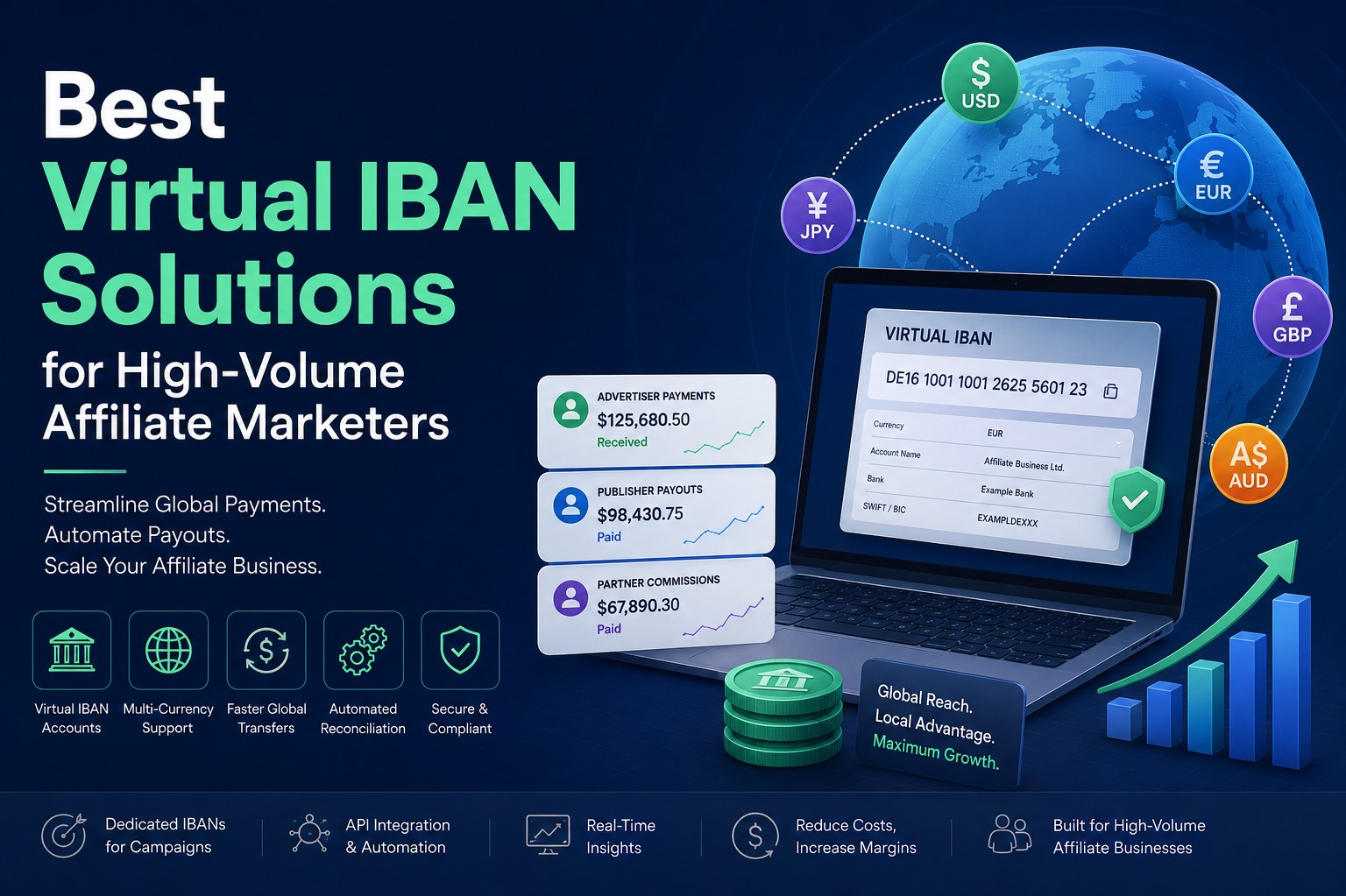
Affiliate marketing has evolved into a global business model where publishers, media buyers, networks, and advertisers operate across multiple jurisdictions simultaneously. A successful affiliate business today may receive commissions from Europe, advertising reimbursements from the United States, traffic payments from Asia, and partner settlements from the Middle East.Managing these payment flows through traditional banking infrastructure often creates operational bottlenecks. Delayed settlements, expensive SWIFT transfers, reconciliation errors, account restrictions, and cross-border compliance challenges can significantly impact cash flow.This is why virtual IBAN solutions have become a preferred financial infrastructure layer for high-volume affiliate marketers. Instead of maintaining multiple bank accounts across countries, affiliate businesses can generate dedicated virtual IBANs that simplify collections, automate payment matching, and improve treasury visibility.
As affiliate marketing scales globally in 2026, the best virtual IBAN providers are no longer simply offering account numbers. They are delivering complete payment ecosystems that combine global banking access, multi-currency capabilities, API-driven automation, and institutional-grade compliance.
Why Affiliate Marketers Need Virtual IBAN Infrastructure
Traditional banking systems were not designed for modern affiliate operations.
An affiliate network may process thousands of inbound and outbound transactions every month. Managing these transactions through a single bank account creates reconciliation challenges and increases operational risk.
Virtual IBANs solve this problem by assigning unique account identifiers to specific campaigns, advertisers, partners, traffic sources, or business entities. Payments are automatically attributed to the correct source without requiring manual matching.
This automated attribution model reduces accounting workloads while improving payment accuracy.
The increasing complexity of global affiliate operations has also created demand for faster settlement cycles. Advertisers expect immediate funding, while publishers increasingly demand rapid commission payouts.
Virtual IBAN providers help bridge this gap through local payment rails, real-time settlement capabilities, and multi-currency account structures.
Banking Circle
Among institutional-grade providers, Banking Circle has established itself as one of the strongest solutions for businesses managing substantial payment volumes. The platform offers multi-currency virtual IBANs, safeguarding infrastructure, and direct access to major European payment schemes. It is particularly attractive for established affiliate networks that process large settlement flows and require strong compliance frameworks.
One of Banking Circle’s major advantages is scalability. Rather than relying heavily on correspondent banking relationships, the institution operates infrastructure designed specifically for payment companies and regulated financial businesses.
For affiliate platforms processing millions in annual commission payments, this operational stability becomes a significant advantage.
Airwallex
Airwallex has emerged as one of the most versatile virtual IBAN providers for globally distributed digital businesses. The company offers local account details across more than sixty markets while supporting extensive multi-currency operations.
For affiliate marketers working with advertisers and publishers across Europe, Asia-Pacific, North America, and emerging markets, Airwallex provides a practical solution for reducing international payment friction.
Its API infrastructure enables automated payment workflows, making it suitable for affiliate networks that need recurring commission payouts and real-time treasury visibility.
The platform also offers competitive foreign exchange capabilities, helping businesses reduce costs associated with cross-border settlements.
Currencycloud
Currencycloud, now operating under Visa ownership, remains one of the most respected names in cross-border payment infrastructure. Its virtual account framework supports multi-currency collections, automated payouts, and global settlement capabilities.
Affiliate businesses frequently face challenges when receiving funds in one currency while paying partners in another. Currencycloud addresses this issue through integrated foreign exchange services and a broad payout corridor network.
Another significant advantage is its developer-friendly architecture. Businesses with custom affiliate platforms can integrate Currencycloud APIs directly into their payment workflows, enabling automated commission management and reconciliation.
Wise Business
Wise Business continues to be a popular choice among digital-first companies seeking transparent pricing and simplified international banking. The platform provides local account details in multiple jurisdictions and supports virtual IBAN functionality for global payment collections.
For small and mid-sized affiliate businesses, Wise offers an attractive balance between accessibility and functionality.
Its transparent fee structure and competitive currency conversion rates make it particularly useful for affiliates receiving payments from international advertisers.
While enterprise-level networks may eventually require more advanced treasury capabilities, Wise remains a practical starting point for growing affiliate operations.
Clear Junction
Clear Junction has become increasingly popular among businesses operating in sectors that often encounter banking scrutiny. The provider focuses heavily on compliance, governance, and secure payment infrastructure.
Affiliate marketers operating internationally frequently encounter banking challenges due to elevated transaction volumes and cross-border activity patterns. Clear Junction’s compliance-oriented framework can provide additional operational stability in such environments.
The platform also supports global payment capabilities through SWIFT connectivity and regional payment rails.
Lorum
Lorum represents a newer generation of institutional payment infrastructure providers. Rather than focusing exclusively on virtual IBAN issuance, the company combines account infrastructure, treasury services, cash management, and multi-currency clearing into a unified platform.
For affiliate networks managing advertiser funds, publisher payouts, and operational treasury simultaneously, this integrated approach can simplify financial operations significantly.
Its coverage across Europe, the Middle East, Africa, and other international markets makes it particularly attractive for globally distributed affiliate businesses.
Key Features High-Volume Affiliates Should Prioritize
Not every virtual IBAN provider is suitable for affiliate marketing.
The most successful affiliate businesses evaluate providers based on operational requirements rather than marketing claims.
Multi-currency support remains essential because advertisers and publishers rarely operate within a single currency ecosystem.
Automated reconciliation capabilities help eliminate manual accounting work and reduce payment errors.
API accessibility is increasingly important for businesses that want to automate commission calculations, settlements, and reporting.
Strong compliance frameworks should also be considered a priority. As regulatory scrutiny around cross-border payments increases, providers with established licensing structures and transparent AML procedures are likely to deliver greater long-term stability.
Affiliate businesses should also assess payout speed, FX costs, onboarding requirements, and geographic coverage before selecting a provider.
Industry Trends Shaping Virtual IBAN Adoption
Several trends are accelerating virtual IBAN adoption within affiliate marketing.
The first is the growth of international affiliate ecosystems. Modern publishers increasingly operate across multiple regions, requiring businesses to support localized payment methods and currencies.
The second trend is payment automation. As affiliate networks scale, manual payment operations become financially unsustainable.
Third, regulators are placing greater emphasis on transaction transparency and fund attribution. Virtual IBAN structures provide clearer audit trails compared to traditional pooled account models.
Industry discussions increasingly highlight the operational challenges of international publisher payments, including account freezes, payment delays, banking limitations, and growing demand for alternative settlement methods. Many operators are now exploring hybrid payment infrastructures that combine traditional banking rails with modern payout technologies.
Final Thoughts
Virtual IBAN infrastructure has become a competitive advantage for high-volume affiliate marketers. Businesses that continue relying solely on traditional banking relationships often struggle with payment delays, reconciliation challenges, and limited international scalability.
Providers such as Banking Circle, Airwallex, Currencycloud, Wise Business, Clear Junction, and Lorum are helping reshape how affiliate businesses manage global payment operations.
The ideal solution ultimately depends on transaction volume, geographic reach, compliance requirements, and automation needs. However, one trend is clear: virtual IBANs are rapidly becoming a foundational component of modern affiliate payment infrastructure.
As affiliate marketing continues expanding across borders, organizations that invest in scalable virtual banking architecture today will be better positioned to manage tomorrow’s transaction volumes, regulatory expectations, and global growth opportunities.
Comments
No comments yet. Be the first to share your thoughts.
Leave a comment