
Introduction
Digital interactions have become an essential part of modern life. People open bank accounts online, access government services, sign legal documents electronically, make digital payments, and verify their identities without ever visiting a physical office. While these conveniences improve accessibility, they also increase the need for stronger identity protection. Traditional methods that rely on passwords, PINs, and physical identification documents are becoming less effective against sophisticated cyber threats and identity fraud.
A Biometric Identity Wallet offers a modern solution by combining secure digital identity storage with biometric authentication technologies such as fingerprint recognition, facial recognition, iris scanning, or voice verification. Instead of repeatedly entering passwords or carrying multiple identification documents, users can securely access and share verified digital credentials through a single mobile application or digital wallet.
Governments, financial institutions, healthcare providers, educational organizations, and businesses are increasingly adopting biometric identity wallets to improve security, simplify identity verification, and deliver seamless digital experiences.
What Is a Biometric Identity Wallet?
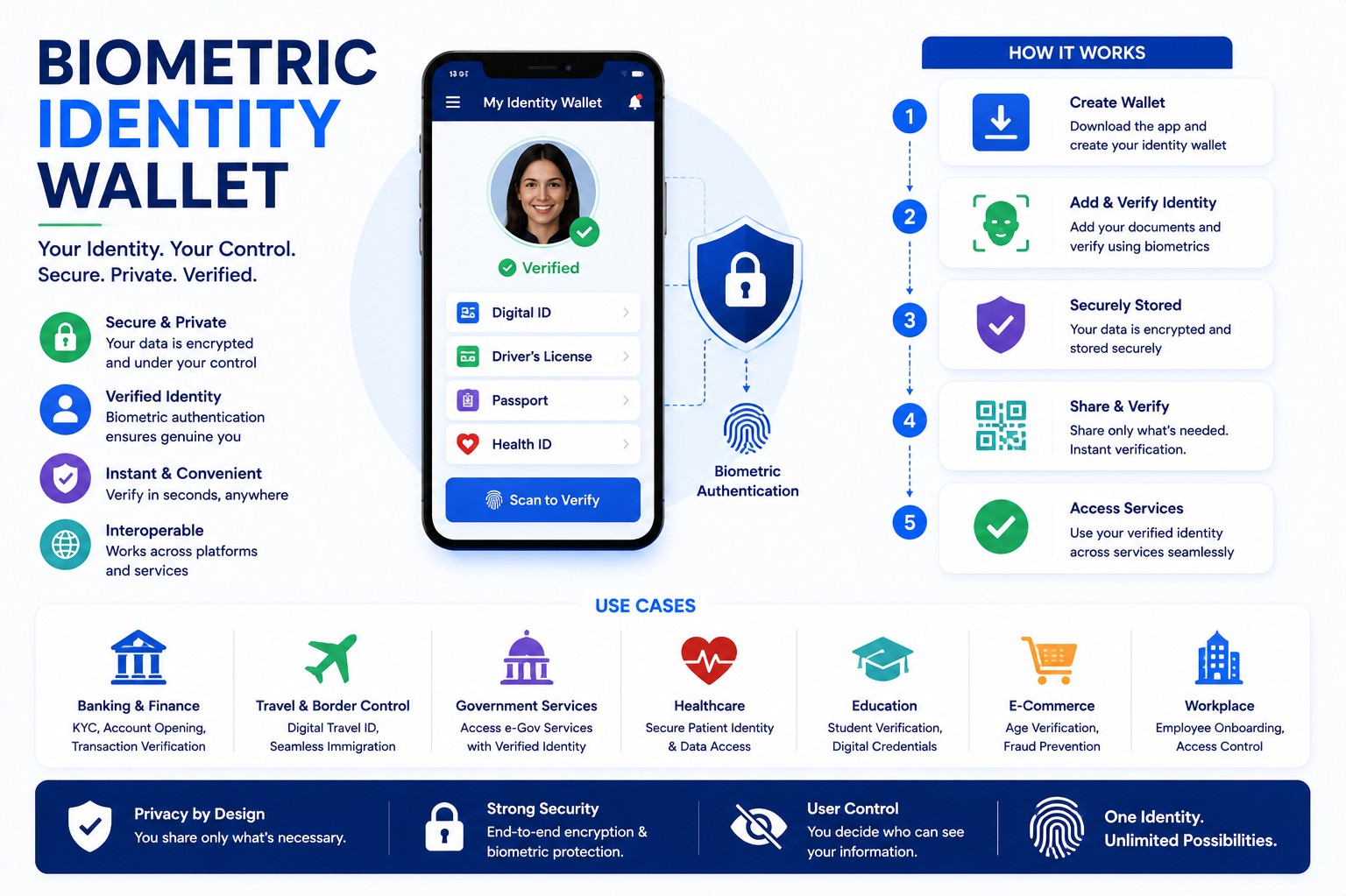
A Biometric Identity Wallet is a secure digital application that stores verified identity credentials and protects access using biometric authentication.
Rather than relying solely on usernames and passwords, the wallet verifies a user’s identity through unique biological characteristics such as fingerprints, facial features, iris patterns, or voice recognition.
The wallet can securely store digital documents including national identity cards, passports, driver’s licenses, employee credentials, educational certificates, insurance information, and financial identity records.
Users maintain control over when and how their verified information is shared.
How a Biometric Identity Wallet Works
The process begins when a user creates a digital identity wallet and completes identity verification through an approved organization such as a government agency, bank, employer, or trusted identity provider.
Verified credentials are securely stored within the wallet using advanced encryption technologies. Access to the wallet is protected through biometric authentication rather than traditional passwords alone.
Whenever identity verification is required, the user authenticates using a fingerprint, facial scan, or another supported biometric method. The wallet then securely shares only the necessary verified information with the requesting organization.
This approach minimizes unnecessary data sharing while improving both security and user privacy.
Why Biometric Identity Wallets Are Becoming Important
The growing number of digital services has increased the need for reliable identity verification.
Consumers expect secure access to banking, healthcare, government services, online shopping, travel, and education without repeatedly submitting physical documents.
At the same time, organizations must reduce identity fraud, simplify customer onboarding, and comply with increasingly strict regulatory requirements.
Biometric identity wallets address these challenges by enabling fast, secure, and privacy-focused identity verification across multiple digital environments.
Key Features of a Biometric Identity Wallet
Modern biometric identity wallets combine multiple technologies into a single platform.
They support biometric authentication, encrypted credential storage, digital document management, identity verification, secure credential sharing, multi-factor authentication, digital signatures, consent management, and interoperability with trusted organizations.
Many solutions also allow users to selectively disclose only the information required for a specific transaction, improving privacy while reducing unnecessary exposure of personal data.
Benefits for Individuals
Biometric identity wallets provide users with greater convenience and stronger protection against identity theft.
Instead of remembering multiple passwords or carrying numerous identification documents, individuals can securely access their verified credentials from a single application.
Biometric authentication offers faster access while reducing the risk of compromised passwords.
Users also gain more control over their personal information by deciding which credentials are shared and with whom.
This improves both security and user confidence.
Benefits for Businesses and Organizations
Organizations benefit from faster identity verification, reduced fraud, and more efficient customer onboarding.
Banks can simplify Know Your Customer (KYC) procedures, healthcare providers can securely verify patient identities, and employers can streamline employee verification.
Automated identity checks reduce manual document processing while improving operational efficiency.
Businesses also strengthen regulatory compliance by relying on verified digital credentials rather than unverified customer information.
Security and Privacy
Security is one of the strongest advantages of biometric identity wallets.
Biometric information is protected using advanced encryption and secure hardware components available on modern smartphones and devices. Many solutions store biometric templates locally rather than transmitting them across networks.
Identity credentials are encrypted, while secure authentication protocols protect access to sensitive information.
Users maintain ownership of their identity data, and consent-based sharing ensures that organizations receive only the information necessary for each transaction.
This privacy-focused approach reduces the risk of identity misuse and large-scale data breaches.
Biometric Identity Wallet vs Traditional Identity Verification
Traditional identity verification often depends on physical documents, passwords, and manual verification processes.
These methods can be slow, inconvenient, and vulnerable to fraud or human error.
A biometric identity wallet replaces many of these manual steps with secure digital verification using trusted credentials and biometric authentication.
The result is faster verification, improved security, and a better user experience across digital services.
Use Cases Across Industries
Biometric identity wallets are transforming identity management across many sectors.
Banks use them to verify customers during account opening and loan applications. Healthcare organizations authenticate patients before providing medical services, while governments issue digital identity documents and support access to public services.
Educational institutions verify student credentials, employers manage workforce identities, and travel companies simplify passenger verification.
E-commerce platforms also use biometric identity verification to reduce fraud and improve customer trust.
Artificial Intelligence and Biometric Identity
Artificial intelligence is making biometric identity wallets even more intelligent and secure.
AI-powered systems improve facial recognition accuracy, detect spoofing attempts, monitor unusual authentication behavior, and strengthen fraud prevention.
Machine learning continuously adapts to evolving security threats while improving authentication speed and reliability.
Together, AI and biometric technologies provide highly secure digital identity verification with minimal user effort.
Challenges and Considerations
Despite their advantages, biometric identity wallets require careful implementation.
Organizations must ensure compliance with privacy regulations, maintain secure biometric storage, provide transparent consent management, and protect users against unauthorized access.
Interoperability between different identity systems is also essential to ensure widespread adoption across industries and countries.
Building public trust through strong governance and privacy protections will remain critical for long-term success.
Future of Biometric Identity Wallets
The future of biometric identity wallets is closely linked to digital transformation.
Governments, financial institutions, and technology companies are investing in digital identity ecosystems that support secure authentication across banking, healthcare, travel, education, and public services.
Emerging technologies such as decentralized identity, blockchain, Open Banking, digital credentials, and artificial intelligence will further enhance wallet capabilities.
As more services become digital-first, biometric identity wallets are expected to become a standard method of identity verification worldwide.
Choosing the Right Biometric Identity Wallet Solution
Organizations selecting a biometric identity wallet platform should evaluate security standards, biometric authentication methods, regulatory compliance, encryption technologies, interoperability, user experience, scalability, API integration, consent management, and ongoing technical support.
A well-designed solution should protect user privacy while supporting seamless identity verification across multiple digital services.
Choosing a trusted provider helps organizations strengthen security, improve customer experiences, and prepare for the future of digital identity.
Conclusion
A Biometric Identity Wallet represents the next evolution of digital identity management by combining verified digital credentials with advanced biometric authentication. It enables individuals to securely access and share their identities while giving organizations a faster, more reliable way to verify users and reduce fraud.
As digital banking, online services, and government platforms continue to expand, biometric identity wallets will play a vital role in creating secure, privacy-focused, and user-controlled identity ecosystems. Businesses and institutions that adopt this technology today will be well positioned to deliver trusted digital experiences in an increasingly connected world.
Comments
No comments yet. Be the first to share your thoughts.
Leave a comment