
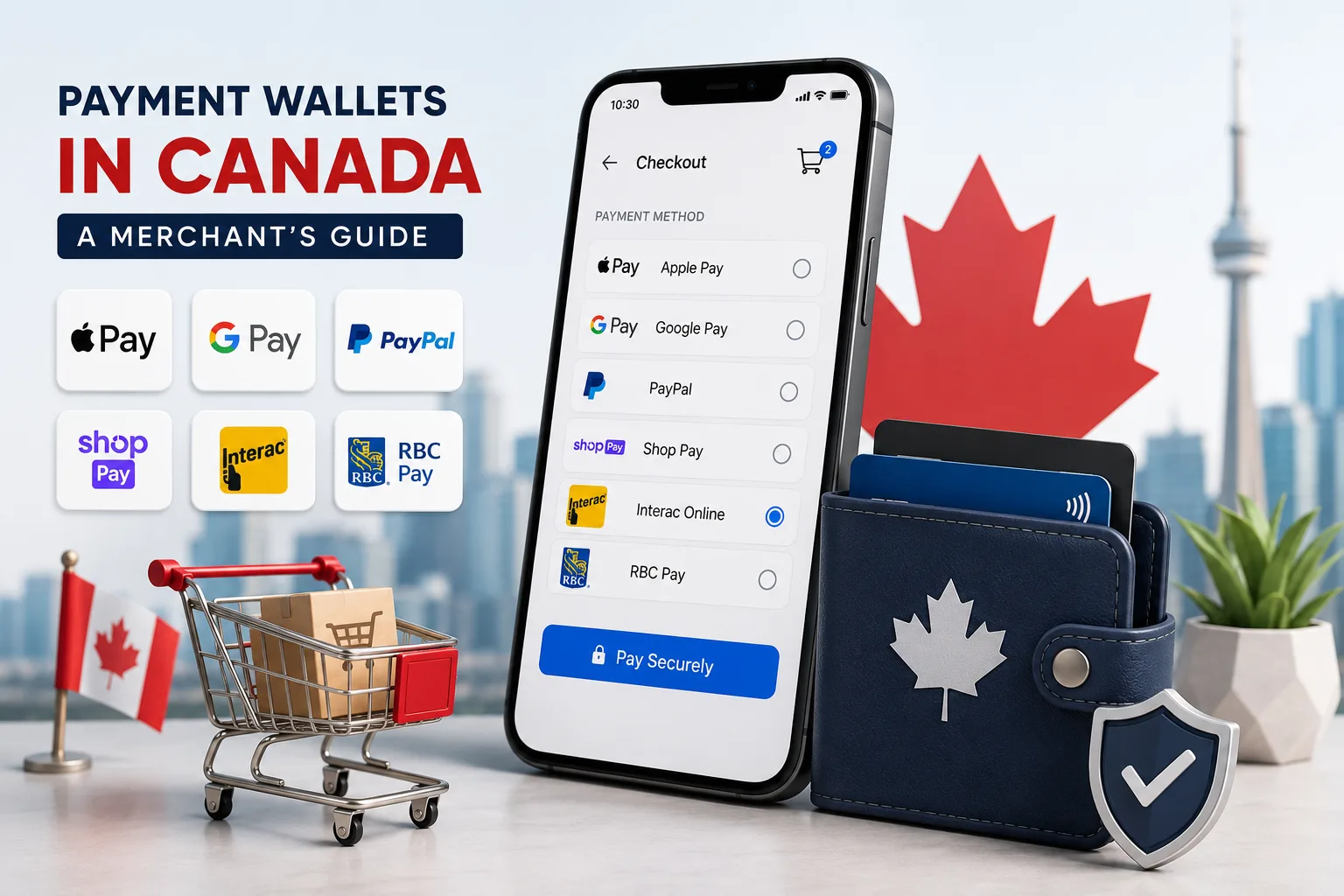
Canada’s payment landscape doesn’t map cleanly onto the US playbook. Interac, a homegrown network most international merchants have never had to think about, still sits at the center of how Canadians pay, while Apple Pay, Google Pay, and PayPal fill in around it. Getting the mix right matters more here than in most markets, because a checkout built purely on US assumptions will miss the payment wallets Canadians actually trust most.
TL;DR:
Interac remains the backbone of Canadian payments, with Interac Debit and e-Transfer together processing billions of transactions annually, and Interac Debit now available inside Apple Pay and Google Pay. Apple Pay leads mobile wallet adoption among Canadian digital wallet users, Google Pay follows, and PayPal remains essential for online purchases. Canada’s Real-Time Rail is targeting a Q3 2026 launch, which will reshape account-to-account payments over the next few years. For merchants, the priority is supporting Interac alongside the major global wallets, not choosing one over the other.
Canada’s Digital Wallet Landscape in 2026
Digital wallet usage in Canada has grown steadily but still trails the US and much of Asia-Pacific in relative terms, with roughly 29% of Canadians having completed a purchase using a digital or mobile wallet. Adoption skews heavily by age: 69% of Gen Z Canadians used mobile wallets by early 2024, and a majority said they now prefer leaving their physical wallet at home entirely for quick outings.
Among the wallets in active use, three dominate: Apple Pay leads with roughly 42% of Canadian digital wallet users, PayPal follows at around 23%, and Google Pay sits close behind at approximately 22%. Layered underneath all of them is Interac, not a wallet in the traditional sense, but the payment rail that increasingly powers wallet transactions themselves.
Interac: Canada’s Homegrown Payment Network
No conversation about payment wallets in Canada is complete without Interac. It’s not a single product but a national payment network, one that’s been core to Canadian merchant services for more than 40 years and now extends directly into mobile wallets.
What it covers:
- Interac Debit: processed roughly 6.5 billion transactions in a recent 12-month period, reflecting how central it remains to everyday Canadian spending
- Interac e-Transfer: surpassed 1.4 billion transactions in a recent 12-month period, dominant for peer-to-peer and small business payments
- Interac Debit In-App: now works directly through Apple Pay and Google Pay, letting Canadians set Interac Debit as their default payment method inside either wallet
Pros for merchants:
- Extremely high consumer trust and brand recognition, Interac is genuinely a household name in Canada
- Near-real-time settlement with no chargebacks on debit-based transactions
- Low fees relative to card-based payment processing
- Works inside Apple Pay and Google Pay, meaning merchants who already support those wallets can often accept Interac Debit without a separate integration
Cons for merchants:
- Interac Direct, the newer solution for online account-to-account payments, is still a comparatively young product replacing the discontinued Interac Online, merchant coverage varies
- Primarily a domestic Canadian tool, offering limited direct utility for cross-border payments
- Not a card network, so it doesn’t extend naturally into loyalty or credit-based purchase behavior the way card-linked wallets do
Apple Pay in Canada
Apple Pay has been available in Canada since 2015 and remains the most-used digital wallet in the country by a meaningful margin.
Pros:
- Highest Canadian digital wallet adoption among the major options
- Strong merchant acceptance, spanning independent retailers, major chains, and transit systems
- Biometric authentication (Face ID, Touch ID) reduces fraud risk compared to manually entered card details
- Now supports Interac Debit directly, combining global wallet convenience with local payment network trust
Cons:
- Limited to Apple hardware, excluding a meaningful share of Canadian Android users
- Still requires an underlying card or Interac Debit connection, it’s a payment wallet layer, not a standalone payment method
Google Pay in Canada
Google Pay trails Apple Pay in Canadian adoption but remains a significant option, particularly for merchants serving Android users.
Pros:
- Broad compatibility across NFC-enabled Android devices
- Also supports Interac Debit In-App, mirroring Apple Pay’s integration
- Strong security through tokenization, similar to Apple Pay’s approach
Cons:
- Meaningfully lower adoption than Apple Pay among Canadian digital wallet users specifically
- Online-only usefulness depends heavily on whether a given merchant’s payment gateway supports it explicitly at checkout
PayPal in Canada
PayPal remains one of the most-used online payment providers in Canada, particularly for ecommerce specifically rather than in-person retail.
Pros:
- High consumer trust for online payments, especially among shoppers wary of entering card details on unfamiliar merchant sites
- Genuinely useful for cross-border payments, supporting international transfers and multi-currency transactions more natively than Interac
- Widely integrated across ecommerce platforms, making implementation straightforward for most online merchant accounts
Cons:
- Higher processing fees compared to Interac-based payment processing
- Less relevant for in-person retail compared to Apple Pay, Google Pay, or Interac Debit
Comparing the Major Payment Wallets in Canada
| Wallet | Adoption Among Wallet Users | Best For | Key Limitation |
|---|---|---|---|
| Interac Debit / e-Transfer | Near-universal awareness | Domestic transactions, low fees | Limited cross-border utility |
| Apple Pay | ~42% | Mobile-first, iOS-heavy audiences | Apple hardware only |
| Google Pay | ~22% | Android-heavy audiences | Lower overall adoption |
| PayPal | ~23% | Online payments, cross-border payments | Higher fees than Interac |
For most Canadian merchants, the practical answer isn’t picking one, it’s ensuring your payment gateway supports Interac alongside the major global digital wallets, since each serves a genuinely different segment of the market.
Canada’s Real-Time Rail: What’s Changing in 2026
The biggest structural shift on the horizon for Canadian merchant payment infrastructure is the Real-Time Rail (RTR), a new account-to-account payment system operated by Payments Canada. After a series of delays, the project has moved from infrastructure-building into industry-wide operational readiness testing, with a targeted Q3 2026 launch.
Once live, the RTR is expected to enable instant, 24/7, data-rich transactions that streamline reconciliation for businesses, a meaningful upgrade for merchants currently relying on slower settlement rails. Open banking, though not yet available as of this writing, is also expected to build on this same real-time infrastructure, giving Canadian merchants a genuine account-to-account payment alternative to card-based online payments for the first time.
Cross-Border Payments: Serving US and International Customers from Canada
Canadian merchants selling into the US, or accepting payments from international customers, face a specific structural challenge: Canada’s ACSS and the US ACH systems are not natively interoperable, requiring International ACH Transactions (IAT) to bridge the two. The good news is that widespread adoption of the ISO 20022 data standard across both countries has streamlined this process considerably, enabling faster clearing times and richer remittance data than was available even a year or two ago.
For merchants specifically handling cross-border payments, PayPal remains one of the more straightforward options given its native multi-currency support, while merchants processing higher international volume should evaluate payment providers built specifically for Canada-US and broader cross-border settlement rather than relying on domestic-only infrastructure.
Why Canadian Travel Companies Need to Get Wallet Support Right
Travel and booking businesses operating in Canada face a sharper version of the cross-border payments challenge than most merchant categories, international customers, high-value bookings, and long gaps between payment and trip delivery that leave room for both currency risk and payment friction to build.
A few considerations specific to Canadian travel merchants:
- Domestic customers still expect Interac: A Canadian booking a domestic trip may specifically look for Interac Debit or e-Transfer as a payment option, and its absence can create hesitation even when card and PayPal options are available.
- International customers need familiar global wallets: Visitors booking travel into Canada, or Canadians booking international trips, are more likely to rely on PayPal, Apple Pay, or Google Pay — meaning a checkout tuned purely to Interac will underperform with this segment.
- High-value bookings amplify the cost of missing preferred payment methods: As with ecommerce broadly, the data is consistent that a meaningful share of shoppers abandon checkout when their preferred payment method isn’t available, and that risk compounds on large travel purchases.
- Cross-border supplier payments benefit from the improving ISO 20022 infrastructure: giving Canadian travel companies faster, more reliable ways to pay international hotels, airlines, and operators than in previous years.
High-Risk Merchants and Payment Wallets in Canada
Canadian merchants routed toward a high-risk payment gateway due to industry classification or chargeback history shouldn’t assume wallet support is unavailable to them. Wallet integrations generally sit at the payment gateway level, meaning a high-risk merchant account can often still support Interac, Apple Pay, and Google Pay, though dispute handling and reserve terms should be confirmed explicitly, since they can differ from standard merchant account terms.
Choosing the Right Wallet Mix for Your Business
- Domestic-only Canadian retailers: should prioritize Interac Debit and e-Transfer support above all else, given near-universal consumer trust
- Ecommerce merchants selling online: should ensure PayPal is available, given its strength specifically in online payments and cross-border transactions
- Mobile-heavy businesses: should support both Apple Pay and Google Pay, since splitting iOS and Android coverage leaves a meaningful adoption gap uncovered
- Travel and international merchants: should treat global wallet support as equally important to Interac, given the international customer mix typical of the category
Frequently Asked Questions
What is the most popular digital wallet in Canada?
Apple Pay leads Canadian digital wallet adoption at roughly 42% of wallet users, followed by PayPal at around 23% and Google Pay at approximately 22%.
Is Interac a digital wallet?
Not exactly, Interac is Canada’s national payment network, covering debit and e-Transfer services. It now integrates directly with Apple Pay and Google Pay, functioning as the underlying payment method inside those wallets for many Canadian consumers.
What is Canada’s Real-Time Rail, and when is it launching?
The Real-Time Rail (RTR) is a new instant account-to-account payment system operated by Payments Canada, targeting a Q3 2026 launch after completing operational readiness testing.
Do Canadian merchants need to support US payment methods separately?
Not directly, but merchants handling cross-border payments should confirm their payment provider supports efficient Canada-US settlement, since the two countries’ clearing systems aren’t natively interoperable despite recent ISO 20022-driven improvements.
Should small Canadian businesses prioritize Interac or global wallets like Apple Pay?
Both, where possible. Interac carries the strongest domestic trust, while Apple Pay, Google Pay, and PayPal matter more for mobile checkout and international customers, the strongest-converting Canadian checkouts tend to support all of them rather than choosing one.
Comments
No comments yet. Be the first to share your thoughts.
Leave a comment