
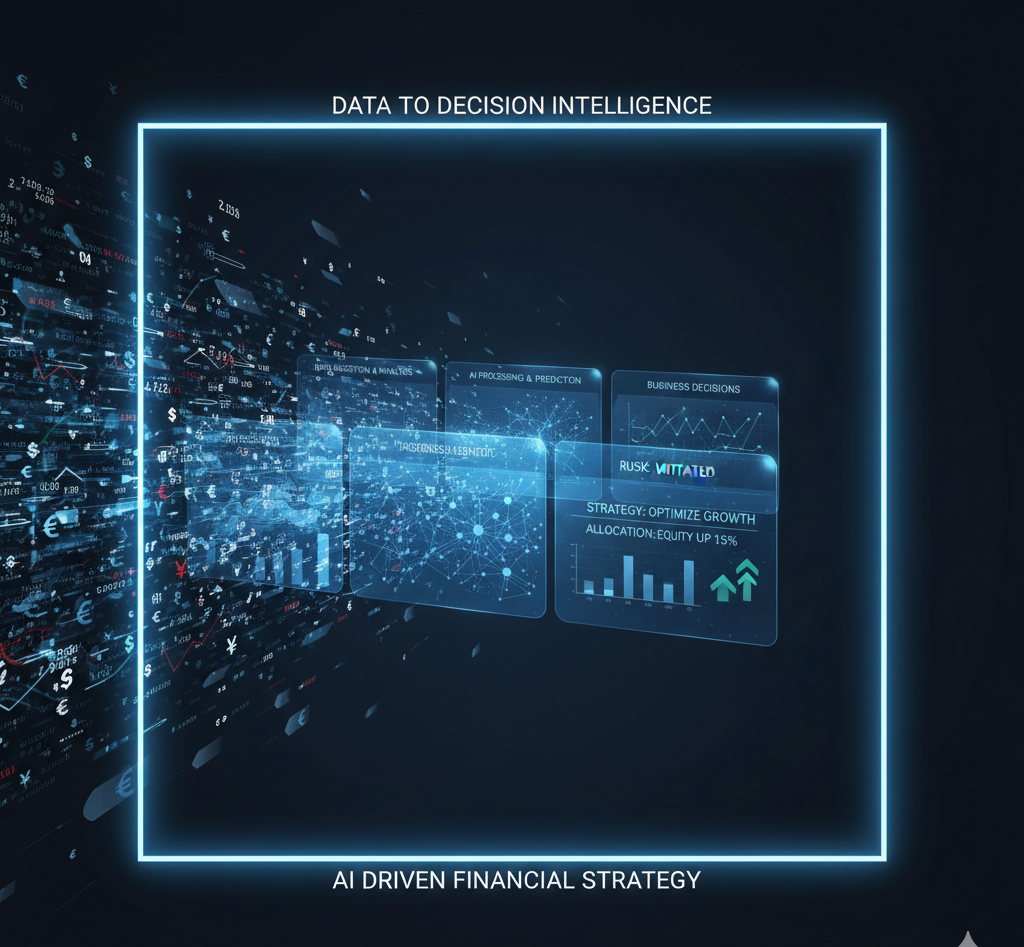
Financial institutions today are surrounded by data—transaction records, market movements, customer behavior, alternative data sources, and real-time signals from digital platforms. Yet data alone has little value unless it can be transformed into actionable insight.
This is where predictive finance comes into play.
Predictive finance uses advanced analytics, machine learning, and artificial intelligence to anticipate future financial outcomes and guide decision-making. Rather than reacting to events after they occur, institutions can forecast risk, demand, behavior, and market trends before they materialize.
As competition intensifies and margins tighten, predictive finance is becoming a strategic necessity rather than a technological advantage.
What Is Predictive Finance?
Predictive finance refers to the use of data-driven models to:
- Forecast future financial behavior
- Anticipate risks and opportunities
- Optimize decision-making in real time
- Improve accuracy and efficiency across financial operations
Unlike descriptive analytics, which explain what happened, predictive finance focuses on what is likely to happen next and how institutions should respond.
It combines:
- Historical and real-time data
- Statistical modeling
- Machine learning algorithms
- Business rules and governance frameworks
The result is faster, more informed financial decisions at scale.
Why Predictive Finance Is Gaining Momentum
Several forces are accelerating the adoption of predictive finance.
Explosion of Data
Digital payments, open banking, IoT devices, and online platforms generate vast volumes of financial and behavioral data.
Advances in AI and Analytics
Machine learning models are now capable of identifying complex patterns that traditional models cannot detect.
Need for Speed
Financial decisions increasingly need to be made in real time—whether approving credit, detecting fraud, or managing liquidity.
Competitive Pressure
Fin Techs and digital-native institutions are leveraging predictive insights to outperform traditional players.
Together, these factors are transforming finance from reactive to proactive.
Key Use Cases of Predictive Finance
Credit Risk and Lending
Predictive models assess borrower risk using both traditional and alternative data, enabling:
- Faster approvals
- More accurate pricing
- Reduced default rates
Fraud Detection
Predictive analytics identify unusual patterns before fraud occurs, allowing institutions to intervene proactively rather than reactively.
Customer Behavior and Retention
Banks and Fin Techs use predictive insights to anticipate churn, personalize offers, and improve customer lifetime value.
Treasury and Liquidity Management
Predictive models forecast cash flows, funding needs, and liquidity stress, enabling better capital planning.
Market Forecasting and Trading
Predictive analytics help institutions anticipate market movements, volatility, and asset performance.
These applications demonstrate how predictive finance moves insight closer to action.
From Insight to Decision: The Predictive Finance Workflow
Predictive finance follows a structured process:
- Data Collection – Aggregating internal and external data sources
- Data Cleansing and Normalization – Ensuring accuracy and consistency
- Model Development – Applying statistical or machine-learning techniques
- Prediction and Scoring – Forecasting outcomes or probabilities
- Decision Execution – Automating or supporting financial actions
- Continuous Learning – Updating models based on outcomes
- This closed-loop system allows financial institutions to adapt continuously.
The Role of Explainability and Trust
Predictive finance must balance accuracy with transparency.
Highly complex models may deliver strong predictions but lack explainability—creating challenges for:
- Regulatory compliance
- Internal governance
- Customer trust
Explainable AI is particularly critical in:
- Credit decisions
- Risk assessments
- Pricing and underwriting
Without transparency, predictive finance risks becoming a black box—undermining confidence in its outputs.
Risks and Limitations of Predictive Finance
Despite its benefits, predictive finance is not without risk.
Data Bias
If training data reflects historical inequality or flawed assumptions, predictions may reinforce bias.
Model Drift
Market conditions change. Models that are not continuously monitored can become inaccurate over time.
Over-Reliance on Automation
Blind trust in predictions without human oversight can lead to poor outcomes during unusual events.
Cybersecurity and Data Privacy
Predictive systems rely on sensitive data, making security and compliance essential.
Responsible predictive finance requires strong governance frameworks.
Regulatory Expectations Are Rising
Regulators increasingly expect financial institutions to:
- Validate predictive models
- Document assumptions and methodologies
- Monitor outcomes for fairness and accuracy
- Maintain human oversight
Predictive finance is no longer just a technology initiative—it is a compliance and risk management concern.
Predictive Finance as a Strategic Advantage
When implemented responsibly, predictive finance delivers measurable benefits:
- Improved risk management
- Better customer experiences
- Reduced losses and fraud
- Faster decision cycles
- Enhanced operational efficiency
Institutions that embed predictive capabilities into core decision-making gain a durable competitive edge.
The Future of Predictive Finance
The next phase of predictive finance will be defined by:
- Real-time, event-driven decisioning
- Greater integration with autonomous systems
- Stronger governance and ethical standards
- Increased collaboration between humans and machines
Predictive finance will not replace human judgment—but it will reshape how decisions are made.
Conclusion
Predictive finance represents a fundamental shift in how financial institutions operate. By transforming data into forward-looking insight, it enables faster, smarter, and more proactive decision-making.
However, prediction without governance creates risk. The institutions that succeed will be those that combine advanced analytics with transparency, oversight, and ethical responsibility.
In the future of finance, data will drive decisions—but trust will determine success.
aging advanced analytics and AI, organizations can anticipate risk, behavior, and opportunity—shifting finance from reactive to proactive decision-making.
Comments
No comments yet. Be the first to share your thoughts.
Leave a comment