
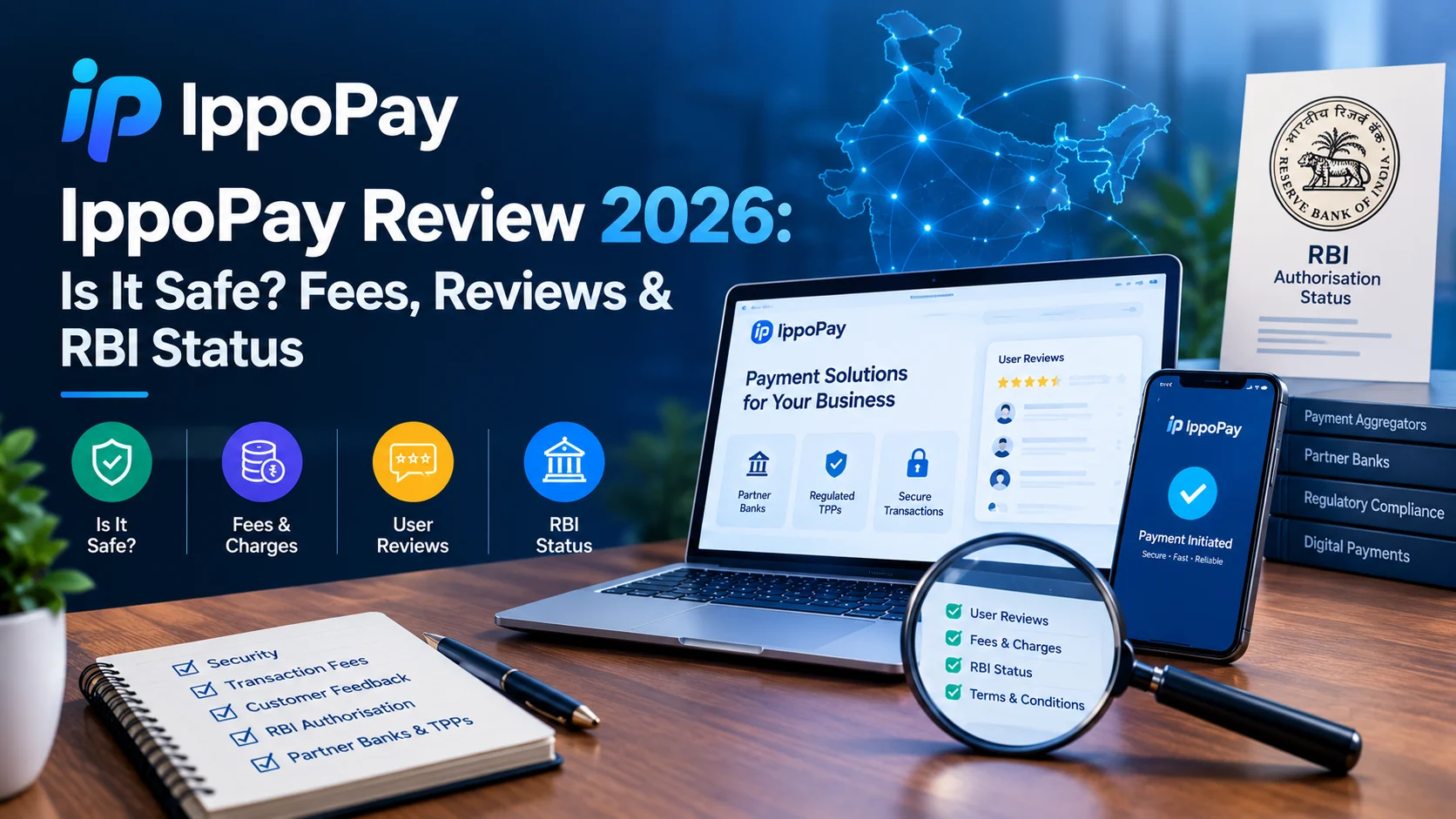
IppoPay is a Chennai-based fintech targeting small businesses, freelancers, and “homepreneurs” across India’s Tier 2 and Tier 3 towns, offering UPI, card, net banking, and wallet payment collection with instant settlement and a genuinely low barrier to entry for very small sellers.
The most important finding in this review isn’t about IppoPay’s product, it’s a specific, current regulatory fact that most reviews of this company won’t have surfaced, IppoPay’s application for RBI Payment Aggregator authorisation was returned by the Reserve Bank of India as of March 2026, and IppoPay’s own Terms of Service explicitly acknowledge it is not an RBI-authorised payment aggregator.
Quick Verdict
IppoPay is a real, operating Chennai fintech founded in 2020, with $2.36 million raised and coverage on Crunchbase and CB Insights. It is not currently an RBI-authorised Payment Aggregator, a published RBI document lists “Ippopay Technologies Private Limited” with an application status of “New PA-P, Application returned on 17.03.2026.” IppoPay’s own Terms & Conditions are explicit and precise about this, stating clearly that it is “a technology service provider and not a bank, payment system operator or authorised payment aggregator” and that all actual fund handling is performed by its “partner banks and/or regulated third party payment aggregators.” Independent reviews are mixed, feature reviews on software directories are largely positive (instant settlement, clean API, zero-fee positioning), but we also found at least one specific consumer complaint alleging funds of ₹5,500 were stuck with no resolution. Our overall assessment confidence is Moderate, driven by a clear, well-documented regulatory picture rather than an absence of evidence.
| Area | Finding |
|---|---|
| Company identity | Ippopay Technologies Private Limited, Chennai, founded 2020, $2.36M raised (Positive Signal) |
| Operating history | 6 years, active product with ongoing feature development |
| Regulatory position | RBI Payment Aggregator application status, returned (March 2026); own T&Cs disclaim PA authorisation (Material Concern for merchants relying on direct settlement) |
| User reviews | Mixed – positive feature reviews on software directories, at least one fund-delay complaint found |
| Pricing transparency | Marketed as free/zero transaction fee in places; exact commercial terms not independently confirmed |
| Overall evidence confidence | Moderate |
What Is IppoPay?
IppoPay is a payments aggregator technology platform aimed squarely at merchants underserved by larger players, freelancers, home-based sellers, women entrepreneurs, small IT service providers, and small retail in smaller Indian cities. Its product spans UPI, card, net banking, and wallet payment collection, digital invoicing, automated subscriptions, a social-commerce storefront tool, and an Android-based point-of-sale app that turns a phone into a checkout terminal.
The company markets same-day settlement, no setup cost beyond a per-transaction model (“pay only when the customer pays”), and multilingual support aimed at merchants outside India’s major metro markets, a genuinely underserved segment that larger aggregators often don’t prioritize.
The Regulatory Finding That Matters Most
Since 2020, India’s Reserve Bank has required non-bank entities that collect and settle payments on behalf of merchants, payment aggregators, to obtain a Certificate of Authorisation (CoA) before continuing to onboard new merchants. This isn’t a minor technicality, it’s the central compliance requirement for exactly the kind of business IppoPay describes itself as.
A published RBI document lists Ippopay Technologies Private Limited among entities with a “New PA-P” application whose status is “Application returned” as of 17 March 2026. “Returned” is a specific status distinct from either approval or outright rejection, it typically means the application was sent back for deficiencies rather than a final denial, but as of this record, IppoPay does not hold a live Certificate of Authorisation.
IppoPay’s own Terms & Conditions are unusually direct about this, and worth quoting for precision, the company states it “does not itself receive, hold, pool, settle or process customer funds and does not independently provide payment aggregation, payment gateway, escrow or any regulated payment system services,” and that it “does not represent, warrant or hold itself out as being licensed or authorised by the RBI to undertake payment aggregation or payment settlement activities in its own capacity.” All actual settlement, per the same document, is performed by “IppoPay’s partner banks and/or regulated third party payment aggregators.”
This is a legally coherent structure, a technology-only intermediary sitting in front of licensed partners is a legitimate model under Indian payments regulation, provided it’s accurate. But it means the protection a merchant might assume comes from “using a payment aggregator” doesn’t rest with IppoPay directly; it depends entirely on which specific bank or licensed PA is actually processing a given merchant’s funds, which IppoPay’s marketing materials don’t name. We treat this as a Material Concern for merchants relying on direct settlement guarantees, not because the structure is improper, but because it shifts the actual settlement risk to an unnamed third party that a merchant has no visibility into.
What Do Merchants Say About IppoPay?
Feature-level reviews on software comparison sites are generally positive. Reviewers on Techjockey describe switching to IppoPay specifically for instant settlement and zero transaction fees, praising the API for payment links and UPI integration, with complaints limited to a relatively basic user interface and a capped micro-loan offering.
Separately, we found a specific and serious complaint on a consumer complaints platform alleging ₹5,500 was “stuck” with IppoPay, naming a specific staff member and describing the company as fraudulent. This is a single complaint, not a pattern, and complaint-aggregator sites are a lower-reliability source than a platform like Trustpilot, but a specific fund-withholding allegation, combined with the unresolved RBI authorisation status above, is exactly the combination that warrants direct verification before a merchant commits meaningful volume.
Products, Pricing and Settlement
IppoPay’s marketing emphasizes “instant activation,” minimal documentation for onboarding, and a pay-only-when-paid pricing model with no stated setup or monthly cost. Same-day settlement is a headline feature across both the company’s own site and third-party review coverage.
We could not independently verify IppoPay’s current transaction fee schedule in detail, or confirm settlement timing performance at scale beyond what’s reflected in the mixed reviews above. Given the regulatory structure described, a merchant’s practical due-diligence question shouldn’t only be “what does IppoPay charge” but “which bank or licensed aggregator actually holds and settles my funds, and what happens to a pending settlement if that relationship changes.”
Complaints and Red Flags
- RBI Payment Aggregator authorisation application status, returned (March 2026), with IppoPay’s own terms explicitly disclaiming PA-authorised status (Material Concern, verify current status and named settlement partner directly)
- A specific consumer complaint alleging stuck funds (₹5,500) with no visible resolution (Caution, a single complaint, not a confirmed pattern, but consistent with the settlement-risk structure above)
- Marketing language (“instant settlement,” “free” processing) is not fully reconciled with the technology-intermediary structure disclosed in the company’s own legal terms (Caution)
Against this, IppoPay is a real, traceable, funded company with a coherent and legally disclosed operating structure, this is not a shell operation, and the regulatory gap is disclosed by the company itself rather than hidden.
Is IppoPay a Scam?
No, based on available evidence, but this is a case where “not a scam” and “fully risk-free” are clearly different conclusions. IppoPay is transparent in its own legal documentation about not holding a payment aggregator authorisation directly, which is the opposite of concealment. The specific fund complaint we found is serious but isolated, and doesn’t establish a pattern of intentional fund withholding.
Who Might IppoPay Be Suitable For?
Very small merchants, freelancers, and home-based sellers who need the lowest possible barrier to accepting UPI and digital payments, and who process modest volumes where any individual settlement delay is recoverable, are IppoPay’s clear intended market and likely reasonable fit.
Merchants processing meaningful volume, or who need contractual certainty about exactly which regulated entity is holding their funds at any given moment, should ask IppoPay directly to name its current settlement partner bank or licensed aggregator, and should independently check IppoPay’s current RBI authorisation status before scaling volume through the platform.
Alternatives to IppoPay
For merchants in the same small-business segment, the meaningful comparison point is exactly the one this review applied, does the provider hold a current RBI Certificate of Authorisation directly, or does it operate, like IppoPay, as a technology layer in front of a named or unnamed licensed partner. A directly authorised aggregator removes one layer of uncertainty that IppoPay’s current structure does not.
Final Verdict
IppoPay is a real, funded Chennai fintech serving an underserved small-merchant segment with a genuinely useful, low-friction product. The most important fact for any prospective merchant is not a hidden red flag but a disclosed one. IppoPay’s RBI Payment Aggregator application was returned as of March 2026, and the company’s own terms are explicit that it does not hold funds directly and is not itself RBI-authorised for payment aggregation.
Before onboarding meaningful volume, a merchant should ask IppoPay to name the specific bank or licensed payment aggregator that will actually hold and settle their funds, and should independently check IppoPay’s current RBI authorisation status, since this is a live regulatory process that can change. Our confidence in this assessment is Moderate, the regulatory picture is unusually well-documented for this series, which is itself informative.
Sources & Methodology
Based on public information reviewed September 2026, a published RBI document listing payment aggregator application statuses, IppoPay’s own Terms & Conditions, Techjockey software reviews, a consumer complaints platform, LinkedIn, and CB Insights. IppoPay’s current RBI authorisation status should be reconfirmed directly given this is an active regulatory process.
Comments
No comments yet. Be the first to share your thoughts.
Leave a comment