
Introduction
The investment industry has undergone a dramatic transformation over the last decade. Traditionally, investing required significant financial knowledge, access to professional advisors, and substantial amounts of capital. For many individuals, building a diversified investment portfolio seemed complicated, expensive, and time-consuming.Today, technology is changing that reality through automated investing. By combining advanced algorithms, artificial intelligence, and digital platforms, automated investing enables individuals and businesses to manage investments more efficiently and cost-effectively.
From robo-advisors and automated portfolio rebalancing to AI-powered investment recommendations, automated investing has become one of the fastest-growing segments of the financial services industry. As investors increasingly seek convenience, transparency, and data-driven decision-making, automated investing is reshaping how wealth is created and managed.
What Is Automated Investing?
Automated investing refers to the use of technology to manage investment portfolios with minimal human intervention.
Instead of relying solely on traditional financial advisors, investors use digital platforms that automatically allocate assets, monitor performance, rebalance portfolios, and manage investment strategies based on predefined goals and risk preferences.
These platforms use sophisticated algorithms to make investment decisions while maintaining diversification and risk management principles.
Automated investing can serve a wide range of objectives, including retirement planning, wealth accumulation, income generation, and long-term financial growth.
The Evolution of Investing
For decades, investment management was primarily accessible through banks, brokerage firms, and wealth advisors.
While these services remain important, technological innovation has introduced more accessible alternatives. Digital platforms now provide investment tools that were once available only to institutional investors and high-net-worth individuals.
The rise of fintech companies has accelerated this shift by creating user-friendly investment solutions that simplify portfolio management.
As technology continues to advance, automated investing is becoming an increasingly important component of modern financial planning.
How Automated Investing Works
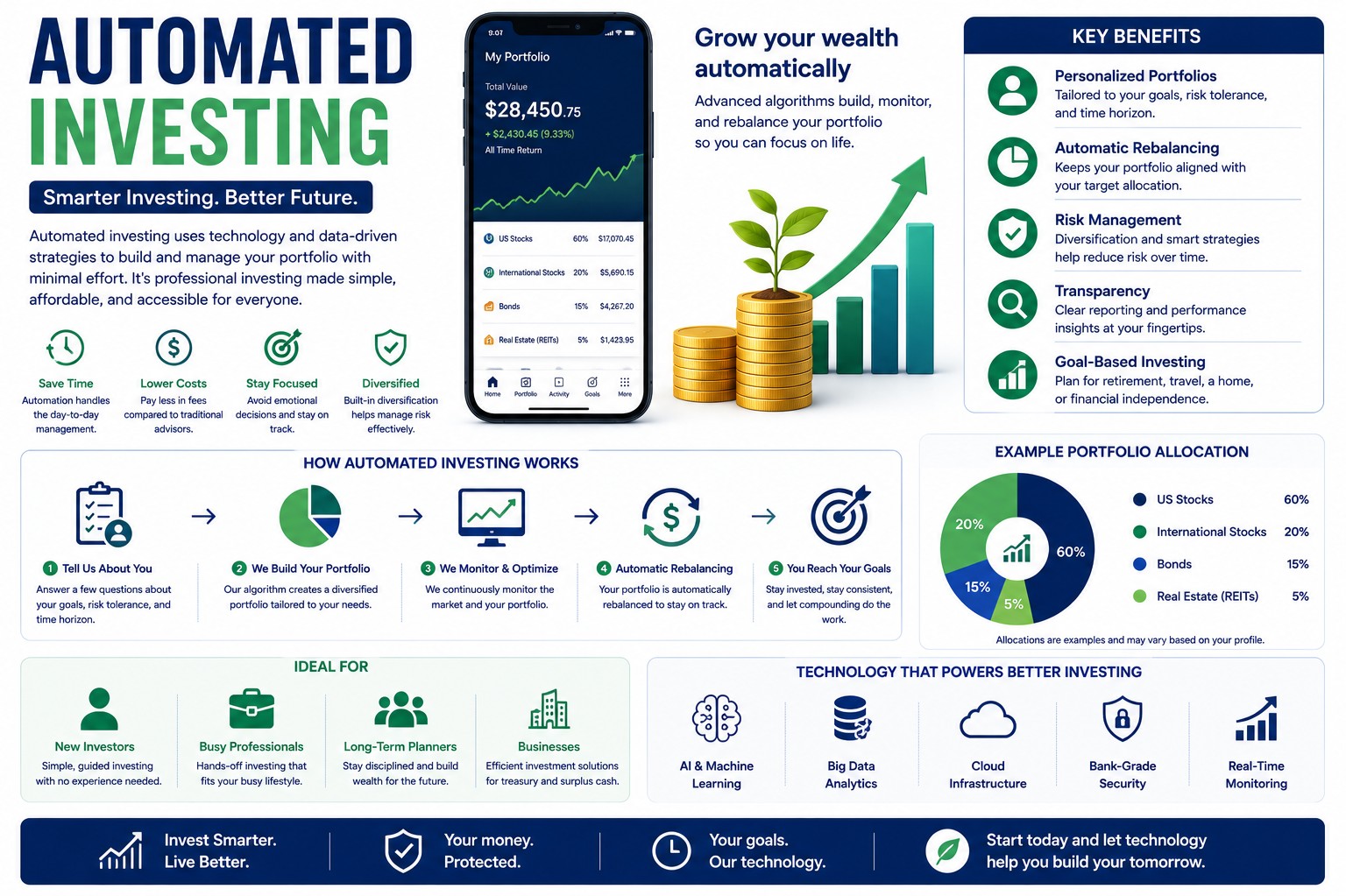
Automated investing platforms typically begin by gathering information about an investor’s financial goals, investment horizon, income level, and risk tolerance.
Based on this information, the platform recommends a portfolio designed to match the investor’s objectives.
Once the portfolio is established, the system continuously monitors market conditions and asset allocations. If the portfolio drifts from its target allocation, the platform automatically rebalances investments to maintain the desired risk profile.
This process reduces emotional decision-making and promotes disciplined investing over the long term.
The Role of Robo-Advisors
Robo-advisors are among the most popular forms of automated investing.
These digital investment platforms provide portfolio management services using algorithms rather than traditional human advisors. Investors can access diversified portfolios, automated rebalancing, and goal-based investing through intuitive digital interfaces.
Robo-advisors have gained popularity because they often offer lower fees than traditional wealth management services while maintaining professional investment strategies.
For many first-time investors, robo-advisors provide an accessible entry point into financial markets.
Benefits of Automated Investing
One of the biggest advantages of automated investing is accessibility.
Investors can begin building portfolios with relatively small amounts of capital while benefiting from sophisticated investment management tools.
Automated investing also reduces costs. Because technology handles many routine investment tasks, operational expenses are often lower than traditional advisory models.
Additional benefits include:
- Automatic portfolio rebalancing
- Consistent investment discipline
- Lower management fees
- Greater transparency
- Improved diversification
- Easy access through digital platforms
- Goal-based investment planning
These advantages have contributed significantly to the growth of automated investing worldwide.
Reducing Emotional Investment Decisions
One of the greatest challenges investors face is emotional decision-making.
Market volatility can trigger fear during downturns and overconfidence during periods of strong performance. These emotions often lead to poor investment choices.
Automated investing helps address this issue by following predefined strategies rather than reacting emotionally to market movements.
By maintaining disciplined portfolio management, automated platforms encourage long-term investing behavior and reduce the likelihood of impulsive decisions.
This consistency can contribute to improved investment outcomes over time.
Automated Investing and Artificial Intelligence
Artificial intelligence is playing an increasingly important role in automated investing.
AI-powered systems can analyze vast amounts of market data, identify trends, evaluate risks, and generate investment insights more quickly than traditional manual processes.
Machine learning algorithms continuously improve their analytical capabilities by learning from historical market behavior and new data inputs.
While human oversight remains important, AI is enhancing the efficiency and sophistication of automated investment platforms.
As technology advances, AI-driven investing is expected to become even more influential within wealth management.
Portfolio Diversification Through Automation
Diversification remains one of the most fundamental principles of successful investing.
Automated investing platforms typically build diversified portfolios across asset classes such as equities, bonds, exchange-traded funds, and alternative investments.
By spreading investments across multiple assets and sectors, diversification helps reduce risk while supporting long-term growth objectives.
Automated systems continuously monitor allocations and make adjustments when necessary, helping investors maintain balanced portfolios regardless of market fluctuations.
Automated Investing for Businesses
While automated investing is often associated with individual investors, businesses are increasingly adopting automated investment solutions as well.
Corporate treasury departments, startups, and small businesses use automated platforms to manage surplus cash, optimize liquidity, and support long-term financial goals.
Automated investing can help organizations improve capital efficiency while reducing administrative complexity.
As businesses seek more sophisticated financial management tools, automation is becoming an important component of corporate finance strategies.
Challenges and Considerations
Despite its many advantages, automated investing is not without limitations.
Algorithms rely on historical data and predefined models, which may not always predict future market behavior accurately.
Investors should also recognize that automated investing does not eliminate market risk. Portfolio values can still fluctuate based on economic conditions and market performance.
Some investors may prefer personalized advice from human financial professionals, particularly when dealing with complex financial situations.
A balanced approach that combines technology with professional guidance may offer the best solution for certain investors.
The Future of Automated Investing
The future of automated investing appears highly promising.
Advancements in artificial intelligence, predictive analytics, big data, and personalized financial services are expected to drive further innovation.
Future platforms may provide increasingly customized investment strategies based on real-time financial data, spending patterns, and life events.
Integration with open banking ecosystems could also create more comprehensive financial management experiences.
As technology continues to evolve, automated investing will likely become an even more integral part of global wealth management.
Automated Investing and Financial Inclusion
One of the most significant impacts of automated investing is its contribution to financial inclusion.
Historically, professional investment management was often inaccessible to individuals with limited financial resources. Automated platforms have lowered barriers to entry by reducing minimum investment requirements and simplifying investment processes.
This democratization of investing enables more people to participate in wealth-building opportunities and improve their long-term financial security.
As digital adoption increases worldwide, automated investing can play a major role in expanding access to financial markets.
Conclusion
Automated investing is transforming the investment landscape by making wealth management more accessible, efficient, and technology-driven. Through robo-advisors, artificial intelligence, automated rebalancing, and digital investment platforms, investors can benefit from professional portfolio management at lower costs and with greater convenience.
While no investment strategy is entirely risk-free, automated investing offers a disciplined and scalable approach to building long-term wealth. As fintech innovation continues to reshape financial services, automated investing is expected to become a cornerstone of modern wealth management for individuals and businesses alike.
Comments
No comments yet. Be the first to share your thoughts.
Leave a comment