
Introduction
Businesses today are looking for faster and more flexible ways to deliver financial services. Whether it’s a fintech launching prepaid cards, a company issuing employee expense cards, or a marketplace providing payout cards to sellers, traditional card issuance processes are often slow, expensive, and dependent on complex banking relationships. As digital transformation accelerates, organizations need solutions that allow them to create, manage, and distribute payment cards through software.Card Issuing APIs provide exactly that capability. They enable businesses to programmatically issue physical and virtual payment cards, manage cardholder accounts, define spending controls, monitor transactions, and automate financial operations using simple API integrations. Instead of building card infrastructure from scratch, companies can leverage APIs to launch secure card programs quickly while maintaining full control over the customer experience.
As Banking-as-a-Service (BaaS), embedded finance, and digital payments continue to grow, Card Issuing APIs have become a key technology for businesses seeking to innovate in financial services.
What Are Card Issuing APIs?
Card Issuing APIs are application programming interfaces that allow businesses to create, manage, and control payment cards through software.
These APIs connect applications with card issuing platforms and banking infrastructure, enabling developers to automate tasks such as card creation, activation, transaction monitoring, spending controls, PIN management, and card replacement.
Card Issuing APIs support both physical and virtual payment cards while providing businesses with complete programmatic control over the card lifecycle.
How Card Issuing APIs Work
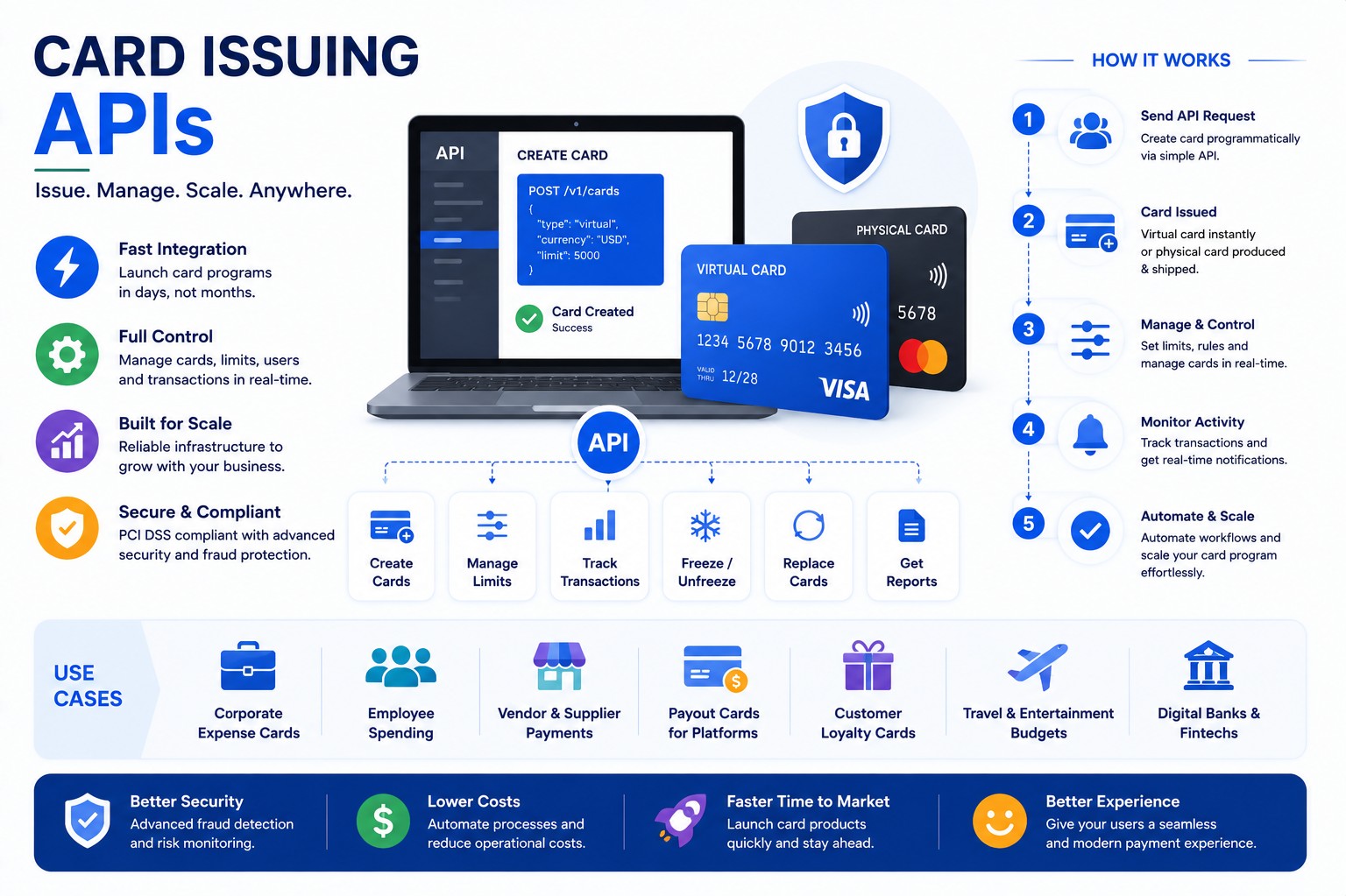
A business integrates the Card Issuing API into its application or platform.
When a new card is required, the application sends a secure API request containing customer information and card configuration preferences. The issuing platform validates the request, creates the card, assigns account details, and returns the necessary information through the API.
Virtual cards can often be generated instantly, while physical cards are personalized, manufactured, and shipped to customers.
Throughout the card’s lifecycle, businesses can use APIs to update settings, monitor activity, block cards, issue replacements, or retrieve transaction history in real time.
Why Businesses Use Card Issuing APIs
Modern businesses require greater flexibility than traditional card issuing models can provide.
Card Issuing APIs eliminate lengthy implementation processes by allowing companies to automate card management directly from their software systems.
Organizations can rapidly launch new financial products, personalize customer experiences, streamline expense management, and introduce innovative payment solutions without becoming a licensed card issuer themselves.
This flexibility accelerates product development while reducing operational complexity.
Types of Cards Supported
Card Issuing APIs support a wide variety of payment card programs.
Virtual cards are commonly used for online purchases, subscription management, supplier payments, and one-time transactions. Physical debit, prepaid, and corporate cards are used for employee expenses, customer rewards, travel spending, payroll, and everyday payments.
Some platforms also support tokenized cards for digital wallets and mobile payment applications.
This versatility allows businesses to create card programs tailored to their operational needs.
Key Features of Card Issuing APIs
Modern Card Issuing APIs offer comprehensive card management capabilities.
Businesses can instantly issue cards, activate or deactivate them, configure spending limits, restrict merchant categories, monitor transactions, manage cardholder information, retrieve real-time notifications, reset PINs, replace lost cards, and automate recurring administrative tasks.
Many providers also include webhooks, developer SDKs, sandbox environments, and detailed reporting tools to simplify implementation and ongoing management.
Security and Compliance
Security is fundamental to card issuing.
Card Issuing APIs use encryption, tokenization, secure authentication, PCI DSS compliance, and real-time fraud monitoring to protect sensitive cardholder information.
Many platforms also support EMV chip technology, 3D Secure authentication, Know Your Customer (KYC) verification, Anti-Money Laundering (AML) compliance, and transaction risk analysis.
These security measures help businesses protect both customer funds and payment data while complying with financial regulations.
Benefits for Businesses
Card Issuing APIs provide businesses with greater operational efficiency and product flexibility.
Companies can launch branded payment cards quickly, automate expense management, improve employee spending visibility, streamline supplier payments, and create customized financial experiences for customers.
Real-time transaction data also improves financial reporting and decision-making while reducing manual administrative work.
As businesses scale, API-driven automation supports efficient growth without requiring significant infrastructure investment.
Benefits for Customers
Customers benefit from faster access to payment cards and greater control over their spending.
Virtual cards can often be issued within seconds, allowing immediate use for online purchases or digital wallets. Mobile applications powered by Card Issuing APIs enable users to freeze cards, view transactions, receive instant spending notifications, adjust card settings, and manage security preferences.
These capabilities provide greater convenience while improving confidence in digital payment services.
Common Use Cases
Card Issuing APIs support a broad range of industries.
Fintech companies launch consumer payment cards, while corporations issue employee expense cards with customized spending rules. Gig economy platforms provide instant payout cards to workers, travel companies offer prepaid travel cards, and marketplaces create seller payout solutions.
Subscription businesses, digital banks, educational institutions, and healthcare organizations also use card issuing technology to streamline financial operations.
The flexibility of Card Issuing APIs makes them suitable for nearly every industry that manages payments.
Artificial Intelligence and Card Issuing
Artificial intelligence is improving card issuing platforms through intelligent fraud detection, spending analysis, and automated risk management.
AI systems monitor transaction behavior in real time to detect unusual spending patterns, identify suspicious activity, optimize authorization decisions, and personalize financial insights for cardholders.
Machine learning also helps businesses improve operational efficiency by automating compliance monitoring and reducing false fraud alerts.
These intelligent capabilities strengthen both security and customer experience.
Future of Card Issuing APIs
The future of card issuing is closely connected to embedded finance, Open Banking, digital identity, and real-time payments.
Businesses increasingly expect API-first platforms that enable instant card issuance, tokenized payment credentials, integrated digital wallets, and AI-driven financial management.
As financial services become more embedded into everyday applications, Card Issuing APIs will continue serving as the foundation for innovative payment products across industries.
Organizations adopting modern API-based card infrastructure today will be better prepared for tomorrow’s digital financial ecosystem.
Choosing the Right Card Issuing API Provider
Businesses evaluating Card Issuing API providers should consider global card network support, API documentation, security standards, virtual and physical card capabilities, tokenization support, compliance features, reporting tools, developer experience, scalability, pricing, and customer support.
A reliable provider should integrate seamlessly with existing systems while supporting future business growth and evolving customer needs.
Selecting the right partner enables businesses to launch secure, scalable, and customer-friendly card programs with confidence.
Conclusion
Card Issuing APIs are transforming the way businesses create and manage payment cards. By enabling software-driven card issuance, real-time management, and seamless integration with modern financial systems, they simplify payment operations while accelerating innovation.
Whether issuing virtual cards for online transactions, corporate cards for employee expenses, or branded payment cards for customers, Card Issuing APIs provide the flexibility, security, and scalability needed in today’s digital economy. As embedded finance and Banking-as-a-Service continue to expand, these APIs will remain a cornerstone of next-generation financial services.
Comments
No comments yet. Be the first to share your thoughts.
Leave a comment