
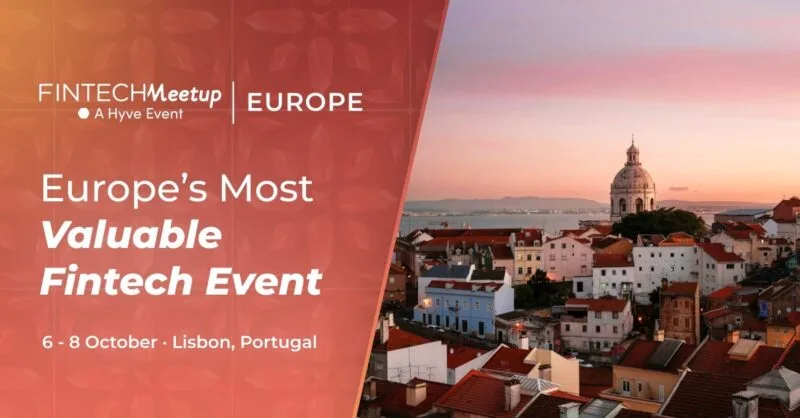
Fintech Meetup Europe 2026 will bring more than 2,500 fintech, banking, payments, and commerce professionals to Lisbon from October 6 to 8, 2026. This marks the new European edition of the Fintech Meetup platform, bringing its meetings-led format to the continent for the first time.
Organisers expect more than 650 hosted buyers from banks, financial institutions, retailers, and merchants, alongside fintech companies, investors, and technology providers. The Lisbon event aims to facilitate more than 25,000 pre-scheduled, double opt-in meetings across the three-day programme.
The agenda covers some of the financial industry’s biggest current issues, including artificial intelligence, payments fragmentation, banking expansion, regulation, fraud, operational resilience, European fintech growth, and the future of financial services.
Fintech Meetup Europe comes to Lisbon.
Fintech Meetup Europe takes place in Lisbon, Portugal, from October 6 to 8, 2026.
The European edition builds on the organiser’s existing meetings-focused model. Attendees can arrange one-to-one conversations through a technology-enabled, double opt-in system. Participants browse attendee profiles and request meetings before the event, according to the organiser. Once both sides accept, the meeting gets scheduled directly into the participant’s calendar.
The official programme includes dedicated tracks covering Banks and Challengers, Enterprise and Infrastructure, Commerce and Fintech, and Startup and Investors, alongside networking and VIP sessions throughout.
More than 2,500 attendees expected
Scale is one of the event’s main draws. The organiser expects 2,500-plus attendees, with 650-plus hosted buyers and around 70% of attendees at C-suite level or above. Lisbon’s event is designed to facilitate more than 25,000 meetings across the fintech, banking, payments, and investment ecosystem.
These meetings are not simple open networking sessions. Instead, the programme runs on a double opt-in process where participants select who they want to meet, and both sides confirm before a meeting gets scheduled. Attendees can access up to 24 meeting opportunities, depending on availability and mutual interest.
That structure puts the meeting programme at the centre of the event, rather than treating it as a side activity around the conference agenda.
AI and accountability take centre stage.
Artificial intelligence runs through the 2026 programme as a major theme. One opening session asks, “When AI Decides, Who Holds Accountability?” This discussion examines how AI is moving beyond back-office applications and into financial products and customer journeys.
Speakers include Aidos Zhumagulov, Chief Banking Officer at Freedom Bank; Jouk Peiter, CEO of Backbase; Ricardo Chaves, Chief AI Officer at Banco BPI; and Rui Lopes, CEO of Agentifai, with Theodora Lau of Unconventional Ventures moderating.
This session reflects a wider question facing financial institutions: how can banks introduce AI into decision-making while keeping accountability, trust, and appropriate controls intact?
A related session, “Replace or Reshape? Designing the Workforce of the Future” examines how AI and automation could change financial-services roles. Speakers include Cedric Zunino of Citi, Clare Gambardella of Zopa Bank, Dimitri Masin of Gradient Labs, Jeff Courtney of Reply, and Johnnie Martin of Augmentum.
European payments and market fragmentation
Payments will also get significant attention. A session titled “44 Countries, 50+ Payment Rails: Can Europe Solve its Fragmentation Problem?” tackles the challenges created by different payment systems, regulations, and market behaviours across Europe.
The panel includes Evaldas Ruzgys of the Bank of Lithuania, Joao Guerra of Nickel, Michele Mattei of BUNQ, and Roisin Levine of Wise. For fintech companies operating across multiple European markets, payment infrastructure and regulatory fragmentation remain important considerations day to day.
The event will also explore how banks can expand across borders while managing different licensing requirements, operating models, and customer behaviour.
Banking expansion and the next phase of European fintech
Cross-border growth is another major theme this year. The session “Building Scale Across Borders: The Multi-Market Toolbox” looks at how banks can expand across Europe without losing control or operational clarity.
Panellists include Bianca Zwart of Bunq, Gauthier Henroz of Chift, Mikael Modig of Saldo Bank, and Tristan Kirchner of ClearBank Europe. A separate session examines how fintech companies can navigate Europe’s licensing environment while expanding into additional markets.
The programme reflects an increasingly important reality for European fintech companies: a scalable product is only one part of international expansion. Licensing, regulation, local customer behaviour, and operational infrastructure can also shape how quickly a business enters a new market.
Major fintech and banking leaders on the speaker line-up
The official speaker list includes executives from some of Europe’s major banks, fintech companies, payment businesses, and financial institutions.
Among the announced speakers:
- Michael Carney, EU CEO, Monzo
- Richard Davies, CEO, Allica Bank
- Divya Bhardwaj, COO, Uber Payments
- Miguel Angel Alcala, Managing Director and Head of Europe, BBVA Spark
- Clare Gambardella, CCO, Zopa Bank
- Pol Navarro, Chief Digital Officer, Banco Sabadell
- Heidrun Luyt, Chief Growth Officer, Qonto
- Manuel Costescu, Managing Director, J.P. Morgan
- Bianca Zwart, Chief Strategy Officer, BUNQ
- Keith Grose, UK CEO, Coinbase
- Tom Easterby, Head of Fintech, HSBC UK Innovation Bank
- Yorick Naeff, CIO, ABN AMRO
The agenda also includes speakers from Revolut, N26, Trade Republic, Citi, Wise, Barclays, BNP Paribas, Banco BPI, and other financial-services and technology companies.
Revolut, N26, and Trade Republic discuss Southern Europe.
One main-stage session brings together executives from Revolut, N26, and Trade Republic to discuss expansion across Southern Europe. The panel features Anton Diez Tubet, GM Southern Europe at N26; Ignacio Zunzunegui, Head of Growth South Europe at Revolut; and Pablo Lopez, Regional Manager for Spain, Portugal and Greece at Trade Republic.
Their discussion focuses on customer acquisition, market expansion, and the challenge of turning initial growth into longer-term customer relationships. For European fintech companies, Southern Europe represents a diverse set of markets, each with different financial systems, customer behaviours, and competitive conditions.
Regulation and financial infrastructure remain key themes.
Regulation forms another major component of the agenda. Sessions explore Europe’s regulatory environment and ask whether its depth can become a strategic advantage for financial institutions, rather than just a compliance burden.
The programme also covers operational resilience, fraud, market structure, liquidity, and financial infrastructure. These topics sit alongside AI and innovation, reflecting the event’s dual focus on technological development and the operational requirements financial institutions actually face. For fintech companies, this combination of innovation and regulation matters particularly as businesses expand across multiple European jurisdictions.
A meeting-led event for fintech decision-makers
The defining feature of Fintech Meetup Europe is its structured meetings programme. Organisers say more than 25,000 confirmed in-person meetings will take place in Lisbon, spanning fintech, banking, payments, and investment.
Meetings run through the event’s double opt-in platform, letting participants identify potential contacts before they even arrive in Lisbon. The event’s previous US programme delivered more than 50,000 meetings, and its published figures for the European edition include a 92% meeting satisfaction rate and a 96% meeting completion rate. These figures come from the organiser directly.
This structure gives the Lisbon event a different emphasis from a traditional conference built mainly around stage sessions.
Why Fintech Meetup Europe matters to the European fintech ecosystem
Fintech Meetup Europe arrives at a time when European financial services face several overlapping changes at once. Banks are investing in AI and digital infrastructure. Fintechs are expanding across borders. Payment providers are adapting to new infrastructure and regulatory requirements. Meanwhile, investors and financial institutions are assessing which technologies can move from experimentation into commercial use.
The event’s agenda reflects those pressures directly. AI accountability, payment fragmentation, cross-border banking, regulatory complexity, fraud, workforce transformation, and fintech investment all appear within the programme. Combining conference sessions with structured meetings also puts commercial relationships right at the centre of the event.
Key event details
- Event: Fintech Meetup Europe 2026
- Dates: October 6 to 8, 2026
- Location: Lisbon, Portugal
- Expected attendees: 2,500+
- Hosted buyers: 650+
- C-suite and above: 70% of attendees, according to the organiser
- Pre-scheduled meetings: 25,000+
- Main sectors: Fintech, banking, payments, commerce, and investment
- Key themes: AI, regulation, payments, fraud, European scale, operational resilience, innovation, and market structure
What to expect from Fintech Meetup Europe 2026
Fintech Meetup Europe combines three days of conference programming with structured one-to-one meetings and networking. Attendees get access to senior executives, financial institutions, fintech companies, investors, retailers, and merchants all in one place.
The organiser’s published programme gives the event a strong focus on practical issues facing European financial services, from AI accountability and payment infrastructure to regulation and international expansion. With more than 2,500 attendees expected and over 25,000 pre-scheduled meetings planned, the Lisbon event is positioning itself as a major meeting point for Europe’s fintech and financial-services ecosystem this October.
The most relevant themes for the wider industry will likely centre on AI, payments, banking expansion, regulation, and European fintech growth. All of these areas are expected to feature prominently across the three-day programme.
Comments
No comments yet. Be the first to share your thoughts.
Leave a comment