
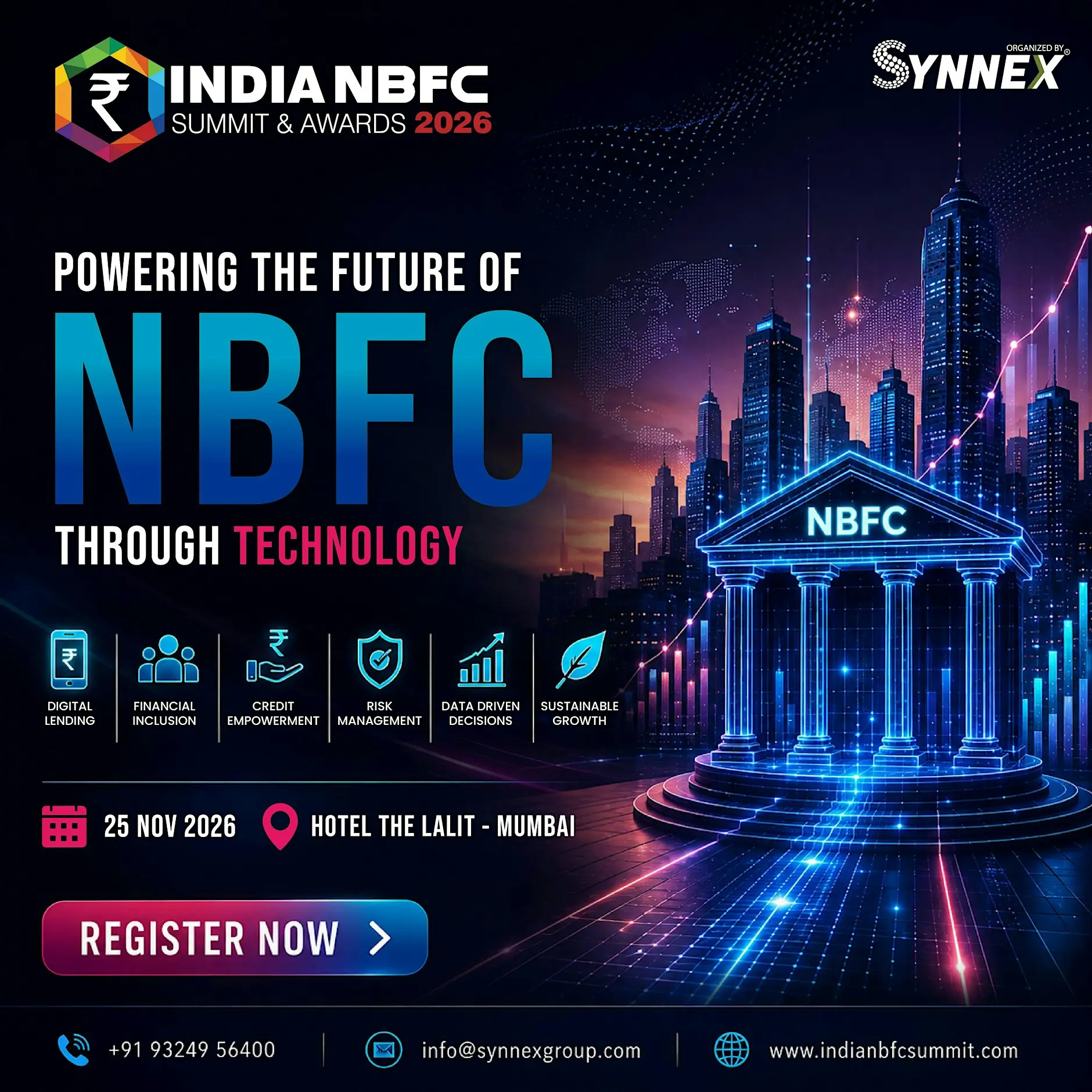
The Mumbai summit will bring together non-banking financial companies, fintech leaders and technology providers to discuss AI-driven lending, credit underwriting, digital transformation and the future of India’s credit ecosystem.
India’s non-banking financial companies (NBFCs) are preparing for another phase of technology-led change, with artificial intelligence, digital lending and data-driven credit decisions becoming increasingly important to the sector. Against this backdrop, the India NBFC Summit & Awards 2026 is scheduled to take place on 25 November 2026 at The LaLiT Mumbai.
Organised by Synnex Group, the event will bring together NBFC executives, fintech companies, lending specialists, technology providers and other financial-services stakeholders to discuss the changing economics and technology of lending in India.
The summit’s official theme is “Riding over Digital Lending.” Its programme includes sessions on inclusive lending, agentic AI, AI-based credit underwriting, growth strategies and digital transformation. The event will also host the India NBFC Awards 2026, recognising organisations and professionals for their contributions to innovation and business development in the sector.
The programme is relevant to an industry in which lenders are looking to expand credit access while improving operational efficiency, risk assessment and customer experience. For NBFCs, the challenge is not simply to digitise existing processes, but to develop lending models that combine speed and scale with responsible underwriting, effective controls and sustainable growth.
Event Details: India NBFC Summit & Awards 2026
- Date: 25 November 2026
- Venue: The LaLiT Mumbai, Mumbai, Maharashtra, India
- Organiser: Synnex Group
- Format: In-person industry summit and awards
- Main themes: Digital lending, agentic AI, credit underwriting, data-driven finance and digital transformation
- Official website: https://www.indianbfcsummit.com/
- Agenda: https://www.indianbfcsummit.com/agenda/
- Registration: https://www.indianbfcsummit.com/delegate-registration/
The organiser lists delegate registration at ₹10,000 plus 18% GST. Registration arrangements and availability should be confirmed directly with the organiser before making plans.
Why Digital Lending Is a Central Theme
Digital lending has changed how financial institutions acquire customers, collect application information, assess creditworthiness and manage loans. Online applications, automated workflows and data-driven decision systems can help lenders process applications more efficiently and reach customers through digital channels.
For NBFCs, these capabilities are particularly relevant when serving small businesses, individual borrowers and customers who may have limited access to conventional credit channels. Technology can help reduce manual processing and improve the consistency of decisions, although access to reliable data and appropriate risk controls remains essential.
The organiser describes India’s NBFC credit market as reaching ₹48 trillion in FY2025, with credit growth of 13.9% compound annual growth between FY2020 and FY2025. These figures are presented in the event’s own market overview and should be understood as organiser-provided industry context.
As lending expands, institutions must balance growth with portfolio quality, affordability, fraud prevention and compliance. Digital tools can improve the process, but they do not eliminate the need for sound credit policies or appropriate human oversight.
The summit’s focus on digital lending therefore places technology within a broader business question: how can NBFCs scale their services while maintaining effective risk management and responsible lending practices?
Agentic AI and the Next Generation of NBFCs
One of the programme’s most forward-looking sessions is “Agentic AI Revolution: Building the Next Generation Intelligent NBFCs,” scheduled for 12:10 PM to 1:00 PM.
Agentic AI refers to systems designed to carry out defined tasks through multiple steps, potentially using tools and business applications to complete workflows. In lending, such systems could support document processing, customer-service operations, internal research, loan-application preparation and certain back-office processes.
The potential benefit is a shift from AI systems that simply answer questions towards systems that help execute operational work. An agent might, for example, collect documents, check whether required information is present and prepare an application for review.
However, financial institutions must establish clear boundaries for these systems. Credit decisions, customer data, fraud detection and collections all involve material risks. Any AI-driven workflow requires suitable access controls, monitoring, testing, escalation procedures and accountability.
The summit’s agentic AI session is therefore particularly relevant to NBFC leaders assessing where automation could improve productivity and where decisions should remain subject to human review.
The event agenda does not, by itself, establish which specific technologies or vendors will be discussed in detail. Attendees should consult the organiser’s latest programme for any additional session descriptions or speaker updates.
AI, Data and the Future of Inclusive Lending
The first panel, “Digital Lending Revolution – AI, Data & the Future of Inclusive Lending,” is scheduled for 9:30 AM to 10:20 AM.
Inclusive lending involves expanding access to appropriate financial products for customers and businesses that may be underserved by traditional credit channels. Digital onboarding, alternative data and automated assessment tools can help lenders evaluate applications more efficiently, particularly where conventional credit information is limited.
Yet expanding access requires careful implementation. Data quality, consent, privacy, model bias and the ability to explain decisions are important considerations when lenders use automated systems to assess borrowers.
For NBFCs, the opportunity lies in using technology to improve how applicants are assessed and served without allowing automation to undermine fairness or credit quality.
The session’s focus on AI and data is therefore relevant to both lenders seeking new growth opportunities and technology providers developing the infrastructure behind digital credit.
Credit Underwriting and Risk Management
The summit’s third panel, “NBFC Credit Underwriting: the future of Underwriting with AI,” is scheduled for 2:25 PM to 3:15 PM.
Credit underwriting is the process of evaluating a borrower’s ability and willingness to repay a loan. It can involve analysing income, cash flow, existing obligations, credit history, business performance and other relevant information.
AI and data analytics can support parts of this process by identifying patterns, organising information and helping analysts evaluate applications. Automation can also reduce repetitive work and help lenders process applications at scale.
But more automation does not automatically produce better lending outcomes. Models can be affected by incomplete information, changing economic conditions or historical biases in the data used to train them. Lenders need appropriate validation, monitoring and governance to ensure that technology supports sound credit decisions.
For NBFCs, the central question is how to combine analytical capabilities with accountable decision-making. The session places this challenge on the agenda for discussion among industry stakeholders.
Growth Strategies and Digital Transformation
The fourth panel, “NBFCs for the Next Decade – Growth Strategies, Partnerships & Digital Transformation,” is scheduled for 3:45 PM to 4:35 PM.
Digital transformation in lending extends beyond deploying a new application or automating a single process. It can involve modernising core systems, connecting data sources, improving customer onboarding, integrating with fintech partners and strengthening operational reporting.
Partnerships can help NBFCs adopt capabilities that would be expensive or time-consuming to build internally. Fintech companies and technology vendors can provide specialised tools for loan origination, underwriting, fraud prevention, collections and customer engagement.
At the same time, lenders must assess vendor reliability, information security, integration complexity and the responsibilities associated with outsourced or partner-operated services.
As the market evolves, NBFCs will need to determine which capabilities differentiate their businesses and which can be supported by external infrastructure. The summit’s growth and transformation session is designed to address these wider strategic questions.
Industry Leaders and the NBFC Ecosystem
The organiser positions the summit for senior leaders across NBFCs, housing finance companies, microfinance institutions, digital lending platforms, fintech firms, credit bureaus and technology providers.
The official website lists speakers including Jiji Mammen, Executive Director and CEO of Sa-Dhan; Shachindra Nath, Founder and Managing Director of U GRO Capital; Parvez Mulla, Managing Director and CEO of Fedbank Financial Services; and Ashish Mehrotra, CEO and Managing Director of Northern Arc Capital.
Other listed speakers include Ritesh Jain of FlexiLoans, Dheeraj Mittal of Hiranandani Financial Services, Gaurav Tanna of Godrej Finance and Sandip Barmera of Godrej Housing Finance. Speaker participation and programme details should be reconfirmed against the latest official listing.
The event’s intended audience also includes technology leaders, risk and compliance professionals, data and AI executives, lending specialists and business heads. This mix reflects how lending transformation increasingly requires coordination across technology, risk, operations and customer-facing teams.
For fintech vendors, the gathering may also provide opportunities to connect with potential clients and partners. The organiser advertises sponsorship, speaking and promotional opportunities for participating companies.
India NBFC Awards 2026
The summit will conclude with the India NBFC Awards 2026, scheduled for 4:50 PM to 5:30 PM according to the published agenda.
The organiser describes the awards as recognising innovation, customer service, digital transformation and business growth across the NBFC sector. Listed categories include digital lending, SME finance, customer service, technology-driven innovation and leadership.
Awards can provide visibility for organisations developing new lending models, digital products and operational capabilities. However, prospective nominees should review the organiser’s award criteria and nomination terms directly before applying.
The awards form part of the event’s broader focus on recognising companies and individuals contributing to the development of India’s lending ecosystem.
What Attendees Can Expect
The programme combines panel discussions, corporate presentations, networking sessions and the awards ceremony. The organiser also promotes networking opportunities for senior executives and technology providers.
For NBFC leaders, the agenda offers a structured opportunity to discuss how AI, data and digital platforms may influence operating models and credit strategies. For fintech companies, it provides a forum to explore the needs of lenders and the potential role of specialised technology.
The most useful conversations are likely to focus on practical implementation: where automation can improve processing, how lenders can strengthen underwriting, how data should be governed and how institutions can expand responsibly.
The event should be approached as a forum for industry discussion rather than as evidence that any particular technology will deliver guaranteed improvements in lending performance.
Registration and Practical Information
The official event website lists The LaLiT Mumbai as the venue and 25 November 2026 as the event date. The published delegate registration fee is ₹10,000 plus 18% GST.
Eventbrite’s listing currently indicates that ticket sales have ended and advises interested participants to contact the organiser directly. It also warns that third-party tickets are not considered valid unless accompanied by an official invitation from Synnex Group.
Prospective attendees should therefore verify registration availability, ticket validity and the latest event arrangements through the official website or the organiser before purchasing a pass.
- Official event website: https://www.indianbfcsummit.com/
- Delegate registration: https://www.indianbfcsummit.com/delegate-registration/
- Agenda: https://www.indianbfcsummit.com/agenda/
- Organiser contact: [email protected]
- Phone/WhatsApp: +91 93249 56400
The Road Ahead for India’s NBFC Sector
India’s lending ecosystem is being shaped by the interaction of digital distribution, data analytics, automation and changing borrower expectations. NBFCs have opportunities to extend services to new customer segments and improve operating efficiency, but they must do so while managing credit risk, protecting customer information and maintaining appropriate governance.
The India NBFC Summit & Awards 2026 brings these issues together through its focus on digital lending, agentic AI, underwriting and business transformation.
For TheFinRate’s fintech audience, the event is worth watching because it connects emerging technology with the practical demands of lending businesses. Its relevance will ultimately depend on the quality of the discussions, the solutions presented and how participating institutions translate ideas into responsible implementation.
Comments
No comments yet. Be the first to share your thoughts.
Leave a comment