
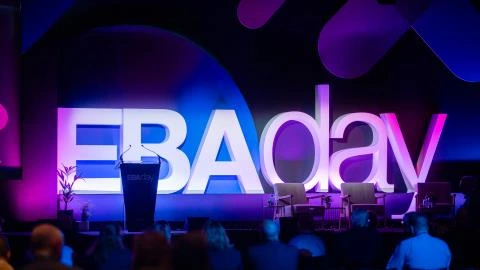
EBAday 2027 will take place on 15–16 June 2027 at the Roma Convention Center La Nuvola in Rome, bringing together senior executives, technology leaders, regulators, and fintech innovators from across the payments and transaction banking ecosystem.
Europe’s payments industry is entering a period of significant change. Instant payments are raising expectations for transaction speed, financial institutions are exploring artificial intelligence, and cross-border payment providers continue to face pressure to improve efficiency, transparency, and connectivity. At the same time, developments in digital money and European payments regulation are creating new strategic questions for banks and fintech companies.
Against this backdrop, EBAday will return for its 22nd edition in Rome, Italy, on 15–16 June 2027.
The annual summit, organized by Finextra Research and the Euro Banking Association, is designed to bring together senior practitioners, innovators, and industry leaders to discuss developments shaping payments and transaction banking. The 2027 event will be held at the Roma Convention Center La Nuvola.
EBAday 2027: Event Details
- Event: EBAday 2027
- Dates: 15–16 June 2027
- Venue: Roma Convention Center La Nuvola
- Location: Rome, Italy
- Organizers: Finextra Research and the Euro Banking Association
- Official website: https://www.ebaday.com/
The organizers position EBAday as a meeting point for banking and payments executives, technology specialists, regulators, fintech companies, and financial infrastructure providers. The event combines industry discussions, networking, and opportunities for emerging companies to present their solutions.
Building on the Discussions from EBAday 2026
The 2026 edition took place at the Bella Center in Copenhagen on 16–17 June. According to the organizers, the event brought together 1,442 senior professionals, speakers, and innovators.
Its discussions covered instant payments, cross-border payment systems, artificial intelligence, stablecoins, open banking, and European payments regulation. These subjects reflect the interconnected challenges facing the industry: delivering more responsive services while strengthening security, interoperability, and compliance.
The 2026 program also examined how AI could change the way money and payments are understood, alongside the practical challenge of preventing fraud as transactions become faster. Regulatory discussions considered how Europe's evolving payments framework could influence innovation, market access, and consumer protection.
These topics provide useful context for understanding the issues likely to remain relevant to the industry as it prepares for the 2027 summit. The organizers have not yet established a complete 2027 agenda on the event homepage, so individual speakers and sessions should be confirmed when the official program is published.
Why Instant Payments Remain a Strategic Priority
Instant payments have changed expectations about how quickly money should move between accounts. Customers increasingly expect transfers to happen within seconds, while businesses want quicker access to funds and more predictable cash-flow management.
However, faster settlement does not eliminate operational risk. Payment providers must still address fraud, account verification, transaction monitoring, service availability, and the recovery of funds sent in error.
For banks, the challenge is therefore not simply to process transactions more quickly. It is to build payment services that combine speed with appropriate controls, reliable infrastructure, and a clear customer experience.
Industry discussions around instant payments also raise questions about interoperability between payment systems, the responsibilities of participating institutions, and the availability of accurate payment information. These issues matter to banks, payment service providers, merchants, and businesses that rely on dependable domestic and international transfers.
AI Is Expanding the Payments Conversation
Artificial intelligence is becoming an important consideration for financial institutions seeking to improve operational efficiency, customer service, fraud detection, and payment experiences.
The emergence of agentic AI adds another dimension. Rather than only generating information or responding to questions, AI agents may be designed to carry out multi-step tasks within defined permissions. In financial services, that creates opportunities as well as governance challenges.
Potential applications include helping customers navigate financial services, supporting payment operations, and coordinating tasks across digital systems. But practical adoption requires strong controls around authorization, identity, data access, explainability, and accountability.
The key question for banks is how to introduce useful AI capabilities without weakening the security and oversight expected of financial infrastructure. For fintech providers, the challenge includes demonstrating that new solutions can integrate with existing banking environments and meet institutional requirements.
AI was one of the subjects featured at EBAday 2026. The 2027 program will need to be consulted for confirmation of the specific AI sessions and speakers planned for Rome.
Cross-Border Payments and Interoperability
Cross-border payments remain a central concern for companies operating internationally, financial institutions serving global customers and businesses managing suppliers in different markets.
International transfers can involve multiple intermediaries, different payment systems, varying compliance requirements, and differences in transaction information standards. These factors can affect cost, speed, transparency, and reconciliation.
Improving cross-border payments requires coordination across the payment chain. Banks and infrastructure providers need to consider how payment messages, settlement arrangements, compliance checks, and customer information work together across jurisdictions.
For fintech companies, this creates opportunities to develop payment connectivity, orchestration, compliance technology, and business payment services. For established banks, it places greater emphasis on modernizing infrastructure while maintaining resilience and regulatory oversight.
EBAday's focus on transaction banking makes these issues relevant to its audience. Discussions among financial institutions and technology providers can help identify common challenges, although actual implementation depends on commercial decisions, technical standards, and regulatory conditions.
Stablecoins and Digital Money
The development of stablecoins and other digital-money models has added new questions to the payments landscape. Financial institutions are assessing how different forms of digital value may fit into existing payment, settlement, and treasury processes.
The implications vary by model and jurisdiction. Questions include how an instrument is backed, how redemption works, which entity is responsible for issuing it, what regulatory requirements apply, and how it connects with conventional banking infrastructure.
For banks and payment companies, digital-money developments are not only a technology issue. They also involve governance, liquidity, compliance, operational risk, and customer trust.
EBAday 2026 included discussions on stablecoins and the wider digital-money landscape. These subjects are likely to remain relevant to industry debate, but the precise content of the 2027 program should be verified against the official agenda as it becomes available.
European Payments Regulation and Open Banking
Regulation is another major factor influencing the development of European payments. Financial institutions must evaluate how evolving requirements affect product design, access to payment services, customer protection, and relationships between banks and third-party providers.
Open banking and open finance also raise questions about data access, consent, interoperability, and the commercial models that support services built around financial information.
For established institutions, the challenge is to adapt processes and technology while maintaining compliance and operational stability. For fintech companies, regulatory change can create new opportunities but may also increase the cost and complexity of entering or expanding in a market.
The interaction between regulation and innovation is therefore an important subject for industry discussion. EBAday provides a forum where financial institutions, technology providers, and other stakeholders can exchange perspectives on these challenges.
EBAday 2027 Fintech Zone
EBAday's Fintech Zone gives early-stage companies with working products or proof-of-concept solutions an opportunity to showcase their technologies to industry participants.
The organizers have announced Salv as the winner of the 2026 Fintech Zone, sponsored by Itea P2B. The competition featured live pitches to judges and senior banking executives in Copenhagen.
For emerging fintech companies, such platforms can provide visibility among potential partners and customers. They also offer an opportunity to explain how a product addresses a specific financial-services problem, whether in payments, compliance, infrastructure, or operational technology.
Companies interested in participating in the 2027 edition should consult the official website for application requirements, deadlines, and updated program details.
Who Should Attend EBAday 2027?
The event may be relevant to several groups across the financial-services ecosystem:
- Banks and transaction banking teams assessing payment infrastructure, corporate payment services, and operational priorities.
- Payment service providers and fintech companies seeking partnerships, market insight, and opportunities to present new solutions.
- Technology and infrastructure providers working on payment processing, connectivity, fraud prevention, data and AI.
- Compliance and risk professionals following developments in payment security, regulatory requirements and digital money.
- Senior executives and strategy teams evaluating the direction of the payments industry and potential areas for collaboration.
The practical value of attending will depend on each organisation's objectives, the final agenda and the availability of relevant speakers and partners.
What to Know Before Registering
EBAday 2027 is scheduled for 15–16 June 2027 at the Roma Convention Center La Nuvola in Rome. The official event website provides registration information and details about the venue.
Prospective attendees should check the official site for ticket availability, pricing, programme announcements, speaker confirmations and any changes to event arrangements.
Official event website: https://www.ebaday.com/
Conclusion
EBAday 2027 will bring Europe's payments and transaction banking community to Rome at a time when financial institutions are reassessing how money moves, how payment systems connect and how new technologies can be deployed responsibly.
Instant payments, AI, cross-border connectivity, digital money and regulation were among the subjects discussed at the 2026 edition. They provide a useful framework for understanding the industry's current priorities, even as the detailed 2027 agenda remains to be confirmed.
For banks, fintech companies and infrastructure providers, the summit offers a setting to exchange perspectives and explore collaboration. Its wider significance will depend on the ideas, partnerships and practical initiatives that emerge from the discussions in Rome.
This article is based on information published by the event organisers. The 2027 agenda, speakers and individual sessions should be confirmed through official event updates.
Comments
No comments yet. Be the first to share your thoughts.
Leave a comment