
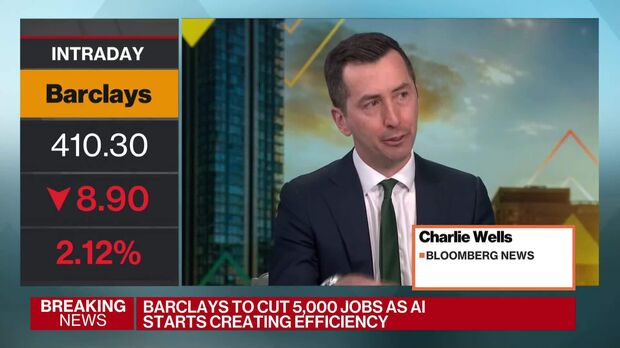
Barclays plans to reduce its workforce by around 5,000 employees by the end of 2026 as the British banking group expands technology-led efficiency measures and increases its use of artificial intelligence (AI). The planned reduction represents approximately 5% of its global workforce.
The bank has already closed around 1,000 positions, with another 4,000 reductions expected by year-end. Most cuts are linked to operational and support functions, particularly within its UK retail banking business. Its investment banking division will also be affected.
The announcement highlights a growing challenge for the financial services industry: banks are investing in AI and automation to simplify operations, but those efficiency gains may also reduce demand for some existing roles.
Barclays reported £2.3 billion in third-quarter profit before tax, up 12% from a year earlier, although the result fell slightly short of analyst expectations. At the same time, the bank expects its efficiency measures to generate a further £1.1 billion in savings during 2027. (Barclays' Q3 results)
However, Barclays has not attributed all 5,000 job reductions directly to AI. Chief Executive C.S. Venkatakrishnan described AI as the “icing on the cake” of a broader modernization program, emphasizing that technology infrastructure and process simplification are essential to achieving efficiency gains.
The distinction matters. The announcement reflects both an ongoing cost-reduction strategy and a growing role for AI in banking operations. It does not establish that AI alone is responsible for the planned workforce reduction.
Barclays' 5,000 job cuts: What the bank has announced
Barclays is approaching the end of a three-year cost-cutting program focused primarily on its UK retail banking business. The initiative also affects parts of its wider global operations, including investment banking and support functions.
According to reporting by the BBC and The Guardian, around 1,000 positions had already been eliminated, while a further 4,000 reductions were expected before the end of 2026. The overall reduction amounts to approximately 5% of the bank's global workforce. (BBC report, The Guardian report)
The distribution of the cuts provides an important clue about the bank's priorities.
Barclays has indicated that around 60% of the reductions will affect support functions, including developer roles. These functions can involve internal technology, administration, and operational processes that support the bank's customer-facing and commercial businesses.
Some UK back-office activities are carried out in India. As a result, reporting indicates that a significant proportion of the affected roles may be based there. However, the announcement does not provide a complete country-by-country breakdown.
The bank has linked the changes to technology investment, business simplification, and a broader effort to control costs. AI is becoming a more important part of that strategy, but it is not the only driver.
Why Barclays says AI is only part of the story
Barclays CEO C.S. Venkatakrishnan has stressed that the bank needs a modern technology foundation before it can realize the full benefits of AI.
His explanation challenges the idea that banks can simply introduce an AI tool and immediately remove large numbers of employees. In practice, financial institutions must first modernize systems, improve data access, and redesign processes before automation can deliver consistent results.
Older banking environments often rely on multiple systems, manual hand-offs, and separate workflows. These arrangements can make routine work slower and more expensive.
Modern technology can help reduce that complexity. AI can then support selected activities, such as handling information, assisting software development, and automating parts of administrative work.
Yet those capabilities depend on the surrounding infrastructure. Banks also need suitable controls, reliable data, monitoring, and clear accountability.
Barclays' strategy therefore reflects two connected changes: modernizing the systems that run the bank and using AI to improve the efficiency of certain tasks.
This distinction is important for assessing the employment impact. Some reductions may result from restructuring, consolidation, or earlier cost-saving decisions. Others may become possible as technology changes how work gets done.
The bank has not disclosed the exact number of positions attributable solely to AI.
Which banking jobs could face the greatest pressure?
The announcement points towards support functions and developer roles, rather than demonstrating that every banking occupation faces the same level of risk.
Administrative and operational work
Banks process large volumes of documents, customer requests, internal reports, and routine operational tasks. Some of these activities involve repetitive steps that software can standardize or automate.
AI tools may help employees retrieve information, prepare summaries, classify documents, or handle routine requests. Combined with workflow automation, these capabilities can reduce the time required for certain processes.
However, banking operations also involve exceptions, customer complaints, sensitive decisions, and regulatory obligations. Those activities may still require human review, particularly when a decision affects a customer or creates legal and financial risk.
Software development and technology support
The inclusion of developer roles is notable because AI coding assistants can help programmers write, review, test, and document code.
These tools may increase productivity in selected development tasks. Banks could then deliver some projects with smaller teams or redirect employees towards more complex work.
But faster code generation does not remove the need for software architecture, cybersecurity, testing, system integration, and operational accountability.
Financial institutions must also ensure that changes do not introduce vulnerabilities or disrupt critical services. AI-assisted development therefore changes the composition of technical work rather than automatically eliminating every engineering responsibility.
Back-office and shared services
Banks use shared-service teams to support activities across multiple divisions. These can include reconciliation, reporting, process management, and other internal functions.
Process standardization and automation can reduce duplicated work across such teams. As a result, employees may face pressure where tasks become easier to automate or where separate processes are consolidated.
The impact will depend on how individual banks redesign their operations. Barclays' announcement provides an indication of its direction, but it does not establish a uniform employment trend across every bank or role.
The financial context: £2.3 billion in quarterly profit
Barclays announced the workforce reduction alongside its third-quarter financial results.
The bank reported £2.3 billion in profit before tax for the three months ended September 30, 2026, representing a 12% increase from £2.1 billion in the same period a year earlier. Group income reached approximately £7.4 billion, up 3% year-on-year. (Barclays Q3 results)
The bank's performance was mixed across its businesses. Equities trading performed strongly, while fixed-income trading faced a more difficult environment. The overall profit result also came in slightly below analyst expectations, according to reporting by Sky News. (Sky News)
Alongside the results, Barclays announced a further £500 million share buyback. Its year-to-date shareholder distributions reached £2.8 billion, according to its results announcement.
These figures provide context for the debate about technology investment and employment. Barclays is pursuing cost reductions while continuing to invest in its business and return capital to shareholders.
The bank expects further savings from its efficiency program, including approximately £1.1 billion in 2027. However, this figure relates to its broader efficiency measures and should not be interpreted as savings generated by AI alone.
The central business question is whether technology investment can help the bank operate more efficiently while maintaining service quality, resilience, and sustainable growth.
Barclays' workforce changes reflect a wider banking trend.
Barclays is not the only bank reassessing its workforce as AI capabilities expand.
HSBC and Standard Chartered have also discussed workforce changes linked to technology and efficiency. Standard Chartered, for example, has announced plans to reduce more than 7,000 jobs over several years as it restructures its operations and increases its use of AI, according to The Guardian. (The Guardian)
These developments suggest that banks are moving beyond AI experimentation towards changes in how some functions are organized.
For years, financial institutions have invested in digital banking, cloud infrastructure, data platforms, and automation. Those investments can create the foundation for more advanced AI applications.
Now, some banks are looking at whether the combination of modern systems and AI tools allows them to reduce manual work, consolidate processes, and deliver services with fewer resources.
Nevertheless, the industry remains highly regulated. Banks must manage fraud, financial crime, customer data, cybersecurity, operational resilience, and regulatory compliance. They cannot judge an AI deployment solely by the number of hours saved or roles removed.
The longer-term test will be whether technology delivers measurable improvements without creating unacceptable risks or degrading customer service.
The employment debate: Efficiency versus reskilling
Barclays' announcement has also drawn criticism from trade unions.
Sharon Graham, general secretary of Unite, argued that the bank was using AI as an excuse to discard employees rather than focusing on upgrading their skills. Her comments reflect a wider concern about how employers distribute the benefits and costs of technological change. (The Guardian)
For employees, the uncertainty is not limited to whether a particular job will disappear. It also concerns how quickly roles may change and whether workers will receive the training needed to move into new responsibilities.
Banks could respond to technological change through several routes. They may reduce headcount in selected functions, retrain employees for different roles, redesign workflows or create new positions in AI governance, data management and technology risk.
These approaches are not mutually exclusive. A bank can reduce some roles while recruiting or retraining for others.
However, reskilling requires time, investment and realistic pathways into new positions. Training alone may not protect every job if the underlying demand for a particular task falls sharply.
Barclays has said it is committed to helping colleagues develop skills and build rewarding careers as the business changes. The practical outcome will depend on how that commitment translates into training, redeployment and support for affected employees.
What this means for banking technology and AI strategy
For banking executives, the announcement highlights the importance of measuring AI through operational results rather than adoption figures alone.
A bank may introduce AI assistants or automation tools across thousands of employees. Yet the financial benefit depends on whether those tools improve productivity, reduce processing times, lower error rates or allow staff to focus on higher-value work.
The technology also introduces risks. AI-generated outputs can be inaccurate, systems can expose sensitive information if poorly controlled, and automated processes can create new operational dependencies.
Banks must therefore evaluate both efficiency and control. They need to determine where AI can safely support work, which decisions require human approval and how to monitor the results.
For technology teams, the growing use of AI could change the balance between routine implementation work and higher-level engineering. For operations teams, it may shift attention from manual processing towards exception handling, oversight and service improvement.
For customers, the intended benefit should be better service, more reliable operations or improved access to financial products. Lower costs alone do not guarantee those outcomes.
What to watch next
Three developments will help show how Barclays' strategy evolves.
First, workforce execution. The bank's progress towards the planned 5,000-role reduction will reveal how the changes are distributed across functions and markets.
Second, measurable savings. Barclays expects further efficiency savings in 2027. Investors and employees will need to distinguish savings linked to technology and AI from those arising through wider restructuring or other cost controls.
Third, service quality and risk. The bank will need to show that its modernisation strategy supports operational resilience, customer service and appropriate oversight as it deploys AI more widely.
These measures will offer a clearer picture than headline job-cut numbers alone. They can help establish whether AI is changing the economics of banking operations, and how those changes affect employees and customers.
TheFinRate takeaway
Barclays' planned reduction of around 5,000 jobs illustrates the growing connection between AI adoption, technology modernisation and workforce restructuring in banking.
Yet the announcement should not be read as evidence that AI alone is replacing 5,000 employees. Barclays has described the cuts as part of a broader efficiency programme, with AI expected to play an increasingly important role.
The bank's £2.3 billion quarterly profit and its plans for further savings underline the commercial pressure to improve efficiency. At the same time, the inclusion of developer and support roles shows that technology-led restructuring can reach beyond traditional administrative work.
For the banking industry, the challenge is no longer simply whether to adopt AI. It is how to redesign operations responsibly, capture productivity gains and support employees through the transition.
The next phase will be judged not only by lower costs, but also by the quality, resilience and accountability of the banking services that remain.
Sources
- Barclays, Q3 2026 results: https://home.barclays/investor-relations/results-and-reports/
- BBC News, “Barclays cutting 5,000 jobs as it increases reliance on AI”: https://www.bbc.com/news
- The Guardian, “Barclays to cut 5,000 jobs as bank’s bosses hail AI productivity advances”: https://www.theguardian.com/business/2026/oct/22/barclays-profits-up-as-uk-banks-brace-for-tax-increase-in-budget
- Sky News, “Barclays cutting 5,000 jobs in AI-led efficiency drive”: https://news.sky.com/story/barclays-cutting-5000-jobs-in-ai-led-efficiency-drive-13602151
Comments
No comments yet. Be the first to share your thoughts.
Leave a comment