
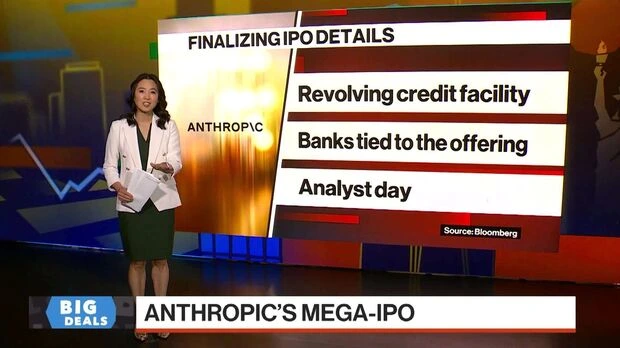
Anthropic could publicly disclose its IPO prospectus as early as October 23, according to reports. With quarterly revenue reaching $16.8 billion and enormous computing commitments ahead, the Claude developer faces a defining test of public-market confidence in AI.
Anthropic is moving closer to a potential stock market debut that could reshape the market for artificial intelligence investments. The company is reportedly preparing to make its S-1 registration statement public as early as Friday, October 23, according to people familiar with its plans cited by Yahoo Finance.
The move would advance the listing process for the company behind Claude, Claude Code and Claude Cowork. It would also give public-market investors a closer look at a business growing rapidly while committing extraordinary resources to computing infrastructure.
The potential offering arrives at a crucial moment for the AI industry. Investors still see enormous commercial opportunities in advanced AI, but they are increasingly questioning the costs required to build, train and operate increasingly capable models.
Anthropic's financial trajectory illustrates that tension. The company reportedly generated $16.3 billion in revenue during the first half of 2026. Its third-quarter revenue then rose to $16.8 billion, according to information shared with prospective investors.
Yet the company also reported a first-half net loss of approximately $80.7 billion, much of which stemmed from accounting adjustments linked to financing instruments. Separately, its commitments to cloud computing and infrastructure point to substantial spending obligations over the coming years.
The central question for investors is whether Anthropic can turn exceptional demand for its AI products into durable profits while managing the cost of the computing capacity that supports them.
Anthropic's IPO filing could open the next stage
Anthropic confidentially submitted a draft registration statement to the US Securities and Exchange Commission on June 1, 2026. The company confirmed the submission in an official announcement.
A confidential submission allows the SEC to review a proposed offering before the company publishes its registration materials. Anthropic said at the time that a future IPO would depend on market conditions and other factors.
The reported public filing expected later this week would represent another important step. Under the confidential filing process, registration materials generally must become public at least 15 calendar days before the formal investor roadshow begins.
However, a public S-1 does not mean a company has completed its IPO. The SEC review, offering terms, investor demand and market conditions can all affect the eventual timetable.
Reports have pointed to a potential November listing, although the schedule remains subject to change. Anthropic has not confirmed the timing described in the latest report.
The prospectus will be important because it can provide investors with a clearer view of revenue, operating expenses, financing arrangements, infrastructure commitments and business risks.
For a company operating at Anthropic's scale, those disclosures matter as much as the headline valuation. Investors will need to understand both the opportunity created by demand for AI and the resources required to serve it.
Source: Anthropic's official announcement of its confidential S-1 submission.
Revenue reaches $16.8 billion as growth attracts attention
Anthropic's reported revenue figures highlight how quickly its business has expanded.
According to Reuters, the company told prospective investors that third-quarter revenue reached $16.8 billion, up approximately 45% from $11.6 billion in the second quarter. First-quarter revenue was reported at $4.7 billion.
The figures indicate strong demand for Anthropic's AI products, particularly among enterprise customers.
Its Claude models compete in a market where businesses increasingly use AI for software development, research, document processing, customer service and other knowledge-intensive work. Claude Code has also helped establish the company in AI-assisted software development.
For enterprise customers, AI tools can offer productivity benefits across multiple departments. For Anthropic, wider adoption can create recurring revenue from subscriptions, enterprise contracts and usage-based services.
The company also told prospective investors that it achieved adjusted profitability in the third quarter. That is an encouraging signal, but investors will want to examine the definition of adjusted profitability and compare it with operating income, net income and cash flow.
Adjusted results can exclude items that materially affect reported earnings. They should therefore be assessed alongside the complete financial statements rather than treated as proof that every part of the business is profitable.
Revenue growth is also slowing on a sequential basis. The reported increase of 45% between the second and third quarters is substantial, but it is below the more-than-doubling growth recorded between the first and second quarters.
That distinction could matter when investors decide how much to pay for future growth.
Sources: Reuters on Anthropic's third-quarter revenue and Financial Times reporting on the company's investor briefing.
Why an $80.7 billion loss needs careful interpretation
Anthropic's reported first-half net loss is likely to attract considerable attention. At first glance, a loss of $80.7 billion against revenue of $16.3 billion appears to raise serious questions about the business model.
However, the accounting details are essential.
Reuters reported that the first-half loss was largely driven by a $72 billion accounting charge linked to changes in the value of convertible notes and other financing instruments. These instruments can convert into company equity under specified conditions.
When the estimated value of such instruments changes, accounting rules can require a company to recognise a large gain or loss. That can substantially affect reported net income without representing an equivalent cash outflow from day-to-day operations.
This does not make the loss irrelevant. Investors still need to understand the terms of the financing instruments and the potential effects on future equity ownership and financial statements.
However, the distinction prevents a misleading conclusion: an $80.7 billion accounting loss does not mean Anthropic spent $80.7 billion operating its business during the first half of the year.
The company's 2025 financial disclosures illustrate a similar pattern. Reuters reported a net loss of approximately $42 billion for that year, including roughly $34 billion in accounting charges associated with financing instruments. Its operating loss, excluding those financing-related effects, exceeded $8 billion.
The operating loss is more directly relevant to understanding the cost of running the business, although it still does not replace a complete assessment of cash flow and capital commitments.
For prospective shareholders, the important questions include how much revenue remains after operating costs, how efficiently computing resources are used and whether the company can sustain growth without continually increasing its financing needs.
Source: Reuters analysis of Anthropic's financial disclosures.
The $750 billion question: computing capacity at extraordinary scale
Anthropic's infrastructure requirements may prove just as important as its revenue growth.
Advanced AI models require large amounts of computing power to train, operate and serve customers. As adoption increases, companies must secure enough specialised processors, data center capacity, networking and electricity to support demand.
Anthropic relies on infrastructure partnerships with major technology companies, including Amazon and Google. It has also pursued additional computing capacity as demand for its models has grown.
Reporting based on its draft IPO materials has highlighted hundreds of billions of dollars in cloud and computing commitments over the coming decade. The Wall Street Journal has also reported that the company's potential computing and infrastructure spending could reach approximately $750 billion, including arrangements still under negotiation.
That figure should not be interpreted as a confirmed cash payment due immediately. Existing contractual commitments, potential future agreements and spending estimates are different categories. Their timing and conditions matter.
Nevertheless, the scale of the numbers reveals how closely Anthropic's growth depends on access to infrastructure.
If customer demand continues to rise, the company will need enough computing capacity to deliver its services reliably. If demand weakens or costs remain too high, large long-term commitments could become a financial burden.
The challenge is not unique to Anthropic. Across the AI sector, companies are investing heavily in processors, data centers and cloud infrastructure before the long-term economics of the industry are fully established.
For investors, the critical issue is whether revenue and productivity gains can grow faster than the cost of serving customers.
Source: The Wall Street Journal's reporting on Anthropic's financials and computing commitments.
Investors are reconsidering the potential valuation
Anthropic's possible IPO has been discussed at valuations approaching $2 trillion. Yet recent reporting suggests some investors have become more cautious.
Reuters reported on October 15 that some investors were lowering their valuation expectations towards $1.5 trillion. The reassessment followed disclosures about slower sequential revenue growth and the enormous cost of developing and operating advanced AI systems.
The difference between $1.5 trillion and $2 trillion is substantial. It reflects more than a debate over the company's current financial performance. It also reflects different views about how much future revenue and profit Anthropic can generate.
High-growth technology companies are often valued on expectations of future performance. Investors may accept limited current profitability if they believe a business can expand quickly and establish a durable market position.
However, such valuations become harder to justify when growth slows or costs rise faster than expected.
Anthropic's enterprise position gives it a strong commercial opportunity. Its AI products serve businesses that may be willing to pay for reliable models, coding tools and workflow automation.
But competition remains intense. OpenAI and other AI developers are pursuing enterprise customers, while major technology companies continue to invest in their own models and AI services.
Anthropic must therefore demonstrate that customer demand can translate into sustainable margins, rather than simply greater computing consumption.
The eventual offering price will help reveal how public-market investors value that opportunity.
Source: Reuters on changing Anthropic IPO valuation expectations.
AI infrastructure spending creates both opportunity and risk
Anthropic's potential listing is also a test of the broader AI infrastructure economy.
Cloud providers, semiconductor companies and data center operators benefit when AI developers require more computing capacity. Long-term agreements can provide infrastructure suppliers with significant revenue visibility.
At the same time, these relationships create dependencies.
An AI developer needs sufficient computing resources at competitive prices. Infrastructure providers must invest in equipment and facilities ahead of demand. Both sides face risks if expectations change.
For Anthropic, long-term agreements may help secure capacity in a market where advanced processors and data center access can be constrained. Yet those commitments can also limit flexibility if demand or technology changes.
Investors must therefore assess both sides of the equation: whether AI becomes more efficient and whether the market grows quickly enough to support continued infrastructure investment.
The company's financial disclosures will be important in determining how it manages these trade-offs.
Public investors will need to examine customer concentration
Another important consideration is the concentration of Anthropic's revenue.
Reporting on the draft prospectus has indicated that a meaningful share of the company's revenue comes from a relatively small number of customers. Reuters reported that nearly a quarter of its 2025 revenue came from two customers.
Customer concentration can create risk even when a company is growing rapidly. If a major customer reduces spending, changes suppliers or develops competing technology, the financial impact can be significant.
Large enterprise customers can also have considerable negotiating power. They may seek lower prices, additional capacity or more favourable contract terms.
For Anthropic, the challenge is to broaden its customer base while retaining large commercial relationships. Its Claude products and enterprise tools provide several routes to growth, but investors will want evidence that demand is diversified and durable.
The prospectus should help clarify the company's exposure to major customers and the extent to which contracts protect future revenue.
AI safety and governance will also shape the investment case
Anthropic has built its public identity around developing advanced AI with a focus on safety. That positioning may appeal to enterprise customers, but it also introduces questions that investors must evaluate.
Reuters reported in September that Anthropic's draft IPO prospectus discussed the possibility that advanced AI could create severe risks, including harmful or unpredictable model behaviour.
These disclosures are significant because they show that the company views AI safety as a material business risk, not simply a public-relations issue.
As AI systems become more capable, companies must consider security, reliability, misuse and potential liability. A serious incident could affect customers, trigger regulatory scrutiny and damage trust.
For Anthropic, maintaining customer confidence will require investment in research, testing, security and governance alongside commercial expansion.
These activities carry costs, but they may also support long-term adoption by businesses that need reliable AI systems.
What the Anthropic IPO could mean for fintech and financial services
Anthropic's public debut would be relevant beyond the technology sector.
Banks, fintech companies, payment providers and financial infrastructure firms are increasingly exploring AI for fraud detection, software development, customer support, document analysis and internal operations.
Claude and other enterprise AI tools can help financial firms automate repetitive work and make information easier to analyse. But these uses also create requirements around data protection, accuracy, oversight and operational resilience.
The economics of AI providers matter to their customers. If computing costs remain high, providers may need to raise prices or limit access to certain capabilities. If efficiency improves, they may be able to deliver more powerful tools at lower cost.
A successful IPO could give Anthropic additional access to public capital and increase scrutiny of its financial performance. It could also provide investors with a more transparent basis for evaluating the commercial prospects of enterprise AI.
TheFinRate takeaway
Anthropic's potential IPO brings together two defining forces in the AI economy: rapid commercial growth and extraordinary infrastructure requirements.
Its reported $16.8 billion third-quarter revenue demonstrates the scale of demand for Claude and related products. Yet the company's accounting losses, long-term computing commitments and evolving valuation expectations show why investors are looking beyond revenue growth.
The reported first-half net loss requires careful interpretation because most of it was linked to financing-related accounting adjustments. At the same time, the underlying costs of developing and operating advanced AI remain substantial.
A public S-1 would provide investors with more information, but it would not settle the central question. Anthropic still needs to demonstrate that its revenue can support the infrastructure, research and operating costs required to compete at the frontier of AI.
The real test for Anthropic is not whether investors will fund the AI boom. It is whether the company can turn that funding into durable, profitable growth.
Sources and further reading
- Anthropic — Official announcement of confidential S-1 submission
- Yahoo Finance — Anthropic may publicly file its IPO prospectus as early as Friday
- Reuters — Anthropic's third-quarter revenue and adjusted profitability
- Reuters — Anthropic's financial disclosures and infrastructure costs
- Reuters — Investors temper Anthropic IPO valuation expectations
- The Wall Street Journal — Anthropic's revenue growth and IPO risks
Comments
No comments yet. Be the first to share your thoughts.
Leave a comment