
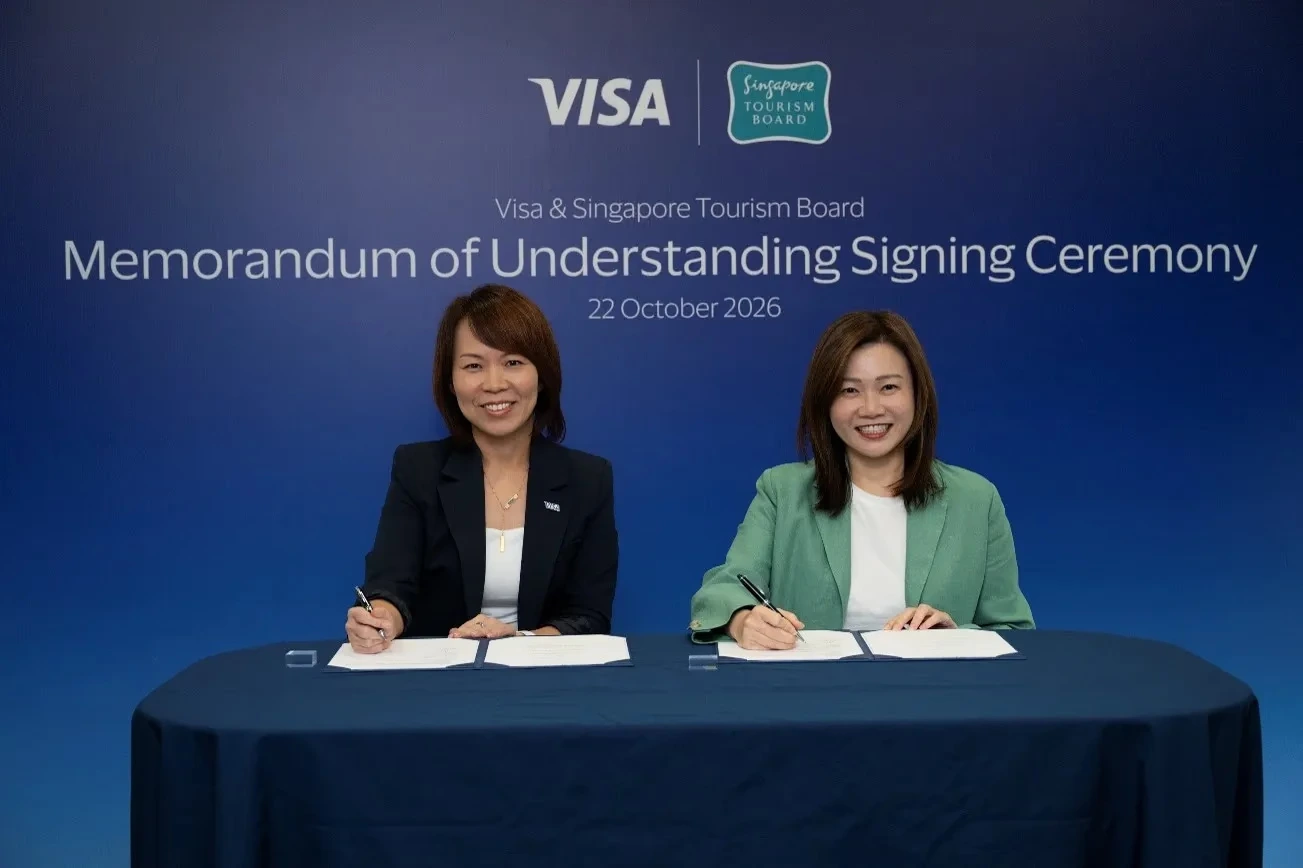
A three-year partnership will use spending insights, curated experiences, and targeted campaigns to strengthen Singapore’s appeal, with Visa Destinations launching in the city-state in November 2026.
Visa and the Singapore Tourism Board (STB) are combining payments data and destination marketing to attract international visitors and encourage them to explore more of Singapore.
Announced on October 23, 2026, the three-year memorandum of understanding focuses on three priorities: promoting Singapore’s tourism experiences, identifying higher-value visitor opportunities through data insights, and running joint marketing campaigns.
The collaboration will also introduce Visa Destinations in Singapore from November 2026. The global travel program connects Visa cardholders with destination experiences, offers, and selected partnerships.
The commercial logic is clear. Visa’s data indicates that repeat visitors spend approximately four times more than first-time visitors. Meanwhile, its analysis of Singapore Grand Prix week in October 2026 showed a significant rise in restaurant and entertainment spending.
For Singapore, the partnership creates another route to encourage repeat visits and higher tourism spending. For Visa, it offers an opportunity to connect its global cardholder network with travel experiences, attractions, dining, and retail.
However, the announcement does not specify a target for visitor arrivals, tourism spending, or campaign-generated revenue. Its impact will depend on how the partners turn spending insights into campaigns that attract travelers and support local businesses.
What the Visa–Singapore Tourism Board Partnership Covers
The memorandum of understanding sets out three pillars for cooperation.
First, the partners will promote Singapore’s tourism experiences. These include attractions, restaurants, entertainment, retail, tours, and activities across the city’s tourism precincts. The program will also highlight Singapore’s nighttime economy.
Second, they will use data insights to identify high-value tourism opportunities. Visa’s payments data can help the partners understand visitor spending patterns, source markets, and categories that may have greater potential for growth.
Third, Visa and STB will develop co-branded marketing campaigns. These will combine Visa Destinations with STB’s “Passion Made Possible” destination brand. Planned activities include travel storytelling, co-marketing, and in-destination experiences aimed at selected international markets.
Together, these priorities connect destination promotion with consumer spending behavior. Instead of focusing only on attracting more arrivals, the partners want to encourage visitors to discover more experiences and return to Singapore.
The program is scheduled to begin in Singapore in November 2026. The partners have not yet announced specific campaign budgets or quantified performance targets.
Why Repeat Visitors Matter to Singapore Tourism
One of the announcement’s most notable figures concerns repeat travel.
According to VisaNet data covering April 2025 to March 2026, repeat visitors to Singapore spend approximately four times more than first-time visitors.
That finding helps explain why the partnership places emphasis on repeat travel and deeper exploration. A visitor who returns may already know the major attractions and may be more willing to explore neighborhoods, restaurants, shopping areas, and activities beyond a first-trip itinerary.
For tourism businesses, that creates opportunities to build demand across several categories rather than relying on a single attraction or landmark.
Visa and STB plan to use spending trends to identify visitor segments and experiences with the potential to encourage higher-value demand. They will also seek to promote local businesses through offers and curated experiences.
Still, the four-times figure should be interpreted carefully. It is a finding based on VisaNet data, not a guarantee that every returning visitor spends four times as much. Spending patterns can differ by source market, trip length, income, travel purpose, and personal preferences.
The partnership’s success will depend on whether targeted campaigns encourage additional spending and repeat visits, rather than simply shifting spending between businesses or categories.
Visa Destinations: Come to Singapore
Visa Destinations is a global travel program designed to connect travelers with experiences in selected destinations.
Singapore will become the second country in Asia Pacific to join the program, following Thailand’s introduction in July 2026. The program also operates in destinations including London, New York, and Paris.
In Singapore, Visa Destinations will serve as a platform for selected partnerships, flagship initiatives, and experiences across tourism precincts. The partners plan to introduce benefits and experience packages for Visa cardholders globally at key attractions.
The program will also build on existing collaborations, including a partnership with Pelago by Singapore Airlines to promote attractions and tours.
For visitors, the potential benefit is easier discovery of local experiences and access to selected offers. For tourism businesses, the platform may provide another route to reach international customers.
The announcement does not specify the full list of Singapore offers, their terms, or the number of participating merchants. Those details will matter when travelers begin using the program.
Visa Destinations is therefore best understood as a distribution and experience platform within the wider partnership, rather than a new payment network or a guarantee of discounts across all tourism businesses.
Dining and Night-Time Experiences Take Center Stage
The collaboration places particular emphasis on dining and activities after dark.
Singapore’s tourism offering extends beyond daytime attractions. Restaurants, entertainment venues, events, and neighborhood experiences can encourage visitors to spend more time in the city and explore areas outside the most familiar tourist routes.
Visa’s spending data from the 2026 Singapore Grand Prix offers a useful example.
During race week, from October 5 to 11, restaurant and entertainment spending rose by approximately two-thirds compared with Visa’s 52-week benchmark average. Visa also reported that evening spending increased by almost half between 7 p.m. and 11 p.m. Spending between 11 p.m. and 5 a.m. nearly doubled against the benchmark.
These figures suggest that major events can generate activity well beyond the main event itself. Visitors may spend on meals, nightlife, and entertainment before and after scheduled activities.
Visa clarified that it has no commercial affiliation or sponsorship relationship with Formula 1. Its figures are based on VisaNet spending data during the Singapore Grand Prix week.
The results do not prove that the new partnership caused the increase. Instead, they provide an example of the spending patterns Visa and STB may use to understand tourism opportunities.
The partners also intend to build on an existing collaboration with Grab to encourage visitors to discover more of Singapore’s night-time experiences.
For local businesses, the opportunity is to reach visitors at different stages of their trips and encourage them to spend beyond traditional sightseeing.
How Payments Data Could Shape Tourism Marketing
The second pillar of the agreement focuses on data-led targeting.
Visa says some of Singapore’s largest inbound travel corridors among its cardholders include Australia, Indonesia, mainland China, Malaysia, and the United States. These markets also rank among Singapore’s major visitor source markets in STB’s arrival data, according to the announcement.
Combining relevant market insights could help the partners better understand visitor preferences and spending behavior. They could then tailor campaigns to specific markets and experiences.
For example, marketing aimed at repeat visitors might highlight lesser-known neighborhoods, local dining, or specialist tours. Campaigns aimed at first-time visitors could focus on experiences that help them discover Singapore beyond its most recognizable attractions.
However, payments data is only one input into tourism planning. It can reveal spending patterns, but it does not independently explain every travel decision or establish why a person chooses a particular destination.
The announcement also does not detail the precise data-sharing arrangements, privacy safeguards, or measurement framework that will govern the collaboration. Those details would help clarify how the partners intend to translate insights into campaigns.
The stated objective is to focus resources on source markets and visitor segments with stronger potential for higher-value tourism growth.
Co-Branded Campaigns Aim to Turn Interest Into Visits
The third pillar brings together Visa Destinations and STB’s “Passion Made Possible” brand.
The partners plan to develop campaigns across key source markets, using destination-led storytelling, co-marketing, and activities within Singapore itself. The campaigns will combine travel content with selected experiences and access for Visa cardholders.
They also intend to build on previous collaborations, including “Seasons. Made in Singapore” and “Non-stop Fun,” which connected Visa, STB, and Pelago campaigns with earlier destination-marketing initiatives.
This approach links inspiration with a practical reason to book or explore. Travel content can raise awareness, while curated offers may help visitors decide which experiences to add to their itineraries.
For Visa, the partnership strengthens the connection between its payment services and travel-related consumer activity. For STB, it provides access to Visa’s international network and spending insights.
The commercial results will depend on campaign reach, traveler response, offer quality, and participation from local businesses. Neither party has announced expected visitor numbers or incremental spending attributable to the new agreement.
What the Partnership Means for Local Tourism Businesses
Restaurants, attractions, retailers, tour operators and entertainment venues could benefit if the partnership directs more international visitors towards their services.
The focus on tourism precincts may also help promote experiences beyond the city’s most established visitor routes. That could give participating businesses more opportunities to attract visitors who want distinctive local activities.
At the same time, the announcement does not guarantee that every Singapore tourism business will participate or receive additional customers.
The practical impact will depend on which merchants join the programme, how offers are structured and whether campaigns reach travellers who are likely to make additional visits or purchases.
For small and medium-sized businesses, the key measure will be whether participation creates incremental demand at a sustainable cost. For the tourism sector more broadly, the question is whether targeted promotion supports wider economic activity rather than concentrating spending in a small number of locations.
Supporting Singapore’s Tourism 2040 Ambitions
The collaboration aligns with STB’s longer-term ambition to develop high-quality tourism growth under its Tourism 2040 priorities.
That ambition involves more than increasing visitor numbers. It also places emphasis on the quality and value of tourism demand, the experiences offered and the opportunities created for businesses across the sector.
Visa’s global network and payments insights may help STB understand spending patterns and develop more targeted campaigns. Visa Destinations, meanwhile, provides a platform for presenting experiences and offers to international cardholders.
Yet data-led marketing is only one part of destination development. Visitor experience, transport, accommodation, service quality and the strength of local attractions will continue to influence whether people choose to visit and return.
The partnership gives Visa and STB a framework for working together over three years. Its value will become clearer as the programme launches and the partners disclose more information about participating businesses, campaigns and outcomes.
The Bigger Picture: Payments Networks Are Moving Further Into Travel
The Visa–STB agreement illustrates how payment networks can play a role beyond processing transactions.
Spending data can provide insight into how visitors use a destination. Global cardholder reach can support international marketing, while partnerships with attractions and local businesses can connect that marketing to experiences on the ground.
For Singapore, the objective is to turn its established international appeal into deeper visitor engagement and higher-value tourism. For Visa, the collaboration creates another way to connect payments, travel discovery and merchant partnerships.
The four-times spending difference reported between repeat and first-time visitors provides a clear rationale for the strategy. The Grand Prix spending figures also highlight the potential importance of dining and night-time activity.
Neither finding guarantees the partnership’s success. The decisive test will be whether the collaboration brings additional visitors, encourages repeat travel and generates measurable benefits for tourism businesses.
Visa Destinations is scheduled to begin in Singapore in November 2026. As the programme develops, details about its offers, participating businesses and performance will show whether the partnership can translate payments insights into lasting tourism growth.
Sources: Visa’s announcement, reproduced by TMCnet; Visa Singapore; Singapore Tourism Board.
Comments
No comments yet. Be the first to share your thoughts.
Leave a comment