
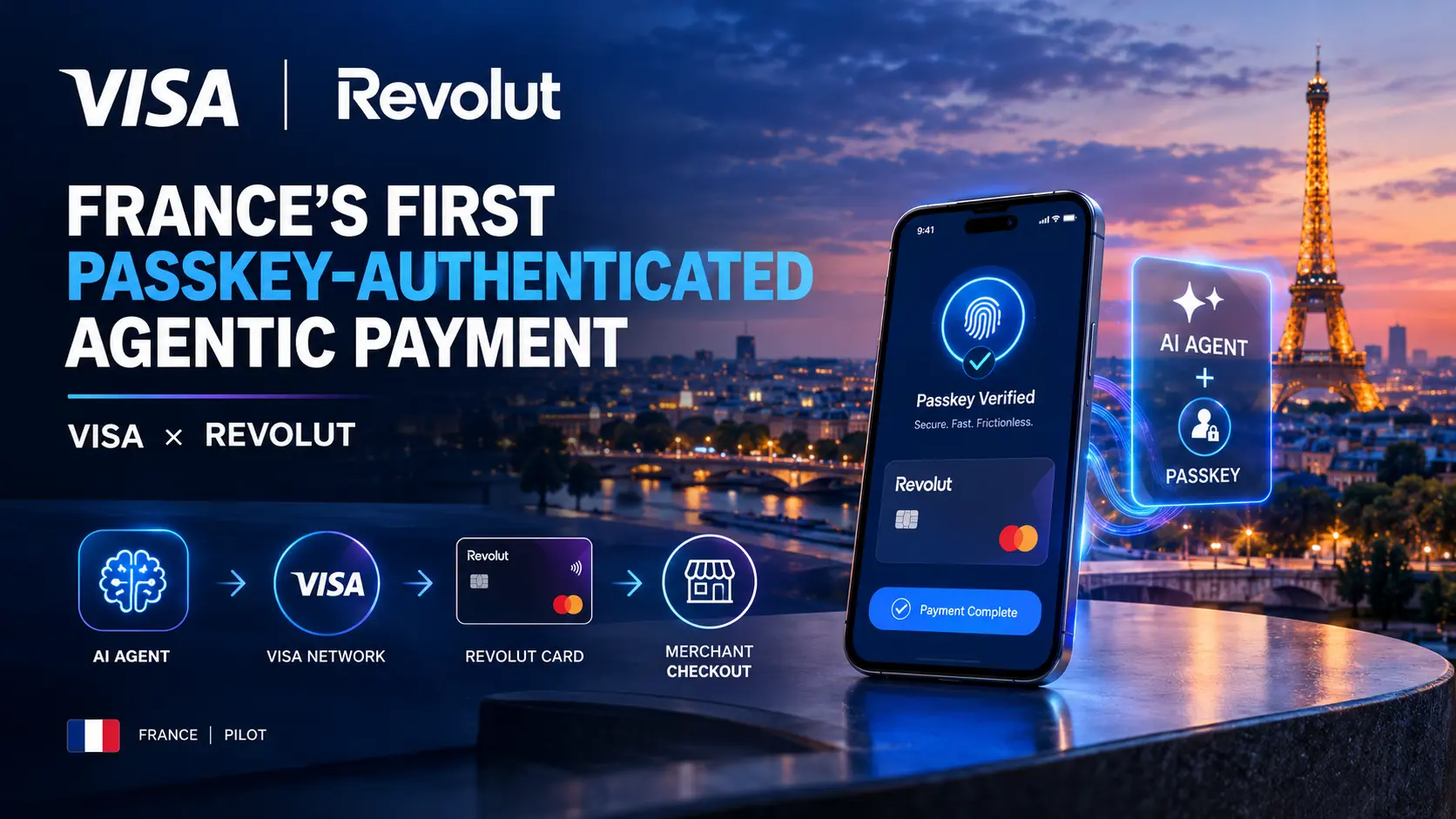
Visa and Revolut have completed what they describe as France’s first passkey-authenticated agentic card payment, giving a real-world glimpse of how AI agents could eventually shop and pay on behalf of consumers.
The transaction was completed through a live checkout at software reseller Cleverbridge, using a real French consumer Revolut card. Visa’s test agent, My Agent, handled the purchase, while Visa Payment Passkey authenticated the payment.
The test is an important step for agentic commerce because the AI was not simply recommending a product or helping a customer navigate checkout. It was able to take the transaction through to payment within a controlled framework.
Visa and Revolut Put AI Agents Into a Real Payment Flow
The French transaction was conducted as part of Visa’s broader Agentic Ready programme, which is designed to help the payments ecosystem prepare for transactions initiated by AI agents. Visa has been developing infrastructure around agent identity, authentication, tokenisation and fraud controls as AI moves from answering questions to taking actions.
In this test, My Agent operated using a Revolut consumer card and completed the purchase at Cleverbridge. The merchant has already been working with Visa on agentic commerce and its Trusted Agent Protocol, which is designed to help merchants distinguish approved AI agents from unknown or unverified automated traffic.
That distinction matters.
An AI agent that can make a purchase needs more than access to a payment card. The payment ecosystem needs to know which agent is acting, who authorised it, what it is allowed to buy and whether the transaction should be trusted.
Passkeys Add a Security Layer to Agentic Payments
The transaction used Visa Payment Passkey for authentication rather than relying on traditional passwords or manually entering card credentials at checkout.
Visa describes passkeys as a way to authenticate transactions using device-bound credentials and biometrics, such as a fingerprint or facial recognition. The technology is intended to help establish that the authorised consumer is behind the payment while reducing reliance on credentials that can be stolen or shared.
For agentic commerce, this becomes particularly important.
An AI agent may be able to search, compare and select products. But consumers still need a reliable way to give that agent permission to spend money.
Visa’s approach is to combine agentic software with tokenisation, passkeys and payment controls, allowing the agent to act while keeping the customer involved in key authorisation decisions.
Customers Still Set the Rules
The French test does not mean consumers are handing unrestricted control of their cards to AI.
According to the companies’ announcement, the agent requires prior customer authorisation and operates according to user-defined spending rules. Revolut also retains issuer-level control over the transaction.
Visa’s Intelligent Commerce infrastructure also brings together payment security, identity checks and real-time fraud monitoring.
That creates an important model for agentic payments:
The AI gets the ability to act. The customer keeps the authority to define the boundaries.
That distinction could become one of the most important design principles in AI-powered commerce.
Why the France Test Matters for Payments
For years, AI-powered shopping has largely stopped at discovery.
A consumer could ask an AI assistant to find a laptop, compare prices or identify the best travel option. The final purchase, however, still required the human to step in.
Agentic commerce changes that model.
Visa defines agentic commerce as a system in which AI agents can browse, compare options and ultimately make payments within rules set by consumers.
The Revolut transaction demonstrates that this concept can now operate on existing card infrastructure in a live merchant environment.
It also shows why trust and authentication may become just as important as the AI itself.
If agents eventually handle subscriptions, travel bookings, household purchases or business procurement, payment networks will need to determine how to authenticate both the customer and the software acting on their behalf.
Visa Is Building the Infrastructure for Agentic Commerce
Visa has been steadily expanding its agentic-commerce infrastructure in 2026.
Its Agentic Ready programme has expanded beyond Europe into Asia-Pacific and Latin America, while Visa has also introduced technologies including the Trusted Agent Protocol, Agentic Directory and Payment Passkeys.
Visa has also partnered with OpenAI to support secure Visa payments within agentic commerce environments, highlighting how quickly payment networks are positioning themselves around AI-driven transactions.
The broader strategy is clear: Visa does not want AI agents to become a new payment layer disconnected from existing financial infrastructure. Instead, it is trying to make existing payment rails work with autonomous software while preserving authentication, security and consumer control.
Revolut Adds Another Piece to Its AI and Payments Strategy
The development also fits Revolut’s broader push into next-generation payments.
Earlier this year, Revolut said it planned to make Revolut Pay compatible with emerging agentic-commerce platforms and became one of the first European payment methods compatible with Google’s Agent Payments Protocol.
The company has therefore been positioning itself not simply as a digital banking provider, but as a payment platform that can participate in the emerging AI-commerce ecosystem.
Its French expansion adds another layer to that strategy. Revolut received a full European banking licence from French regulators in August and plans to establish a new Western European headquarters in Paris next year.
The Bigger Shift: From AI Assistant to AI Buyer
The most interesting part of the Visa-Revolut experiment is not the individual purchase.
It is the direction of travel.
AI is moving from helping consumers make decisions to potentially acting on those decisions.
That creates a new relationship between consumers, merchants, banks, card networks and AI platforms.
The winning systems will need to make autonomous payments feel simple without making them uncontrolled.
Visa and Revolut’s French test suggests that the infrastructure for that future is beginning to take shape.
The next question is no longer whether an AI agent can pay.
It is how much of our everyday spending we will eventually be comfortable letting it handle.
Visa and Revolut carry out passkey-based agentic payment in France
Comments
No comments yet. Be the first to share your thoughts.
Leave a comment