
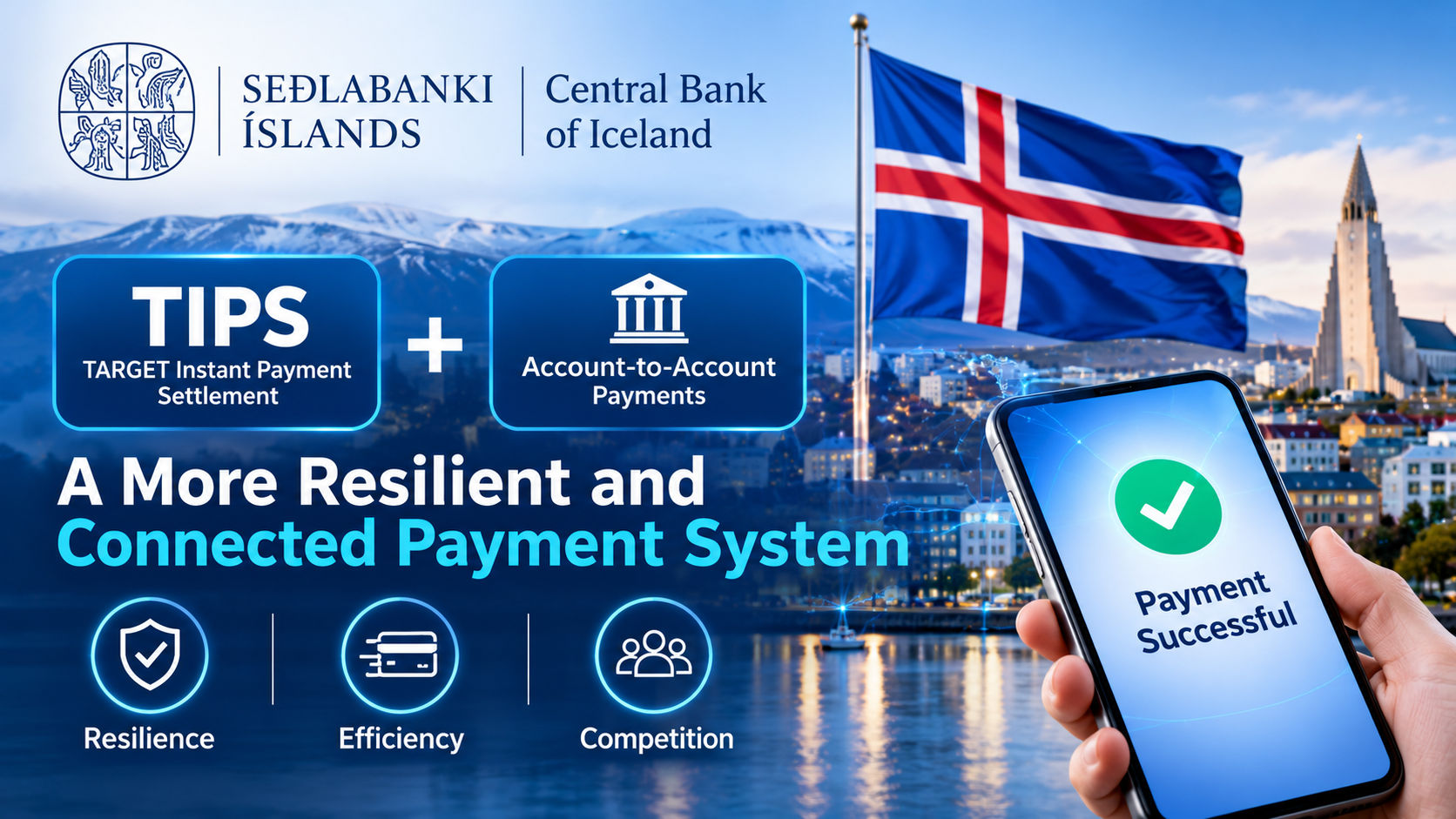
The Central Bank of Iceland is pursuing a more diversified payment system, combining international integration with domestic resilience as digital payments become increasingly important to economic security.
Iceland is strengthening its payment infrastructure through a combination of international cooperation and domestic investment, as the country seeks to reduce reliance on individual payment channels and prepare for severe disruptions.
Speaking at the Money Live Nordic Banking conference in Copenhagen on 30 October 2026, Tómas Brynjólfsson, Deputy Governor for Financial Stability at the Central Bank of Iceland, outlined the bank's approach to payment infrastructure. He emphasized that payment sovereignty does not require a small country to operate independently of international systems.
Instead, Iceland’s strategy is to combine international support with domestic capacity. The objective is to ensure that neither becomes a single point of failure.
The announcement highlights two important developments: Iceland’s agreement with the European Central Bank concerning participation in the Eurosystem’s TARGET Instant Payment Settlement system, known as TIPS, and the Central Bank’s preparations for a tender covering infrastructure for account-to-account payments.
Together, these initiatives form part of a broader effort to improve resilience, efficiency, and competition in Iceland’s payment market.
Payment sovereignty does not mean self-sufficiency.
Iceland is a small, highly digital economy. That creates opportunities for efficient financial services, but it also makes payment continuity an important economic and operational concern.
A disruption to payment infrastructure can affect consumers, businesses, and financial institutions. For that reason, the Central Bank is treating payment resilience as a strategic issue rather than simply a technology upgrade.
Brynjólfsson argued that strengthening strategic autonomy in payments should not mean retreating from international cooperation. For Iceland, international integration remains fundamental to security and prosperity.
However, international connections alone cannot guarantee resilience. Domestic preparedness and the ability to respond to severe disruptions remain essential.
The bank's approach therefore combines two objectives: maintaining access to international payment infrastructure while strengthening the range of payment options available within Iceland.
This balance is particularly important as payment systems evolve. New technologies and providers can improve speed, convenience, and competition, but they can also introduce new operational dependencies.
Iceland’s three principles for payment infrastructure
Brynjólfsson outlined three principles guiding the Central Bank’s policy on payment intermediation.
1. Maintain multiple payment solutions and channels.
The first principle is to ensure that more than one payment solution and channel is available.
The Central Bank’s agreement with the European Central Bank concerning Iceland’s participation in TIPS is an important part of this effort. TIPS supports instant payments in central bank money within the Eurosystem’s payment infrastructure.
The Central Bank said Iceland’s participation is expected to strengthen the resilience and efficiency of payments. It also provides an additional payment infrastructure option as the country works to diversify its arrangements.
A second development is also underway. The Bank is in the final stages of preparing a tender for infrastructure that would make it easier for banks and payment service providers to offer payments for goods and services through account-to-account transfers.
The tender is intended to increase the number of available payment channels. The announcement does not yet provide a supplier, implementation schedule, or final technical specifications.
The combined direction is clear: Iceland wants payment providers and users to have more than one route for making and receiving payments.
2. Make international integration and domestic capacity complementary.
The second principle is that international integration and domestic capacity should reinforce one another.
For Iceland, participation in international infrastructure can provide access to capabilities that would be difficult or inefficient to develop independently. At the same time, domestic preparedness can help the country manage disruptions and maintain essential payment services.
This is not a choice between international cooperation and national resilience. The Central Bank’s position is that both are necessary.
The approach also reflects a wider challenge facing smaller economies. They must benefit from shared infrastructure while understanding the operational risks that come with reliance on external systems.
3. Provide shared infrastructure while leaving room for innovation.
The third principle concerns the role of central banks and private-sector providers.
Brynjólfsson said central banks should provide robust shared infrastructure, while banks and payment service providers should be responsible for innovation in customer service.
This division aims to combine stability at the infrastructure level with competition and product development at the customer level.
Central banks can support reliable payment foundations. Meanwhile, commercial providers can develop services, interfaces, and payment experiences that respond to customer needs.
The model also gives the payment ecosystem room to evolve as technology changes, without making the reliability of core infrastructure dependent on any single commercial service.
Why account-to-account payments matter
Account-to-account payments allow funds to move directly between bank accounts, rather than relying exclusively on card-based payment channels.
The Central Bank’s planned infrastructure tender is intended to make it simpler for banks and payment service providers to offer these transfers for purchases of goods and services.
For consumers and merchants, broader access to account-to-account payments could create additional ways to complete transactions. For providers, it could support new services and payment experiences.
However, the announcement does not specify the infrastructure’s final design, commercial model, or expected launch date. Those details will become clearer as the tender progresses.
The initiative should therefore be understood as a planned infrastructure development, rather than a fully launched payment service.
What Iceland’s strategy signals for the payments market
The Central Bank’s announcement reflects a broader shift in how payment infrastructure is being considered by policymakers.
Resilience is increasingly linked to diversification: multiple systems, channels, and operational arrangements can reduce dependence on a single route. At the same time, international cooperation remains important for economies that cannot efficiently build every capability on their own.
Iceland’s approach also places payment infrastructure and competition within the same policy framework. The Bank is seeking stronger resilience while creating conditions for banks and payment service providers to develop new customer-facing services.
The next developments to watch are Iceland’s operational participation in TIPS and the outcome of the planned account-to-account infrastructure tender. Their eventual implementation will help show how the Central Bank’s principles translate into practical payment options.
For now, the policy direction is explicit: payment sovereignty for Iceland means combining international integration, domestic preparedness, and diversified payment channels—not pursuing self-sufficiency at the expense of cooperation.
Source: Central Bank of Iceland, “Deputy Governor for Financial Stability addresses the Money Live Nordic Banking conference,” 30 October 2026.
Comments
No comments yet. Be the first to share your thoughts.
Leave a comment