
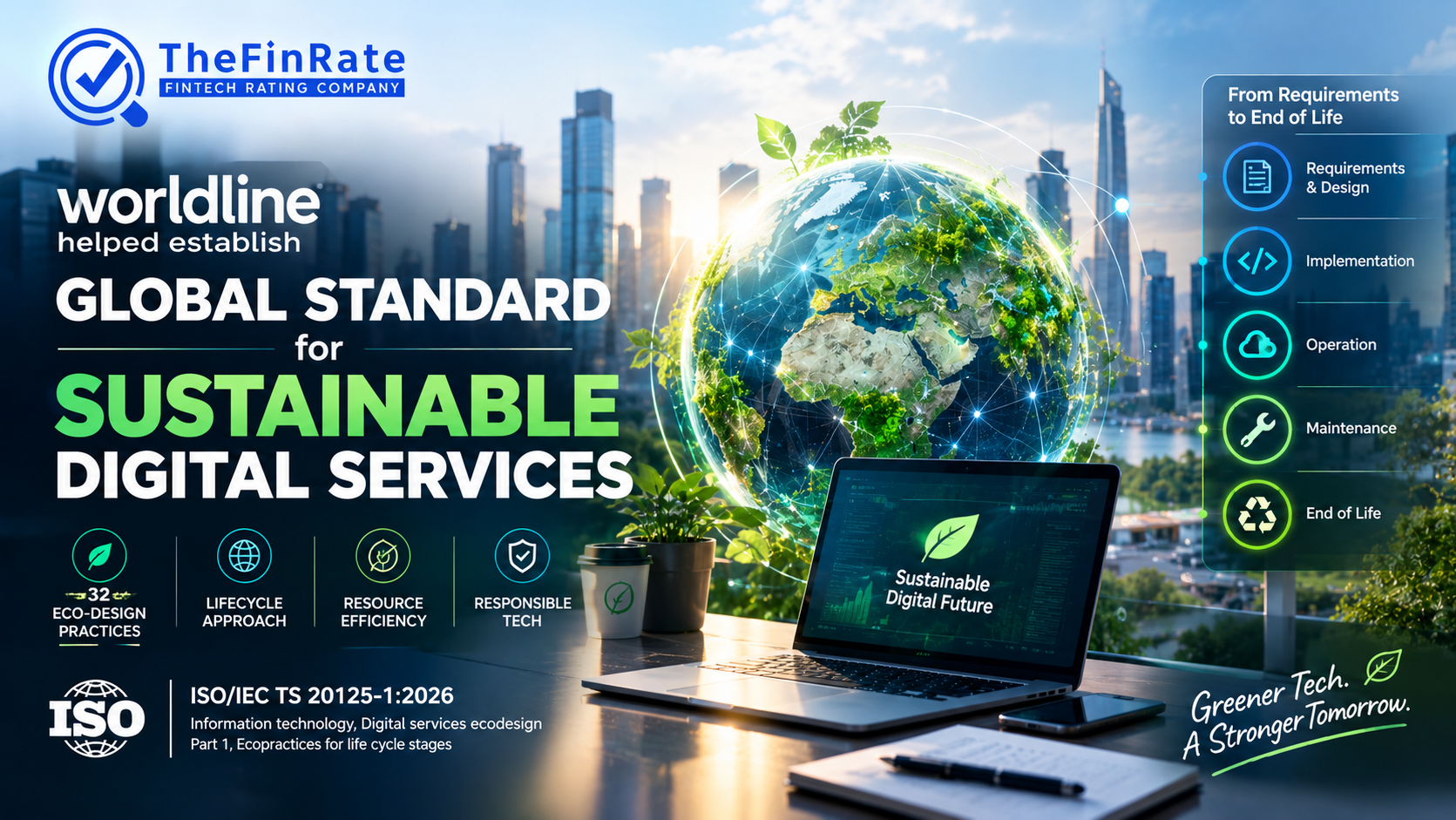
Worldline has helped create a new international standard for sustainable digital services. The specification, ISO/IEC TS 20125-1:2026, sets out 32 eco-design practices spanning the digital service lifecycle, giving businesses a shared approach to resource efficiency, responsible technology development and sustainability measurement.
Digital services now power banking, payments, commerce and everyday business operations. As a result, the environmental impact behind them is drawing more attention. Data processing, software development, cloud computing and the devices people use to access these services all require resources, making sustainability an important consideration for technology providers and the businesses that depend on them.
Worldline, the European payments and financial technology group, helped lead the international collaboration behind the new standard and announced the development on 14 October 2026.
ISO published the specification in February 2026 under the full title: Information technology, Digital services ecodesign, Part 1, Ecopractices for life cycle stages. The framework sets requirements and recommendations to reduce environmental harm across a service's life, from requirements gathering and design through implementation, operation, maintenance and end of life.
For organisations that build or buy digital services, the standard offers a shared method for weaving environmental thinking into technology decisions, treating sustainability as part of the process rather than a separate reporting task. Worldline led the two year international collaboration that produced the framework, with contributions from technology companies, sustainability specialists, academic institutions and industry bodies.
What Is ISO/IEC TS 20125-1:2026?
ISO/IEC TS 20125-1:2026 is an international technical specification focused on the environmental side of digital service design. Its main purpose is to help organisations spot ways to cut environmental impact throughout a service's lifecycle, from early decisions such as defining what a service needs to do, through later choices made during implementation, maintenance and retirement.
The framework promotes eco-design, weighing environmental consequences during the design and management process rather than addressing them only after launch. It also encourages digital sufficiency, an approach that questions whether a service truly needs every feature and resource in its current design. In practice, this can mean cutting unnecessary functionality, reducing duplicated services and prioritising features that deliver real value.
According to ISO, the specification establishes a common language for reducing environmental impact across the digital service lifecycle, working across different development methods, including agile and waterfall approaches.
The scope stays focused on environmental considerations and does not replace standards covering security, reliability or other aspects of technology quality. A service can be secure and reliable while still using more computing resources than necessary, so cutting resource use should never come at the cost of security or essential performance.
The 32 Eco-Design Practices
Worldline says the specification lays out 32 eco-design practices to help organisations improve efficiency and manage environmental impact, spanning several stages of a service's life rather than focusing only on development.
During requirements and design, teams can assess whether a service is truly necessary, define essential functions early and avoid features that add complexity without real value. Clearer requirements also prevent unnecessary processing and infrastructure demand later on. During implementation and operation, teams can examine how software design and architecture affect resource use, which matters most for platforms processing large transaction volumes. Maintenance and end of life carry weight too, since feature updates, duplicated systems and retiring outdated applications all affect resource use over time.
Why This Matters for Financial Institutions
For banking and payments, sustainable digital design reaches beyond corporate reporting. Financial institutions rely on extensive technology infrastructure to process transactions, run customer applications and support risk controls, while merchants and payment providers depend on digital platforms for checkout, reconciliation and fraud prevention.
As these services grow, their design choices shape how much computing capacity and network activity they consume. An eco-design framework can help institutions ask more consistent questions, such as whether a feature is necessary or how long information needs retaining. The framework itself does not measure any bank's footprint, and adopting it does not prove a company has cut emissions. Organisations still need real measurement and evidence of results, and its value lies in giving teams a shared structure for weighing environmental factors.
Digital Sufficiency: Building Only What Is Needed
Worldline highlights digital sufficiency as a central idea, challenging the assumption that more features, more data collection and more computing activity automatically make a service better.
Unnecessary features add complexity and create ongoing demands for processing and maintenance, while duplicated applications consume resources delivering overlapping functions. Digital sufficiency instead asks organisations to prioritise genuine user and business needs. A simpler service may need fewer resources to run, though the benefit still depends on its design and actual usage. This approach also simplifies maintenance and helps teams focus on features that matter most, though the sustainability case must still come from real performance data.
Supporting ESG Reporting and Procurement
Worldline argues that a shared standard helps organisations meet rising expectations from customers, investors and procurement teams, since ESG reporting increasingly asks companies to explain how their sustainability goals translate into actual operations.
Digital infrastructure is hard to assess consistently, since its impact spreads across software, hardware, hosting and usage patterns, and organisations often use different definitions. A shared eco-design framework gives buyers and suppliers common ground. Procurement teams can ask more structured questions when comparing suppliers, rather than relying on broad sustainability claims, while providers can show environmental thinking shapes their development work. Still, following a specification is not the same as proving a specific emissions reduction.
Worldline's Role in the Collaboration
Worldline led the two year international effort behind the specification. Contributing organisations named in its announcement include CGI France, Ctrl S, Logic Consulting, GreenSpector, the Institut du Numerique Responsable, Nuageo, Orange, Pole Eco-conception, Specinov, Temesis, Thales, Universite La Rochelle, TerraOps and VINCI Energies.
That breadth reflects how many disciplines digital sustainability touches, from software engineering to procurement and long term service management. Worldline's involvement also connects the initiative to its own business, since it processes payments and provides digital transaction services for merchants and banks. In its 2025 sustainability reporting, Worldline described work on eco-design for IT solutions, including staff training. The real test will be how consistently organisations turn the framework into measurable improvements.
What Businesses Should Do Next
Organisations considering the framework can start by identifying their most resource intensive digital services, then review existing practices to spot unnecessary complexity. Technology teams may need to work with sustainability specialists and business owners to set responsibilities and build a repeatable assessment process. Documenting baseline measurements before making changes matters too, since without a clear starting point it becomes hard to show whether an eco-design initiative actually delivered results.
The Bottom Line
ISO/IEC TS 20125-1:2026 gives businesses a common framework for sustainable digital service design. As digital technology becomes more deeply embedded in financial services, the environmental cost of software and infrastructure is becoming a practical issue for developers, buyers and operators alike. The standard alone will not guarantee lower emissions, since that outcome depends on the choices organisations make, the practices they put into action and the results they actually measure.
Worldline helps establish first global ISO 20125 standard for sustainable digital services
Comments
No comments yet. Be the first to share your thoughts.
Leave a comment