
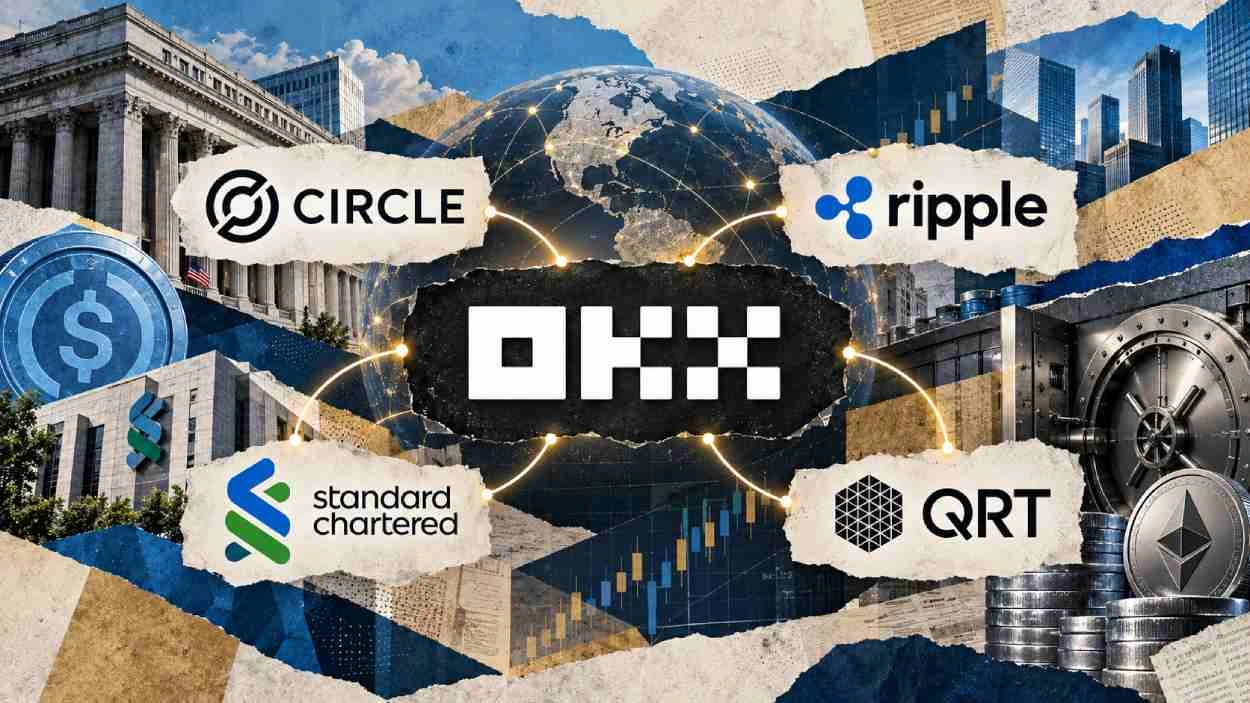
OKX has secured fresh strategic investment from Circle, Ripple, Standard Chartered's SC Ventures, and Qube Research & Technologies at a $25 billion pre-money valuation. The deal strengthens the crypto exchange's ties to the financial infrastructure providers supporting its expansion into stablecoins, institutional markets, and tokenized assets.
The amount raised in the latest investment was not disclosed. OKX said the transaction extends the strategic funding round announced in March, when Intercontinental Exchange (ICE), the parent company of the New York Stock Exchange, invested about $200 million at the same $25 billion valuation.
The new investor group is notable because each participant already has an operational relationship with OKX. Circle brings stablecoin infrastructure through USDC. Ripple contributes payments, liquidity, and stablecoin capabilities, including RLUSD on OKX. Qube Research & Technologies provides institutional liquidity and risk capacity, while Standard Chartered serves as custodian for BUIDL, the tokenized Treasury fund used in a collateral framework developed with OKX and BlackRock.
The investment comes as OKX expands beyond its traditional crypto-exchange role and builds toward a broader financial infrastructure platform.
OKX Maintains Its $25 Billion Valuation
The most striking part of the transaction is not the undisclosed size of the funding. It is the fact that OKX has attracted another group of institutional investors at the same $25 billion valuation established in March.
ICE invested roughly $200 million in the earlier round. Seven months later, Circle, Ripple, SC Ventures, and QRT have joined the shareholder base without a publicly disclosed change in the company's valuation. That gives the latest transaction a different character from a conventional venture funding round. Instead of simply bringing in financial investors, OKX is adding companies and institutions that already operate across important parts of the digital-asset and financial-market ecosystem.
OKX described the latest transaction as a strategic investment designed to deepen relationships with four infrastructure partners. Haider Rafique, OKX's global managing partner, said the capital will focus on strengthening the company's long-term market infrastructure. The company is therefore using the funding to reinforce a wider infrastructure strategy rather than simply expand crypto trading volumes.
Why Circle, Ripple, and Standard Chartered Matter
The investor mix gives the deal its strongest strategic significance. Circle is the issuer of USDC and has become one of the most important companies in the regulated stablecoin market. Its participation connects OKX more closely with the infrastructure surrounding digital dollars and blockchain-based payments.
Ripple brings another piece of the financial infrastructure puzzle. Its payments and liquidity technology, along with RLUSD, gives it an existing relationship with OKX, and the exchange says RLUSD is available across its unified order book.
Standard Chartered's involvement is different again. Its investment arm, SC Ventures, is participating while the bank already provides custody for BUIDL, BlackRock's tokenized U.S. Treasury fund, within a collateral framework launched in partnership with OKX and BlackRock.
Qube Research & Technologies adds an institutional trading dimension. The London-based quantitative investment manager is an important liquidity counterparty for OKX and works with the exchange on products and markets. Its participation therefore links the funding round to the institutional trading infrastructure that OKX is trying to develop.
Together, the investors represent several layers of modern digital financial markets:
- Circle: stablecoin infrastructure
- Ripple: payments, liquidity, and stablecoins
- Standard Chartered: banking and custody
- QRT: institutional liquidity and trading
- ICE: traditional exchange infrastructure through the earlier round
That combination is arguably more important than the undisclosed amount of capital itself.
OKX Is Moving Beyond the Crypto Exchange Model
OKX's latest funding comes as the company increasingly presents itself as a broader financial technology platform. The company says it wants to combine crypto technology with the standards expected from global financial institutions, and that strategy can already be seen across several parts of its business.
OKX has expanded into stablecoin payments and recently introduced OKX Money, a standalone product built around digital dollars, savings, payments, and cards. It has also expanded tokenized-stock trading outside the United States. In July, OKX said it was rolling out more than 40 tokenized U.S. stocks and ETFs to customers across several international regions, allowing eligible customers to trade assets such as Apple, NVIDIA, and Tesla around the clock alongside digital assets.
The exchange subsequently expanded its tokenized-equity offering. Its current unified tokenized-stock platform lists a broad range of stock and ETF exposures, although availability depends on jurisdiction. This matters because OKX is gradually moving from a platform primarily associated with crypto trading toward a model that combines crypto, stablecoins, tokenized securities, and traditional financial-market infrastructure.
The ICE Partnership Adds a Bigger Capital-Markets Ambition
The latest investment also follows a significant development involving ICE. OKX and ICE established a joint venture called OKXICE, which is seeking approval for a tokenized U.S. stock trading venue. The proposed platform is expected to support tokenized shares of 63 U.S. public companies, according to reporting around the filing, with proposed names including major companies such as NVIDIA, Apple, and Coca-Cola.
The timing is important. In September, the U.S. Securities and Exchange Commission introduced its temporary Innovation Exemption, allowing certain tokenized securities venues to conduct limited on-chain trading of tokenized National Market System stocks under specified conditions.
The exemption is not a blanket approval for tokenized equities. The SEC imposed conditions covering issues such as the number of securities and trading volume, investor protections, smart-contract requirements, and the rights attached to tokenized stocks. Tokenized securities traded through qualifying venues must meet requirements designed to ensure holders receive the same rights and privileges as holders of the underlying traditional securities. Issuers also receive an opportunity to object when an unaffiliated third party tokenizes their stock.
The temporary exemptions are scheduled to expire five years after publication of the order, giving the market time to test the technology while regulators gather experience. For OKX, that regulatory development creates an opening to pursue a much larger role in securities markets.
Tokenized Stocks Could Change What a Crypto Exchange Offers
The distinction between traditional securities and tokenized assets is becoming increasingly important. Traditional stock markets operate through established exchanges, brokers, custodians, clearing systems, and settlement infrastructure, while tokenization attempts to represent securities through blockchain-based infrastructure.
The potential advantage is not simply that a stock becomes available in digital form. On-chain infrastructure can support different approaches to trading, settlement, collateral management, and market access. The SEC itself has said tokenization could modernize functions such as issuance, trading, transfer, settlement, and recording ownership.
That does not mean blockchain automatically makes markets cheaper or more efficient. The regulatory framework remains conditional, and operational issues around custody, liquidity, settlement, investor protection, and interoperability still matter. Still, the direction of travel is becoming clearer, as major financial institutions increasingly test where blockchain infrastructure can fit into regulated capital markets. OKX is positioning itself directly in that transition.
Stablecoins and Tokenized Assets Are Converging
Circle's participation also highlights another important part of the strategy. Stablecoins can provide the settlement and payment layer for digital-asset markets, while tokenized securities can provide the asset layer. An exchange that can connect those two components has the potential to operate more like a broader digital financial marketplace.
OKX's existing products already show that convergence. Its tokenized-stock markets allow eligible users to trade tokenized exposure alongside digital assets, while USDC is used as a trading and settlement currency across parts of its platform. OKX has also expanded support for tokenized equities and stablecoin-focused products.
That makes the strategic participation of Circle and Ripple particularly relevant. Both companies are building infrastructure around digital currencies that can operate across borders and blockchain networks. For OKX, stronger relationships with those companies could support the broader development of an always-on financial marketplace.
Institutional Liquidity Is Becoming More Important
The participation of QRT adds another dimension. Crypto markets have historically attracted institutional trading firms because they operate continuously and offer opportunities across highly fragmented markets. As tokenized stocks, stablecoins, and other real-world assets enter these markets, liquidity becomes increasingly important.
An institutional exchange cannot simply list assets. It needs market makers, counterparties, custody arrangements, risk controls, and reliable settlement mechanisms. QRT's role as an institutional liquidity counterparty gives OKX an existing relationship that can support that infrastructure. The investment therefore reinforces a broader pattern: OKX is bringing some of the institutions that already interact with its platform into its ownership structure.
The $25B Valuation Is a Signal, But Not a Guarantee
The unchanged valuation should also be viewed carefully. A $25 billion pre-money valuation means the new investors agreed to participate at that pricing level. It does not mean the company has increased in value by $25 billion through the latest funding, nor does it reveal how much new capital OKX has actually raised, since the company has not disclosed the size of the latest investment.
That distinction is important for investors and readers evaluating the transaction. What can be confirmed is that institutional investors from traditional finance, stablecoins, payments and quantitative trading have committed capital at the same valuation established in March, which provides a clear signal of continued strategic interest in OKX's infrastructure ambitions.
OKX's Bigger Bet Is on 24/7 Financial Markets
The investment ultimately points toward a broader change in how financial markets could operate. Traditional equity markets generally follow exchange-specific trading hours, while crypto markets operate continuously. Tokenization creates the possibility of bringing some traditional financial assets closer to the always-on model of digital assets.
OKX has already described its tokenized-stock products around 24/7 trading, while its proposed OKXICE platform seeks to take that concept into a regulated U.S. market structure. That could eventually connect several markets that have historically operated separately, moving step by step from crypto to stablecoins, then tokenized securities, then institutional liquidity and finally regulated capital markets. The latest investors map closely onto that chain.
What Happens Next for OKX?
The immediate focus will be on infrastructure expansion and the development of new financial products. The proposed OKXICE tokenized-stock venue will face regulatory requirements before it can operate in the United States. The SEC's Innovation Exemption provides a temporary framework, but it also imposes conditions designed to protect investors and maintain market integrity.
OKX will also need to continue expanding liquidity, custody and settlement relationships as it moves into more institutional products. Its international tokenized-stock business will face another challenge, since regulation differs significantly across jurisdictions. That makes Standard Chartered's banking and custody relationship, Circle's stablecoin infrastructure, Ripple's payments capabilities and QRT's institutional liquidity particularly relevant to the company's next stage.
The larger question is whether OKX can turn those individual relationships into a genuinely integrated financial infrastructure platform.
Why the OKX Funding Matters
The latest OKX funding round is notable because of who invested, not just how much they invested. Circle, Ripple, Standard Chartered's SC Ventures and QRT represent different parts of the financial system, while ICE, which invested in the earlier round, brings another connection to traditional market infrastructure.
Their combined participation suggests that the boundary between crypto infrastructure and traditional financial markets continues to narrow. OKX is no longer positioning itself solely as a venue for trading cryptocurrencies. Instead, it is building around stablecoins, institutional liquidity, custody, tokenized assets and potentially 24/7 securities trading.
The $25 billion valuation has remained unchanged from the March round, while the investor base has expanded. That combination gives the transaction a clear message: institutional players are willing to back OKX at its existing valuation as the company tries to connect crypto infrastructure with the wider financial system. The next test will be whether OKX can turn that institutional backing into regulated, scalable and liquid markets for tokenized financial assets.
Comments
No comments yet. Be the first to share your thoughts.
Leave a comment