
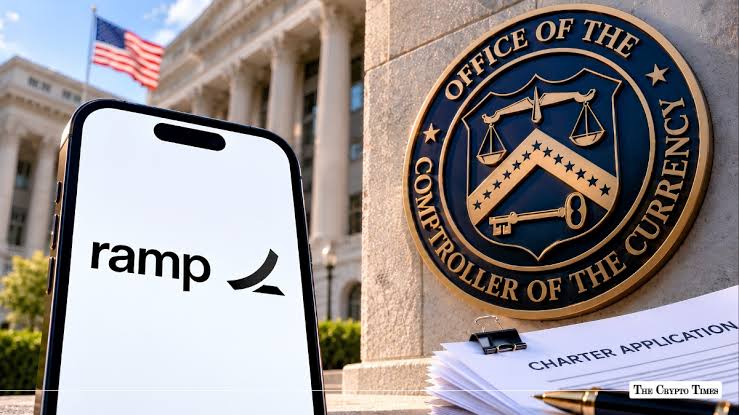
Ramp has applied to establish a national trust bank in the United States, seeking a route into fiduciary investment management and digital-asset custody as the fintech’s valuation reaches $60 billion.
Ramp is taking a significant step beyond its roots in corporate cards and expense management. The company has applied to the US Office of the Comptroller of the Currency (OCC) to establish Ramp National Trust Bank. If approved, the proposed institution could offer fiduciary investment management and custody of digital assets under a federal regulatory framework.
The application signals a broader ambition for Ramp. The company has grown into a financial operations platform serving businesses with corporate spending, expense management, and related financial tools. A national trust bank could give it a more direct role in asset-related services while allowing it to continue working alongside existing banking partners.
However, the application is not an approval. Ramp has not announced that the proposed bank is operational, and its stated plans remain subject to regulatory review.
The proposed institution would also have clear limits. According to Ramp’s announcement, it would not accept deposits or make commercial loans. Its proposed role is therefore different from that of a conventional full-service commercial bank.
The timing is notable. Ramp’s application follows a $1.85 billion primary financing round that valued the company at $60 billion. The company says it serves more than 85,000 clients and has reached $2 billion in annualized revenue, while reporting positive cash flow. These figures underline the scale of the business seeking a broader regulatory footprint.
Source: Ramp’s announcement, as reported by Finextra and Banking Dive.
What Ramp’s National Trust Bank Application Would Allow
Ramp says the proposed trust bank would provide two main services: fiduciary investment management and digital-asset custody.
Fiduciary investment management involves managing assets or investments on behalf of clients under applicable duties and legal requirements. Digital-asset custody involves safeguarding digital assets and the systems or keys used to control them. The precise services Ramp would offer would depend on the application’s scope and any conditions imposed by regulators.
For Ramp, these capabilities could expand the range of financial services it can develop for business customers. The company has built its reputation around helping finance teams manage company spending and automate routine financial work. Trust services could create an additional layer for customers that need asset-related capabilities alongside their existing financial operations.
Nevertheless, a trust charter would not automatically authorize every banking or crypto-related activity. The permitted business would depend on the approved charter, applicable law, and regulatory conditions.
Ramp has also emphasized that it wants to work alongside its banking partners. That matters because applying for a charter does not necessarily mean replacing those partners or bringing every financial service in-house. Instead, the proposed bank could become another part of a wider financial services model.
The company’s stated aim is to bring the proposed services under a consistent federal regulatory framework. Whether that approach will deliver the products Ramp has in mind depends on regulatory approval and the final operating structure.
Why a Trust Charter Is Different From a Traditional Bank Charter
The term “bank charter” can create the impression that a company is preparing to operate like a conventional deposit-taking bank. In this case, that would be misleading.
Ramp says its proposed trust bank would not take deposits or make commercial loans. Its planned activities focus on fiduciary services and digital-asset custody rather than the familiar model of collecting customer deposits and lending those funds to borrowers.
A national trust bank can operate within a more limited scope than a full-service commercial bank. The OCC’s framework recognizes national banks whose activities are limited to trust-company operations and related activities. In February 2026, the OCC issued a final rule clarifying the authority of these institutions to conduct permissible non-fiduciary activities alongside fiduciary activities.
That distinction is important for customers and businesses assessing what the proposed ramp institution could offer. A federal charter does not, by itself, mean that every product has the same features, protections, or eligibility as products offered by a traditional bank.
Customers would need to understand the legal entity providing each service, the assets held in custody, the contractual arrangements, and the protections that apply. They should not assume that digital assets held through a trust institution are equivalent to insured bank deposits.
For Ramp, the proposed structure could provide a regulated foundation for specific services. Yet the actual scope would depend on the OCC’s decision and any subsequent conditions.
Ramp’s $60 Billion Valuation Adds Context to the Move
The charter application comes at a pivotal moment for Ramp’s business.
The company recently secured $1.85 billion in a primary financing round, bringing its valuation to $60 billion. The size of the round and the valuation illustrate investor confidence in the company’s expansion beyond its original corporate-card offering.
Founded in 2019, Ramp has evolved into a broader financial operations platform for businesses. Its customers include large companies such as Visa, Uber, and Shopify, according to the figures reported by Finextra. Ramp says it serves more than 85,000 clients and generates $2 billion in annualized revenue. The company has also reported positive cash flow.
These numbers provide context for the charter application, but they do not guarantee regulatory approval or future performance. A large customer base and strong fundraising history may support a company’s commercial ambitions. They do not remove the need to meet regulatory expectations for governance, risk management, capital, and operational resilience.
The proposed trust bank would also introduce responsibilities that differ from those of a software platform. Custody and fiduciary services require robust controls, clear accountability, and reliable systems for protecting client assets. Ramp would need to demonstrate that its proposed institution can meet the relevant requirements.
Digital-Asset Custody Is Becoming a Bigger Part of Financial Infrastructure
Ramp’s application also reflects a wider development in financial services: companies that began in payments, software, or crypto infrastructure are exploring regulated structures for asset custody and related services.
Digital assets create operational and legal questions that differ from those associated with conventional financial products. Institutions need to consider how assets are safeguarded, who controls access, how transactions are authorized, how records are maintained, and what happens if a provider faces financial or operational distress.
For business customers, custody is not simply a technical function. It can affect counterparty risk, internal controls, reporting, compliance, and the ability to demonstrate who owns or controls an asset.
A trust-bank structure may offer a framework for providing certain services under federal oversight. However, the charter itself would not eliminate digital-asset risks. The details of custody arrangements, governance, security, and legal protections would remain important.
Ramp has not publicly detailed every product it intends to launch through the proposed bank. It would therefore be premature to conclude that the application will immediately produce new digital-asset services for all Ramp customers.
The more measured interpretation is that Ramp is seeking regulatory permission to expand its potential capabilities. If approved, the charter could create a platform for additional services, subject to the final scope and regulatory requirements.
The Regulatory Debate Over National Trust Bank Charters
Ramp’s application arrives amid broader debate over how the United States should regulate trust banks and digital-asset businesses.
On October 2, 2026, the Independent Community Bankers of America (ICBA) filed a lawsuit challenging the OCC’s approach to national trust bank charters. The trade group argues that the regulator’s framework gives certain crypto and digital-asset businesses access to national charters without the same requirements that apply to traditional banks. The OCC’s approach has also drawn support from advocates who argue that firms engaging in lawful financial innovation should have a route into the federal banking system.
The dispute raises a fundamental question: how should regulators balance innovation, competition, and safeguards when a company seeks a national charter but does not plan to take deposits or make commercial loans?
Supporters of trust charters argue that federal oversight can provide a consistent framework for services such as custody. They also argue that a clear regulatory route can help financial innovation develop within established legal structures.
Critics, including the ICBA, question whether some proposed business models fit within the statutory basis for national trust banks. They also warn that customers may misunderstand the protections associated with a federal charter, especially when digital assets are involved.
These are contested legal and policy positions, not settled conclusions. The ICBA lawsuit challenges the OCC’s approach; it does not itself establish that the regulator has acted unlawfully. Its implications will depend on the legal process and any decisions that follow.
Ramp’s application will therefore be assessed against a regulatory backdrop in which trust-bank authority and digital-asset oversight are receiving close attention.
What the Application Could Mean for Ramp’s Business Customers
If the OCC approves the application and Ramp launches the proposed services, some business customers could eventually have access to additional asset-related capabilities within the broader Ramp ecosystem.
The potential appeal is integration. Finance teams often manage spending, cash, investments, compliance and reporting across multiple providers. Adding appropriately authorised trust services could give Ramp more options for connecting parts of that workflow.
However, the application does not establish which customers would be eligible, which assets could be supported or when any service might launch. Ramp has not disclosed a complete product roadmap for the proposed bank in the announcement reported by Finextra.
Businesses should also distinguish between Ramp’s existing services and the services that a future trust bank might provide. The proposed institution is not yet an approved, operating bank based on the announcement. Existing products and partnerships should not be assumed to change immediately.
For treasury teams and financial decision-makers, the practical questions will be specific: what assets can be held, what controls govern access, what fees apply, how custody is structured, which legal entity is responsible, and what protections apply if something goes wrong?
Those details will matter more than the charter label alone.
What Happens Next?
The immediate next step is regulatory review by the OCC. The regulator will assess the application under the applicable chartering framework. Ramp would need to satisfy the relevant requirements before it could operate the proposed national trust bank as approved.
The timeline and outcome remain uncertain. An application does not guarantee approval, and the OCC may request further information, impose conditions or reach a different decision.
The company has not announced an operational launch date for Ramp National Trust Bank. Until the OCC makes a decision and the institution meets any required pre-opening conditions, the proposed services should be treated as planned rather than available.
The application also sits within a changing policy environment. The OCC has publicly signalled an interest in allowing a broader range of eligible businesses to pursue national bank charters, including firms working with digital assets and new technologies. At the same time, legal challenges and questions about consumer protections could influence the debate around trust-bank oversight.
For now, Ramp’s filing represents an important strategic move, not a completed expansion into banking.
TheFinRate Takeaway
Ramp’s national trust bank application points to a new stage in the evolution of fintech platforms. A company that began with corporate cards and expanded into financial operations is now seeking permission to offer fiduciary investment management and digital-asset custody through a proposed federally chartered institution.
Its $60 billion valuation and reported scale make the move significant. Yet the core issue is not just growth. It is whether Ramp can translate its software and financial-services experience into a trust business that meets regulatory expectations.
The distinction between a trust bank and a conventional deposit-taking bank is central. Ramp says the proposed institution would not accept deposits or make commercial loans. Its application remains subject to OCC review, and the final services, conditions and launch timing are not yet confirmed.
If approved, the charter could broaden Ramp’s role in financial infrastructure. Until then, the application is best understood as a strategic ambition with meaningful regulatory steps still ahead.
Comments
No comments yet. Be the first to share your thoughts.
Leave a comment