
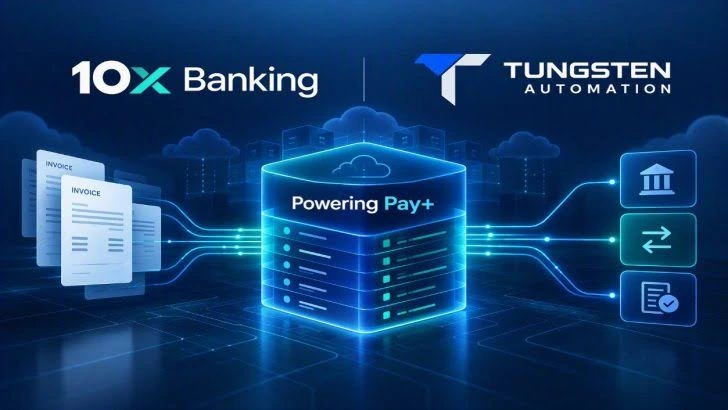
Tungsten Automation is expanding its accounts payable automation capabilities into payments through a partnership with 10x Banking, which will provide the core ledger infrastructure for its new Pay+ platform. The agreement marks a significant step for 10x Banking as it extends its technology beyond traditional financial institutions and into enterprise software-led embedded finance.
Announced in October 2026, the partnership brings together Tungsten’s invoice and accounts payable expertise with 10x Banking’s cloud-native core ledger. Pay+ is designed to connect payment creation, execution, and reconciliation within a single invoice-to-pay workflow, using invoice and supplier information to help determine how payments are processed.
The companies are also highlighting the implementation process. According to 10x Banking, a four-person core team deployed the ledger environment and completed the API integration in less than three months, using an AI agent directed by Tungsten engineers.
Pay+, including the 10x banking ledger, is expected to become generally available in the United Kingdom and the United States in the first quarter of 2027.
Tungsten and 10x Banking Bring Invoice Data Into Payments
Accounts payable teams often manage invoices, approvals, payment execution, and reconciliation across separate systems. Even when invoice processing is automated, finance teams may still need to move information between enterprise resource planning software, banking portals, and payment providers to complete transactions.
That separation can make it harder to maintain a consistent view of payment status, supplier information, transaction costs, and outstanding obligations.
Tungsten’s Pay+ aims to address this gap by extending its invoice-to-pay capabilities into payment orchestration. Rather than treating an approved invoice and its eventual payment as separate processes, the platform is designed to connect them within a unified workflow.
10x Banking will provide the core ledger at the center of that infrastructure. The ledger records transactions in real time and maintains payment information across the Pay+ ecosystem.
The partnership also represents a new deployment model for 10x Banking. The company says this is its first deployment within a platform that is not itself a regulated financial institution, extending its technology into an enterprise software environment.
For Tungsten, the integration adds payment capabilities to an existing relationship with businesses managing invoices and supplier obligations. For 10x Banking, it provides an opportunity to deploy core financial infrastructure in a broader embedded finance setting.
How Pay+ Connects the Invoice-to-Pay Process
Pay+ is designed to bring three essential stages of accounts payable together: payment creation, execution, and reconciliation.
The workflow starts with invoice and supplier information already available within Tungsten’s environment. This information can help determine how payments should be organized and routed through Tungsten’s network of regulated payment partners.
The platform then connects payment execution with transaction recording and reconciliation, reducing the need to reconstruct payment information across disconnected systems.
Payment creation and orchestration
Invoice information can provide important context for payment decisions, including supplier details and the underlying commercial obligation.
Pay+ uses this information to support payment-run creation and route transactions through an appropriate provider or payment rail. This approach is intended to help businesses manage different payment methods within one operating environment instead of relying on separate processes for each provider.
The orchestration layer is important because companies may use multiple banks and payment partners to meet different operational needs. A unified workflow can make those relationships easier to manage while maintaining visibility over individual transactions.
Real-time transaction recording
The 10x Banking ledger records transactions across the Pay+ ecosystem in real time.
According to the companies, ledger entries can include details such as the payment provider, payment rail, transaction category, and associated charges. These records provide a consistent source of transaction information across integrated payment methods.
Keeping payment information together can help finance teams understand what happened to a transaction without having to assemble the full picture from multiple systems.
Reconciliation and auditability
Reconciliation remains a major operational requirement for finance teams. Businesses need to establish that payments correspond to the correct invoices and that the amounts, charges, and transaction statuses are accurately recorded.
By retaining invoice-related commercial information alongside payment records, Pay+ aims to make reconciliation more context-aware and reduce manual work.
A consistent transaction record can also support audit trails and improve visibility when finance teams review payment activity, investigate discrepancies, or prepare period-end accounts.
The intended benefit is not simply faster payment execution. It is a more connected process in which payment activity remains traceable to the original commercial transaction.
Why the Partnership Matters for Embedded Finance
Embedded finance allows businesses to integrate financial capabilities into products and workflows that customers already use. Instead of requiring users to move to a separate financial services platform, a business can offer relevant payment or other financial functions within its existing environment.
The model has expanded across commerce, lending, payroll, marketplaces, and business software. Tungsten’s Pay+ illustrates how it can also develop within accounts payable and enterprise finance.
Tungsten already works with businesses on invoice processing and accounts payable automation. By adding payment orchestration, it can extend the workflow beyond preparing and approving invoices to managing the transactions that settle them.
This creates a more direct connection between the information that initiates a financial obligation and the payment that fulfills it.
The model also demonstrates that a software provider does not necessarily need to become a bank to integrate payment capabilities. Specialist infrastructure providers can supply underlying technology, while regulated payment partners support the relevant payment services.
Olly Richards, SVP Commercial & Strategy at 10x Banking, said the arrangement allows Tungsten to extend its existing invoice and customer relationships into payments without becoming a bank itself.
For enterprise software companies, this approach can provide a route to additional functionality without requiring them to build every component of a financial infrastructure stack internally.
However, embedding payments still requires appropriate operational controls, partner arrangements, and compliance responsibilities. The division of those responsibilities depends on the product structure and the regulated entities involved.
10x Banking Takes Its Core Ledger Beyond Traditional Banks
10x Banking provides core banking technology designed to support financial products and services. Its partnership with Tungsten takes that technology into a different environment: a software platform built around enterprise invoice and payment workflows.
The companies describe the Tungsten deployment as the first time 10x Banking’s ledger has been embedded within a platform that is not a regulated financial institution.
This distinction is important because core ledgers are not limited to recording conventional bank accounts. Their transaction-processing and recordkeeping capabilities can also support financial functions embedded within other digital platforms.
In Pay+, the ledger provides a consistent record of payment activity across the platform’s integrated ecosystem. This allows Tungsten to build payment workflows around transaction-level information without treating every payment provider as a separate source of truth.
The deployment was also configured within Tungsten’s own infrastructure. According to 10x Banking, this self-hosted arrangement allows Tungsten to retain control over its payment data and infrastructure.
For businesses evaluating embedded finance, infrastructure deployment and data control can be significant considerations. They influence how a platform integrates with existing technology, manages information, and establishes operational oversight.
The partnership therefore represents both a product integration and a broader test of how core financial technology can serve enterprise software providers beyond the traditional banking market.
AI-Assisted Integration Completed in Under Three Months
One of the most notable elements of the announcement is the reported implementation timeline.
According to 10x Banking, a four-person core team deployed the ledger environment and completed the API integration in less than three months. The work used an AI agent directed by Tungsten engineers.
The companies present this as an example of AI-assisted software delivery, demonstrating how AI tools can contribute to the implementation of complex financial technology.
For financial infrastructure projects, integration work can involve configuring environments, connecting APIs, testing data flows, and ensuring that systems exchange information correctly. AI-assisted development may help engineering teams accelerate some of these activities.
The announcement does not establish that AI independently built, validated, or operated the entire payment platform. Rather, the stated achievement concerns the deployment of the 10x environment and completion of the API integration by a small team using an AI agent under engineering direction.
That distinction matters in financial services, where implementation speed must be considered alongside security, reliability, data integrity, and operational controls.
The reported timeline is nevertheless relevant to financial technology providers looking to reduce the time and resources required to integrate specialist infrastructure into existing products.
If similar approaches can be repeated across other deployments, AI-assisted implementation could become an important factor in how quickly embedded finance products move from design to operational readiness.
What Pay+ Could Mean for Corporate Finance Teams
The combination of invoice intelligence, payment orchestration and a real-time ledger targets several persistent challenges in accounts payable.
Better payment visibility: Bringing payment activity into a central workflow can help finance teams track transactions and access consistent information about payment status.
More connected reconciliation: Recording invoice-related information alongside payment details can make it easier to trace a transaction to its original obligation and investigate discrepancies.
Support for multiple payment methods: Routing payments through a network of providers and rails can give businesses a more unified way to manage different payment channels.
Stronger transaction records: A consistent ledger can support auditability by preserving details about providers, payment methods, categories and charges.
Less fragmented work: Combining payment creation, execution and reconciliation can reduce the need to move repeatedly between systems and manually reconstruct transaction information.
These are intended capabilities rather than independently verified customer outcomes. The practical impact will depend on implementation, integration with customers’ existing finance systems and the payment partners available through the platform.
For finance leaders, the wider value proposition is the potential to connect invoice processing with the actual movement and recording of money.
UK and US Availability Expected in Q1 2027
Pay+, including the 10x Banking ledger, is expected to become generally available in the United Kingdom and United States during the first quarter of 2027.
The partnership announcement does not establish a confirmed launch day within that period. Businesses considering the platform will need to assess its eventual availability, supported payment partners, integration requirements and suitability for their existing accounts payable processes.
The companies’ approach also reflects a broader shift in enterprise software. Financial functions that were historically managed through separate banking relationships and specialist systems are increasingly being integrated into the applications businesses already use to manage commercial operations.
For providers of core financial infrastructure, this creates opportunities to support new types of platforms. For enterprise software companies, it offers a way to extend products into adjacent financial workflows by working with specialist technology and regulated partners.
The Bigger Picture: Payments Become Part of the Enterprise Workflow
The Tungsten–10x Banking partnership highlights two developments in financial technology: the expansion of embedded payments into enterprise software and the use of AI to support technology implementation.
Pay+ is designed to connect invoices, payment decisions, execution and reconciliation through a shared workflow. The 10x Banking ledger supplies the transaction-recording infrastructure, while Tungsten brings its existing accounts payable capabilities and connections to payment partners.
The reported use of AI in completing the integration adds another dimension, although the longer-term significance will depend on whether similar delivery speed can be achieved consistently while meeting financial infrastructure requirements.
As businesses seek more connected finance operations, the ability to manage the full journey from invoice approval to payment reconciliation could become an important differentiator for enterprise software providers.
The planned Q1 2027 availability in the UK and US will be the next milestone for Pay+. Its progress will help demonstrate how embedded financial infrastructure can move beyond traditional banking environments and become part of everyday corporate finance software.
Comments
No comments yet. Be the first to share your thoughts.
Leave a comment