
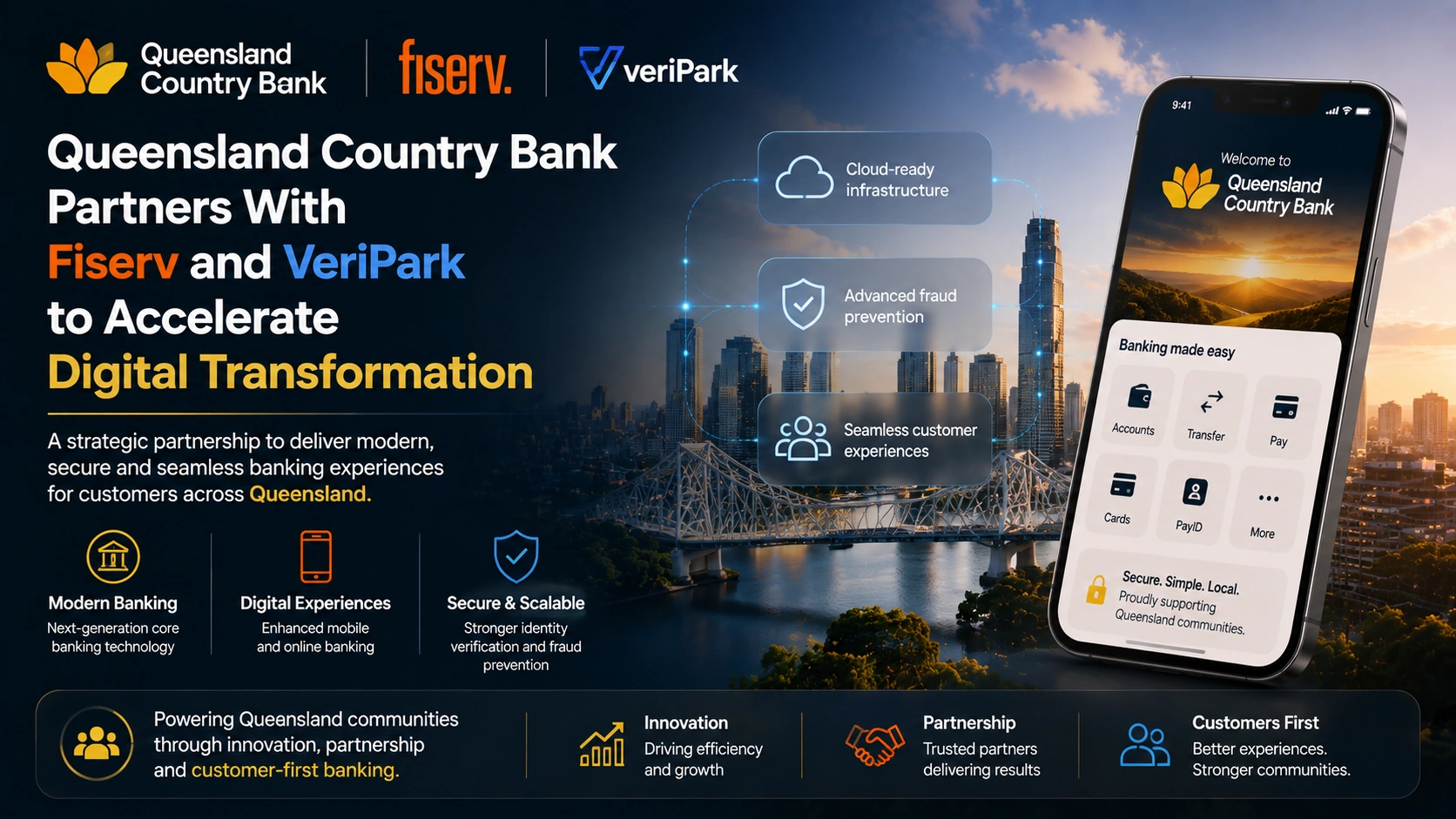
Queensland Country Bank Partners With Fiserv and VeriPark to Modernize Digital Banking
Queensland Country Bank is upgrading its banking technology through partnerships with Fiserv and VeriPark, targeting better digital banking, lending, card services and customer experiences for more than 100,000 members.
Queensland Country Bank is taking a major step in its digital transformation strategy by selecting Fiserv and VeriPark to modernize key parts of its banking technology infrastructure.
The Australian member-owned bank announced the partnerships on August 27 as part of its broader Digital Transformation Program. The initiative is designed to improve the technology supporting everyday banking while making services more connected and easier to use.
According to industry reporting, the transformation will include Fiserv’s Finxact core banking platform and Vision Next card management solution. VeriPark will provide its VeriLoan loan origination system, VeriTouch CRM platform and VeriChannel digital banking technology.
For Queensland Country Bank, the objective goes beyond adding new digital features. The institution is seeking to strengthen the systems behind its banking services while maintaining its member-owned and community-focused identity.
Queensland Country Bank accelerates digital transformation
Banking customers now expect financial services to be fast, convenient and available across multiple channels.
At the same time, financial institutions must keep their underlying technology reliable enough to support those expectations.
Queensland Country Bank says its investment is aimed at addressing both sides of that challenge. The bank wants to improve the member experience while giving its employees better tools to deliver services.
The transformation will cover several important areas, including:
- Digital banking
- Core banking
- Lending
- Card services
- Customer relationship management
- Digital sales and service
- Contact centre operations
- Branch services
As a result, the project could affect many of the systems members interact with during their everyday banking activities.
Fiserv brings core banking and card technology
Fiserv will play a central role in Queensland Country Bank’s technology modernization.
The bank plans to deploy Finxact, Fiserv’s cloud-native core banking platform. The system is designed to provide the underlying infrastructure needed to support modern banking products and services.
Alongside the core platform, Queensland Country Bank will implement Fiserv’s Vision Next card management solution.
The combination is notable because Queensland Country Bank is set to become the first organization to adopt both Finxact and Vision Next simultaneously, according to FinTech Futures.
This approach could help the bank create closer integration between its core banking and card operations.
For customers, that integration may eventually translate into smoother services. However, the practical benefits will depend heavily on implementation and how effectively the new systems connect with existing operations.
VeriPark expands digital and lending capabilities
VeriPark will support another important part of the transformation.
The UK-based technology provider will supply three major platforms: VeriLoan, VeriTouch and VeriChannel. These systems cover loan origination, customer relationship management and digital banking.
Together, the platforms are expected to strengthen both customer-facing and employee-facing services.
For example, a modern loan origination platform can help simplify application workflows. Likewise, stronger CRM technology can give employees better access to customer information and interaction history.
Meanwhile, digital banking technology can help connect services across online channels.
The broader objective is to reduce friction between different parts of the banking journey.
Lending is a key part of the transformation
Lending is one area where customers could see meaningful improvements.
Loan applications often involve multiple stages, documents and internal checks. Legacy systems can make these processes slower and harder to manage.
Modern loan origination technology can automate parts of that workflow while giving banking teams better visibility into applications.
Queensland Country Bank’s deployment of VeriPark’s VeriLoan platform is therefore an important part of the broader transformation.
However, automation does not necessarily mean removing human interaction.
Instead, better technology can allow employees to spend less time managing manual processes and more time helping customers with complex financial decisions.
Digital banking becomes more important for regional institutions
Queensland Country Bank’s investment reflects a wider challenge facing regional and member-owned financial institutions.
Large banks have significant technology budgets and can invest heavily in mobile applications, artificial intelligence, cloud infrastructure and digital services.
Smaller institutions still need to compete on customer experience.
That creates pressure to modernize without losing the qualities that differentiate them.
Queensland Country Bank appears to be taking a partnership-led approach to that challenge. Rather than developing every capability internally, the bank is working with established technology providers to upgrade its infrastructure.
This can potentially accelerate modernization while allowing the institution to focus its internal resources on members and banking operations.
More than 100,000 members could benefit
The scale of the transformation is significant for Queensland Country Bank.
The institution serves more than 100,000 members and operates a 29-branch network alongside digital banking channels, according to FinTech Futures.
That means changes to core systems and digital platforms could have a broad impact across the organization.
Members may eventually experience improvements in areas such as digital banking, lending and card services.
Employees could also gain better tools for managing customer relationships and providing support.
Still, technology projects of this scale take time.
The benefits will depend on how smoothly the platforms are implemented, integrated and adopted across the organization.
Member-owned banking remains central
Despite the technology overhaul, Queensland Country Bank has emphasized that its identity will not change.
The bank says the investment is intended to strengthen its position as a member-owned, community-focused institution rather than move it away from that model.
That distinction matters.
Digital transformation is sometimes presented as a choice between technology and personal service. In reality, modern banking increasingly requires both.
Customers want the convenience of digital channels for everyday transactions. Yet they may still want personal support when dealing with mortgages, financial difficulties or other complex decisions.
Better technology can support that relationship rather than replace it.
Why partnerships are becoming important in banking
Queensland Country Bank’s decision also highlights the growing role of technology partnerships in banking modernization.
Financial institutions face a difficult technology environment. They must upgrade legacy infrastructure, improve digital services, strengthen security and respond to changing customer expectations.
Building everything internally can be expensive and time-consuming.
Technology partnerships offer another route.
Banks can work with specialist providers that already have platforms, expertise and experience across financial institutions.
For vendors such as Fiserv and VeriPark, these agreements also create opportunities to expand their technology footprint within the banking sector.
The result is a growing ecosystem in which banks and fintech providers work together to modernize financial infrastructure.
The Australian banking technology market continues to evolve
Queensland Country Bank’s announcement comes as financial institutions around the world continue replacing older banking infrastructure with cloud-based and more flexible technology.
Core banking systems are particularly important because they sit behind many everyday financial services.
Modern platforms can make it easier for banks to launch products, connect digital channels and integrate third-party services.
At the same time, customer expectations are moving quickly.
Mobile banking is no longer a differentiator on its own. Customers increasingly expect seamless onboarding, faster lending decisions, personalized services and consistent experiences across channels.
That puts greater pressure on the systems underneath the customer interface.
What members can expect
Queensland Country Bank says improvements will be introduced over time as the transformation progresses.
Potential benefits include:
More connected digital banking: Members should gain access to more seamless digital services.
Improved lending processes: Modern loan technology could make applications more efficient.
Better card services: Fiserv’s Vision Next platform will support card management capabilities.
Stronger customer service tools: Employees will have improved technology for managing member relationships.
Greater flexibility: Modern infrastructure can give the bank more room to develop future services.
The bank has indicated that it will continue providing updates as the program moves forward.
The bigger trend: banking infrastructure is becoming strategic
The Queensland Country Bank transformation illustrates a broader change in financial services.
Technology infrastructure was once largely viewed as a back-office function.
Today, it is increasingly a competitive asset.
A bank’s ability to launch products, deliver digital experiences and respond to customer needs depends heavily on the quality of its underlying technology.
That makes core banking modernization a strategic decision rather than simply an IT upgrade.
Queensland Country Bank’s approach shows how this trend is reaching member-owned and regional institutions as well.
What comes next?
The next stage will be implementation.
Queensland Country Bank will need to integrate multiple platforms while maintaining reliable banking services for its members.
The bank will also need to ensure that modernization delivers measurable improvements rather than simply replacing one set of systems with another.
For members, the real test will be straightforward: Does banking become easier?
If digital services become more intuitive, lending becomes more efficient and employees gain better tools to support customers, the transformation could deliver meaningful benefits.
Final Thoughts
Queensland Country Bank’s partnerships with Fiserv and VeriPark represent a significant investment in the future of its banking technology.
The project brings together new core banking, card management, lending, CRM and digital banking capabilities as the institution works to modernize its operations.
Yet the most important part of the strategy may be what happens alongside the technology.
Queensland Country Bank wants to become more digital without losing the member-focused approach that defines its business.
That is the real challenge for modern banking.
The technology needs to become better without making the banking relationship feel less personal.
If Queensland Country Bank can achieve that balance, its transformation could provide a useful example of how member-owned institutions can modernize while preserving the identity that sets them apart.
Comments
No comments yet. Be the first to share your thoughts.
Leave a comment