
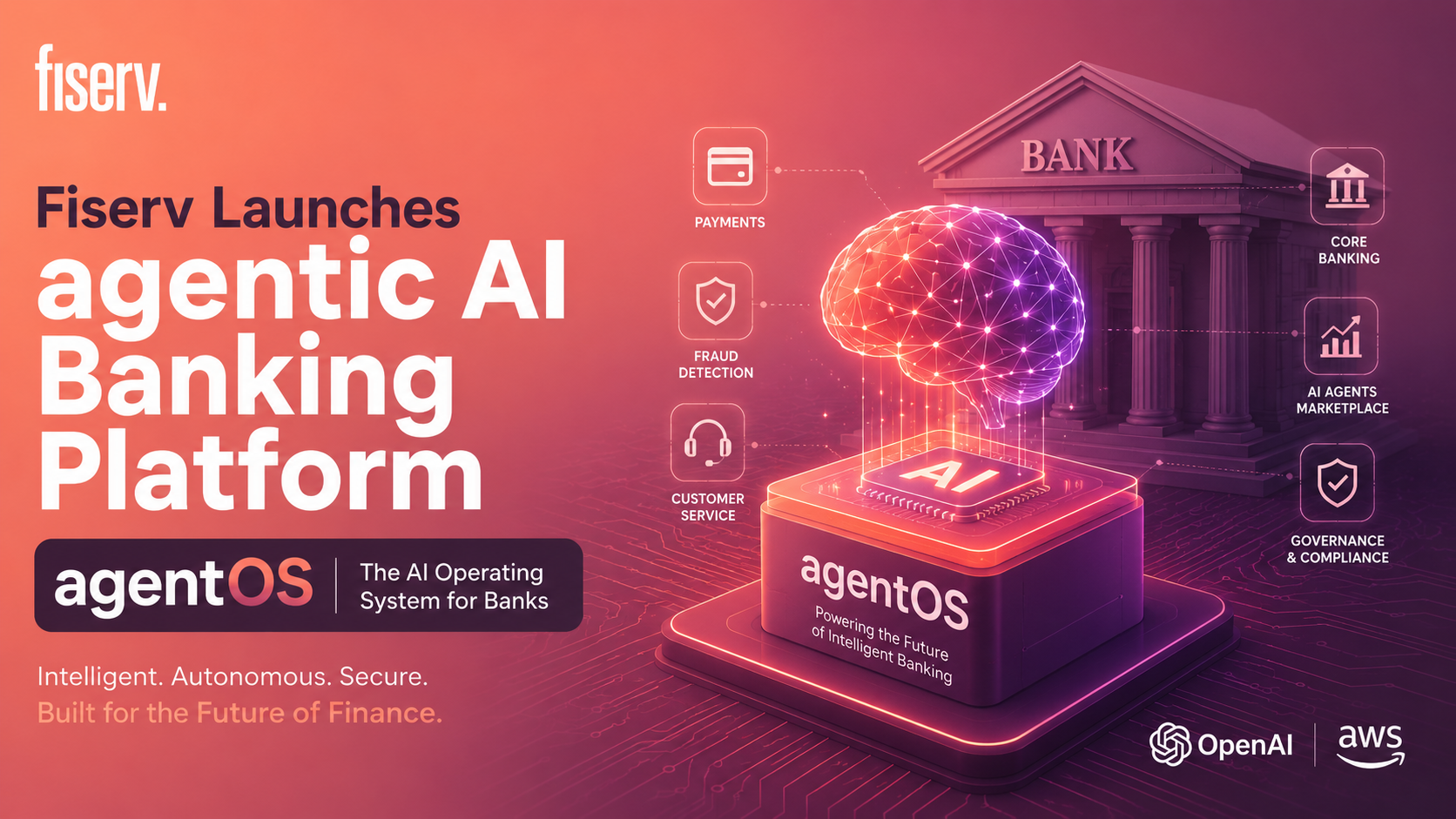
Fiserv has launched a new platform called agentOS, marking a major step in its shift toward agentic AI banking solutions. The announcement highlights how the company is investing heavily in AI-driven banking technology and automated financial systems.
The company is now focusing on agentic AI banking Fiserv innovation, which allows intelligent systems to perform tasks with greater independence within banking operations. As a result, the financial industry is moving closer to fully automated decision-making tools that improve efficiency, reduce manual work, and strengthen customer experiences.
Moreover, this launch reflects the growing demand for smarter financial infrastructure. Banks and fintech firms are increasingly looking for scalable AI systems that can manage operations in real time while also meeting strict compliance standards.
What is agentOS?
The new agentOS platform is designed as an operating system for banks. It enables financial institutions to build, manage, and deploy AI agents across different workflows, supporting the broader agentic AI banking Fiserv strategy.
This system connects several key banking areas, including payments, core banking, fraud detection, customer service, and operational monitoring. Because of this integration, banks can manage all AI functions in a single environment instead of relying on disconnected software tools.
In addition, the platform is designed to simplify AI adoption for financial institutions. Many banks still struggle with outdated infrastructure and fragmented systems. However, agentOS provides a more unified framework that allows institutions to modernise operations without rebuilding their entire technology stack.
At the same time, the platform includes strong governance features. These controls help banks use AI safely while still meeting regulatory requirements and internal risk management policies. As financial regulations continue to evolve, governance tools are becoming increasingly important for AI adoption in banking.
Key features of the AI banking platform
Fiserv has introduced several important capabilities within the platform. A marketplace for AI agents allows banks to choose from Fiserv-built, partner, and custom solutions under the agentic AI banking Fiserv framework.
The platform also supports multiple banking functions through a centralised control system. This helps financial institutions monitor AI performance more efficiently while maintaining transparency across all automated processes.
In addition, the system includes built-in compliance rules, audit logs, and full tracking tools. These features ensure visibility into every AI-driven action and help institutions improve accountability.
Banks can also connect agentOS easily with existing systems, which reduces the need for large infrastructure changes. This makes adoption faster and more practical for both large banks and smaller financial institutions.
Another major advantage of the platform is scalability. As banking operations continue to grow, institutions need systems that can expand without causing operational disruptions. Therefore, agentOS has been designed to support long-term growth and increasing transaction volumes.
Furthermore, the platform supports real-time data analysis, allowing AI agents to react faster to customer activity, fraud risks, and payment behaviour. This capability can improve decision-making speed and operational accuracy.
How agentic AI banking Fiserv supports automation
The rise of agentic AI banking technology, represented by Fiserv, represents a shift from traditional automation toward more intelligent systems. Unlike older automation tools that follow fixed rules, agentic AI systems can analyse situations, make decisions, and complete tasks with minimal human involvement.
As a result, banks can improve efficiency across multiple departments. Customer onboarding, fraud monitoring, transaction reviews, and payment processing can all become faster and more accurate.
In addition, AI agents can support customer service teams by responding to routine questions, handling account requests, and assisting with financial operations in real time. This reduces operational pressure while also improving customer experiences.
The banking industry is also facing growing pressure to reduce operational costs. Therefore, platforms like agentOS may help institutions improve productivity while maintaining strong service quality.
Moreover, intelligent automation can reduce human errors in banking workflows. Since financial institutions handle sensitive transactions every day, accuracy and reliability remain critical priorities.
Partnerships with OpenAI and AWS
To strengthen the platform, Fiserv is working with OpenAI and AWS. These partnerships support the growth of agentic AI banking Fiserv solutions across cloud environments and enterprise systems.
Through this collaboration, banks gain access to advanced AI models and scalable infrastructure. As a result, agentOS becomes more powerful and better suited for large financial institutions handling high transaction volumes.
AWS provides cloud infrastructure support that improves scalability, reliability, and system performance. Meanwhile, OpenAI contributes advanced language and reasoning capabilities that enhance AI agent performance.
Together, these partnerships help Fiserv accelerate innovation in digital banking technology. Financial institutions can benefit from improved automation tools while also maintaining secure and compliant environments.
Furthermore, cloud-based systems allow banks to deploy updates more quickly and improve operational flexibility. This becomes especially important as customer expectations continue to evolve in the digital banking era.
Why this launch matters for banking
This launch represents a clear shift in how banks use artificial intelligence. Instead of relying only on automation, institutions can now deploy agentic AI banking Fiserv systems that act independently within set operational rules.
In addition, agentOS creates a unified control layer for all AI activity. This improves visibility, reduces operational complexity, and helps institutions monitor system performance more effectively.
The banking sector is becoming increasingly digital, and customers now expect faster services, personalised experiences, and real-time support. Therefore, AI-powered systems are becoming essential for modern financial institutions.
Moreover, banks are under constant pressure to improve efficiency while also strengthening security. AI agents can help institutions detect unusual activity faster, respond to fraud risks in real time, and automate repetitive tasks more effectively.
Another important factor is competition. Fintech firms are introducing new digital services at a rapid pace, which forces traditional banks to modernise their systems more aggressively. Platforms like agentOS can help financial institutions stay competitive in a fast-changing market.
Impact on the fintech industry
The introduction of agentOS will influence multiple areas of financial services. Banks adopting agentic AI banking Fiserv solutions are likely to see faster AI adoption and improved efficiency in daily operations.
Fintech companies may also benefit, as the platform opens new opportunities to build agent-based financial products. Meanwhile, payment systems could become more intelligent, responsive, and automated.
In addition, AI-driven platforms may improve fraud prevention capabilities across the payments ecosystem. Real-time monitoring and predictive analysis can help institutions identify suspicious activities more quickly.
The broader fintech sector is also moving toward AI-native infrastructure. Therefore, the launch of agentOS may encourage other companies to accelerate investments in intelligent banking systems.
Furthermore, customer expectations continue to evolve rapidly. Users increasingly demand faster onboarding, seamless digital experiences, and personalised financial services. AI agents can support these expectations more efficiently than traditional systems.
Future outlook for agentic AI banking at Fiserv
Fiserv plans to expand agentOS further in the coming years. Wider adoption of agentic AI banking Fiserv systems is expected as more banks begin to integrate agent-based workflows into their operations.
Over time, AI agents will likely become a core part of banking infrastructure. Consequently, financial systems may become more automated, connected, and intelligent.
Industry experts also expect a stronger regulatory focus on AI governance, transparency, and accountability. Therefore, companies developing AI banking systems will need to maintain high standards for compliance and security.
At the same time, advances in machine learning and cloud computing will continue improving the performance of AI agents. This could lead to even faster decision-making and better operational efficiency across financial institutions.
In the long term, agentic AI may reshape how banks interact with customers, manage risk, and process transactions. As a result, financial services could become more personalised, automated, and accessible.
Conclusion
Fiserv’s agentOS represents a major step toward agentic AI banking transformation. It combines automation, control, scalability, and governance within a single platform designed for modern banking operations.
Overall, this development signals a clear direction for the future of finance, where AI agents play a central role in how banks operate, manage customer relationships, and process transactions. As AI adoption continues to grow, platforms like agentOS could become foundational tools for the next generation of digital banking infrastructure.
Comments
No comments yet. Be the first to share your thoughts.
Leave a comment