
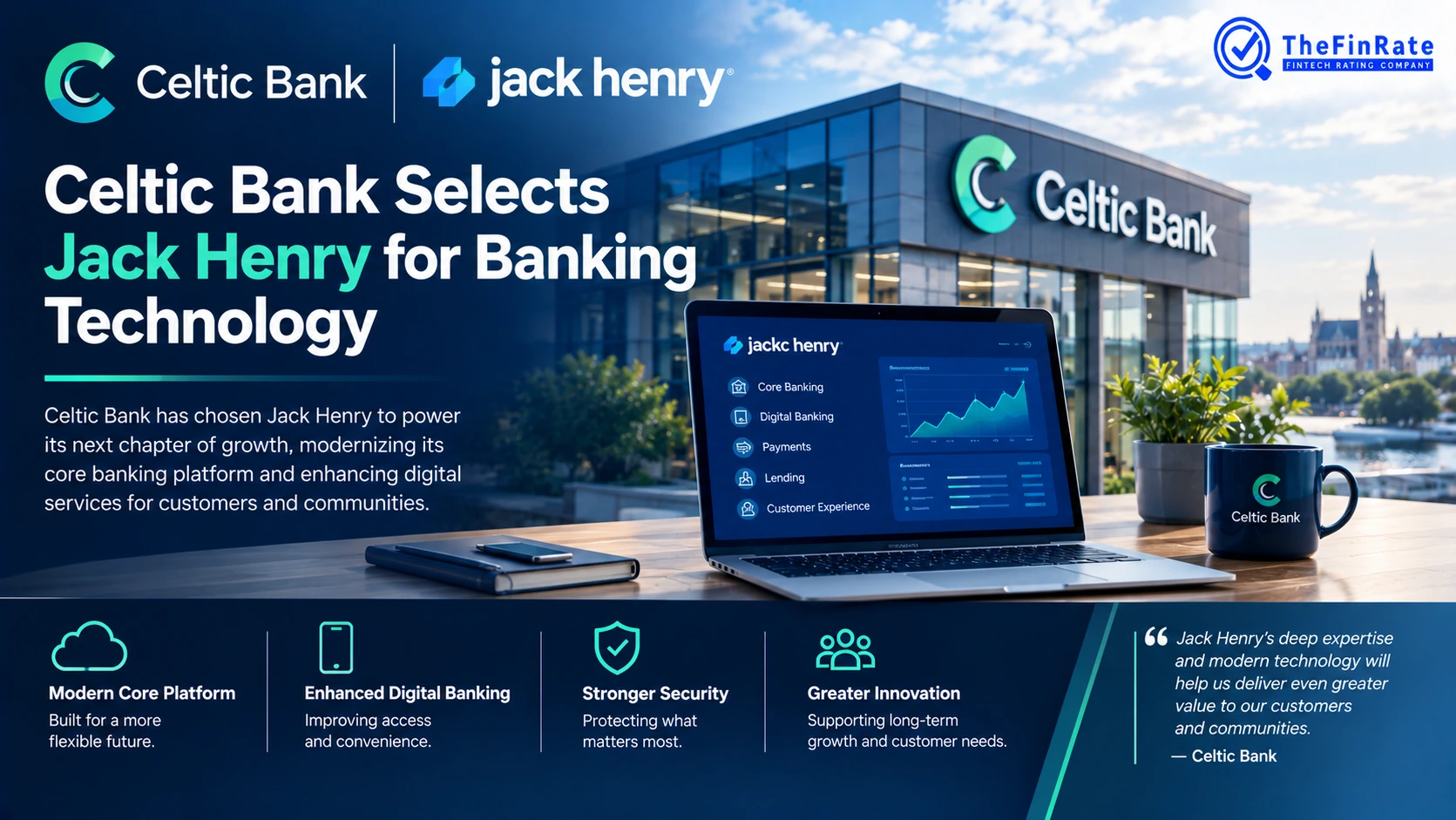
Celtic Bank has selected Jack Henry to modernize its core banking infrastructure, digital business banking and fintech integration capabilities as the $5 billion-asset lender expands its nationwide financing and banking-as-a-service operations.
The agreement is notable because Celtic Bank is not simply replacing its core system. The Salt Lake City-based bank is looking for a broader technology strategy that can support multiple business lines, improve customer experiences and give its BaaS operation more flexibility to integrate fintech providers.
Celtic Bank chooses Jack Henry for core and digital banking
Under the agreement, Celtic Bank will use Jack Henry’s modern core processing platform, alongside several other components from the company’s technology ecosystem.
The bank will deploy Banno Business to provide digital banking capabilities for small-business and commercial customers. It will also use Enterprise Workflow to automate operational workflows and approval processes.
Jack Henry says its open ecosystem provides access to more than 1,000 third-party technology integrations, giving Celtic Bank additional flexibility as it expands its technology stack.
For a bank with a technology-heavy business model, that interoperability is important. Celtic Bank operates across all 50 U.S. states and combines business financing with banking-as-a-service capabilities.
A technology strategy built around flexibility
Celtic Bank CFO Jake Barney said the bank wanted more than a new core system. It wanted a long-term technology strategy that could support growth while improving customer experiences, operational efficiency and BaaS integrations.
That makes the architecture behind the deal particularly important.
Jack Henry’s approach separates core processing from other technology components, allowing financial institutions to select different services instead of being locked into a single technology stack.
The companies also highlighted Jack Henry’s use of modern service components delivered through the public cloud. For Celtic Bank, this provides a path toward modernization without requiring the bank to transform its entire technology environment at once.
Why the deal matters for business banking
Business banking increasingly requires more than basic account and payment functionality.
Small businesses expect digital onboarding, faster financing, intuitive interfaces and increasingly connected financial services. Banks serving fintech partners face an additional challenge: their infrastructure must support external technology providers while maintaining operational control and scalability.
Celtic Bank’s strategy puts that challenge at the center of its technology decision.
The bank is one of the country’s leading SBA lenders and focuses heavily on technology-enabled financing. Its BaaS activities also mean that its infrastructure must support business models beyond traditional branch-based banking.
Jack Henry strengthens its fintech ecosystem position
The Celtic Bank agreement also reinforces Jack Henry’s broader strategy around open banking technology.
Rather than positioning the core as the only source of innovation, Jack Henry is increasingly emphasizing connectivity between its own products and external fintech applications.
Its ecosystem now supports more than 1,000 third-party integrations, while the company says it serves more than 7,200 financial institutions.
That model could become increasingly relevant as banks seek to modernize without rebuilding every part of their technology infrastructure internally.
The bigger shift: from core replacement to technology orchestration
The most interesting element of the Celtic Bank deal may therefore be what it says about the changing role of the bank core.
For years, core banking modernization often meant replacing one large system with another. Increasingly, banks want a more modular architecture in which core processing, digital banking, workflow, payments and fintech applications can evolve independently.
Celtic Bank’s selection reflects that direction.
Its stated objective is to retain the freedom to choose technology based on its business needs while maintaining a scalable foundation for growth.
For a lender combining SBA financing, commercial banking and BaaS, that flexibility could become a competitive advantage.
What comes next
The announcement does not disclose the financial terms of the agreement or a detailed implementation timetable.
What is clear is the strategic direction. Celtic Bank is investing in an infrastructure designed to support nationwide growth, digital business banking and a more integrated fintech ecosystem.
Jack Henry, meanwhile, gains another significant banking customer for its modern core and surrounding technology stack.
As banks increasingly treat technology architecture as a strategic asset rather than simply an operational system, partnerships like this are likely to become more important across the financial-services industry.
Bottom line: Celtic Bank’s Jack Henry selection is less about simply changing core processors and more about building a flexible technology foundation for business banking, lending and BaaS growth
Comments
No comments yet. Be the first to share your thoughts.
Leave a comment