
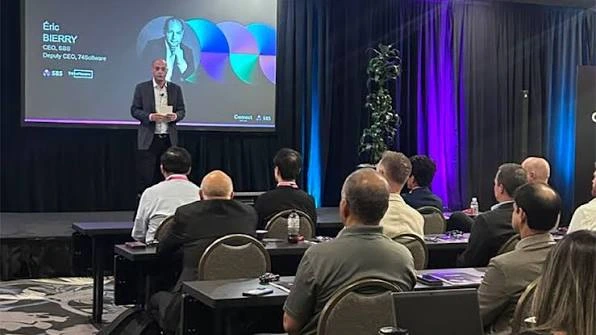
SBS has introduced a sovereign AI platform built with NVIDIA that allows banks to deploy artificial intelligence within their own controlled environments. Already living with Scottish Building Society in the UK, the platform targets data privacy, regulatory governance, and operational efficiency as financial institutions look to move AI beyond experimentation.
SBS, the financial technology provider serving more than 1,500 financial institutions, has launched the SBS AI Foundation, a sovereign AI platform designed to bring generative AI into core banking operations without requiring sensitive customer and transaction data to leave a bank’s controlled environment.
Announced on 13 October 2026, the platform is powered by NVIDIA technology and is designed to operate across private cloud, managed cloud, and on-premises infrastructure. It is already running in production with Scottish Building Society in the UK on Amazon Web Services (AWS), according to SBS.
The announcement addresses a persistent challenge for financial institutions: how to adopt artificial intelligence at scale while maintaining control over sensitive information, regulatory obligations, and internal risk management.
Banks are exploring AI to improve customer engagement, accelerate reporting, identify risk, and reduce manual work. Yet these applications often require access to information held across core banking, lending, digital banking, and compliance systems. Moving that information into external AI services can create additional data protection, governance, and operational concerns.
SBS is positioning its platform as a way to bring AI capabilities to the bank’s data environment, rather than requiring the bank to send sensitive records elsewhere for processing.
What Is the SBS AI Foundation?
The SBS AI Foundation is designed to connect AI capabilities with data held across a financial institution’s existing SBS technology environment. Its intended applications include customer onboarding, customer engagement, natural-language data analysis, operational decision-making, and risk monitoring.
The platform combines SBS banking software with NVIDIA’s AI infrastructure and software stack. According to the company, the technology includes NVIDIA NIM microservices, NVIDIA NeMo Guardrails, and open Nemotron models.
These components serve different purposes. NIM microservices support the deployment and operation of AI models, while NeMo Guardrails is designed to help constrain model behavior according to defined policies. Nemotron models form part of the underlying AI model offering.
By integrating these components into its banking technology environment, SBS aims to give financial institutions a common AI foundation that can support several operational use cases without requiring each application to be developed as an isolated project.
The platform is designed to work with structured and unstructured information from systems covering core banking, lending, digital banking, and regulatory reporting.
This integration is important because AI tools are only as useful as the information they can access, interpret, and use appropriately. When data remains fragmented across systems, banks can face lengthy integration projects and inconsistent outputs. Connecting AI with established banking data infrastructure may help reduce those obstacles, although results will depend on each institution’s systems, data quality, and implementation.
SBS says the platform is available to financial institutions across its global customer base of more than 1,500 institutions.
Why Sovereign AI Matters for Banking
Sovereign AI refers broadly to the ability of an organization or jurisdiction to retain meaningful control over its AI infrastructure, data, deployment environment, and governance. The precise meaning varies by implementation: keeping data within a controlled environment is an important component, but it does not automatically resolve every issue involving legal jurisdiction, third-party access, cybersecurity, or model governance.
For banks, these distinctions matter.
Financial institutions process account information, payment records, lending histories, customer identities, and other confidential data. Their use of AI must account for data protection obligations, contractual restrictions, internal policies, and the regulatory requirements applicable to their operations.
A conventional AI deployment can involve sending information to an external model provider or service environment. Depending on the architecture and contractual arrangements, that may raise questions about data residency, access controls, retention, security, and the use of customer information.
SBS says its AI Foundation is designed so that data does not have to leave the institution’s own environment. Customers can deploy the platform on private cloud infrastructure, managed cloud infrastructure, or entirely on-premises systems, depending on their requirements.
This flexibility could be relevant to institutions that want to modernize operations but are reluctant to move sensitive workloads into environments they cannot govern directly.
However, sovereign deployment should not be confused with automatic regulatory compliance. Banks will still need to assess their specific configurations, access permissions, model behavior, supplier arrangements, and audit processes. The platform provides infrastructure intended to support governance; each institution remains responsible for its own compliance and risk controls.
Scottish Building Society Is Already Using the Platform
Scottish Building Society has become the first announced production customer for the platform. The UK institution is running the SBS AI Foundation within its environment on AWS.
SBS reports that the deployment is delivering approximately 30–40% faster response times, alongside more consistent outputs. The company also says the implementation maintains explainability and an audit trail.
These results are notable because banking AI projects must deliver more than a convincing demonstration. Financial institutions need systems that can function within day-to-day operations and provide sufficient visibility into how outputs are produced and used.
The reported improvement could help reduce delays in workflows that depend on retrieving and interpreting information. However, SBS has not established in its announcement that the same improvement will apply to every institution or workload. Results can vary according to the use case, infrastructure, data architecture, and baseline performance.
For banks evaluating similar platforms, the practical questions extend beyond response speed. They include whether the technology improves staff productivity, reduces the time required to prepare reports, helps teams identify risk earlier, and maintains appropriate controls over decisions that affect customers.
The Scottish Building Society deployment gives SBS a live implementation to demonstrate as it seeks to expand adoption among other financial institutions.
Three Core Use Cases for Banks
SBS identifies three principal areas in which the platform is intended to support banking operations.
1. AI-assisted customer onboarding and engagement
The first application area focuses on using a bank’s own records and product information to support more relevant customer interactions.
AI could help employees understand a customer’s existing relationship with the institution, identify potentially relevant products, and provide more context during onboarding or servicing. It may also support personalization by helping teams interpret information already held within banking systems.
The potential benefit is a more informed customer experience, with less time spent collecting information from separate sources.
For banks, however, personalization must remain consistent with applicable privacy rules, suitability requirements, and internal policies. AI-generated suggestions should not automatically be treated as appropriate recommendations without the necessary checks.
2. Natural-language intelligence and reporting
The second area concerns how employees access and analyze banking data.
Traditional reporting processes can require staff to understand specialist systems, construct complex queries, or wait for analysts to produce reports. Natural-language interfaces aim to make it easier for users to ask questions about data in everyday language and receive relevant insights.
SBS says its platform can help turn complex queries across structured and unstructured information into insights, potentially reducing reporting delays.
If implemented effectively, this approach could help product teams, executives, and operational staff investigate trends without relying on the same manual process for every question.
Accuracy remains essential. AI-generated analysis needs to be grounded in reliable data, and users must be able to understand the source of an answer and recognize when a model is uncertain or has misunderstood a request. For regulated institutions, auditability and appropriate access permissions are particularly important.
3. Risk monitoring and compliance intelligence
The third application area is risk and compliance.
Banks must monitor a range of exposures, review operational information, and maintain records that support internal controls and regulatory scrutiny. AI could help teams identify relevant information across systems, highlight potential issues, and organize findings for further investigation.
SBS says the platform is designed to provide sovereign risk intelligence while maintaining an audit trail within the institution’s controlled environment.
This does not mean AI replaces compliance officers, risk specialists, or established control frameworks. Rather, the intended role is to help employees access information and identify areas requiring attention more efficiently.
Institutions would still need to test outputs, manage false positives and omissions, establish escalation processes, and ensure that consequential decisions receive the appropriate human review.
Agentic AI Is Part of the Roadmap
SBS also plans to extend the platform to agentic AI capabilities.
Unlike a conventional generative AI assistant that responds to a prompt, an AI agent can be designed to carry out a sequence of tasks toward a defined objective. In banking, potential applications could include gathering information from multiple systems, preparing workflow documentation or coordinating steps in an operational process.
SBS says future capabilities will focus on automating multi-step core banking workflows, with human oversight and a governed operating environment.
The distinction between current and planned capabilities is important. The October announcement describes the sovereign AI platform and its production deployment; more autonomous workflow execution is presented as a future extension, not as a claim that every banking process is already being handled autonomously.
For banks, agentic AI could eventually reduce repetitive work across operations, servicing and reporting. Yet the technology also raises questions about permissions, accountability and the boundaries of automated action.
A system that can retrieve information is different from one that can change customer records, initiate transactions or make decisions with financial consequences. The latter requires stronger controls, explicit authorisation, monitoring and reliable intervention mechanisms.
Keeping agents within a bank-controlled environment may address some infrastructure and data concerns, but it does not remove the need for careful design and oversight.
NVIDIA’s Role in the Platform
The collaboration also illustrates NVIDIA’s expanding role in enterprise AI deployments.
Although NVIDIA is widely associated with AI computing hardware, its enterprise software and model ecosystem are increasingly used to build applications for specific industries. In this case, SBS is integrating NVIDIA components into a platform built around banking systems and operational requirements.
SBS says the deployment represents the first use of NVIDIA’s full AI stack—including NIM, NeMo Guardrails and open Nemotron models—within a live core banking system.
The significance is the combination of AI infrastructure with a domain-specific banking platform. Financial institutions often need technology providers to address integration, data management and governance alongside model performance. A packaged approach may reduce some of the work required to connect general-purpose AI tools to established banking applications.
Still, institutions will need to assess the complete architecture, including dependencies on technology providers, deployment costs, system performance, security arrangements and the long-term flexibility of their AI infrastructure.
Can Sovereign AI Help Banks Move Beyond AI Pilots?
The launch comes as financial institutions face pressure to demonstrate measurable returns from AI investments.
Many banks have experimented with chatbots, employee assistants and analytical tools. Scaling these initiatives across core operations is more difficult because production systems must meet expectations for security, reliability, data quality and governance.
SBS is attempting to address this challenge by embedding AI into the technology environment it already provides to financial institutions.
That could appeal to banks that want to build on existing core banking and lending systems rather than create entirely separate AI architectures. It also gives the company an opportunity to extend its relationship with current customers as demand shifts from isolated AI tools towards integrated platforms.
But a controlled deployment environment is only one part of successful adoption. Banks must also establish clear business objectives, train employees, assess model outputs and determine how AI-supported workflows fit into existing accountability structures.
The commercial case will ultimately depend on whether implementations produce tangible improvements in service quality, processing time, operating costs or risk management. The reported results from Scottish Building Society provide an early indication, but broader evidence across different institutions and use cases will be needed to assess the platform’s performance at scale.
What the Launch Means for Core Banking Technology
SBS’s announcement reflects a broader change in how financial institutions are approaching AI infrastructure.
The discussion is moving beyond which model can generate the most impressive answer. Banks are increasingly concerned with where AI runs, what information it can access, how its outputs are governed and whether the technology can be integrated into critical operations.
Sovereign AI platforms could become an important option for institutions that need tighter control over data and deployment. They may also help technology providers differentiate themselves by combining established banking software with governed AI capabilities.
Nevertheless, sovereignty alone is not a guarantee of safety or business value. Strong data foundations, access controls, testing, monitoring and human accountability remain essential.
For SBS, the next challenge will be to turn its initial production deployment into repeatable implementations across a wider customer base. For banks, the decision will depend on whether the platform fits their technical architecture, regulatory responsibilities and measurable operational priorities.
The bottom line: SBS is betting that banks can adopt AI more confidently when the technology is designed around the systems, data and governance requirements they already have. Its collaboration with NVIDIA and live deployment at Scottish Building Society offer an early example of that approach. The longer-term test will be whether sovereign AI can deliver reliable, scalable improvements in core banking without compromising the controls on which financial institutions depend.
Sources
- SBS, SBS Launches Banking’s First Sovereign AI Platform, 13 October 2026: https://sbs-software.com/news/sbs-launches-bankings-first-sovereign-ai-platform/
Comments
No comments yet. Be the first to share your thoughts.
Leave a comment