
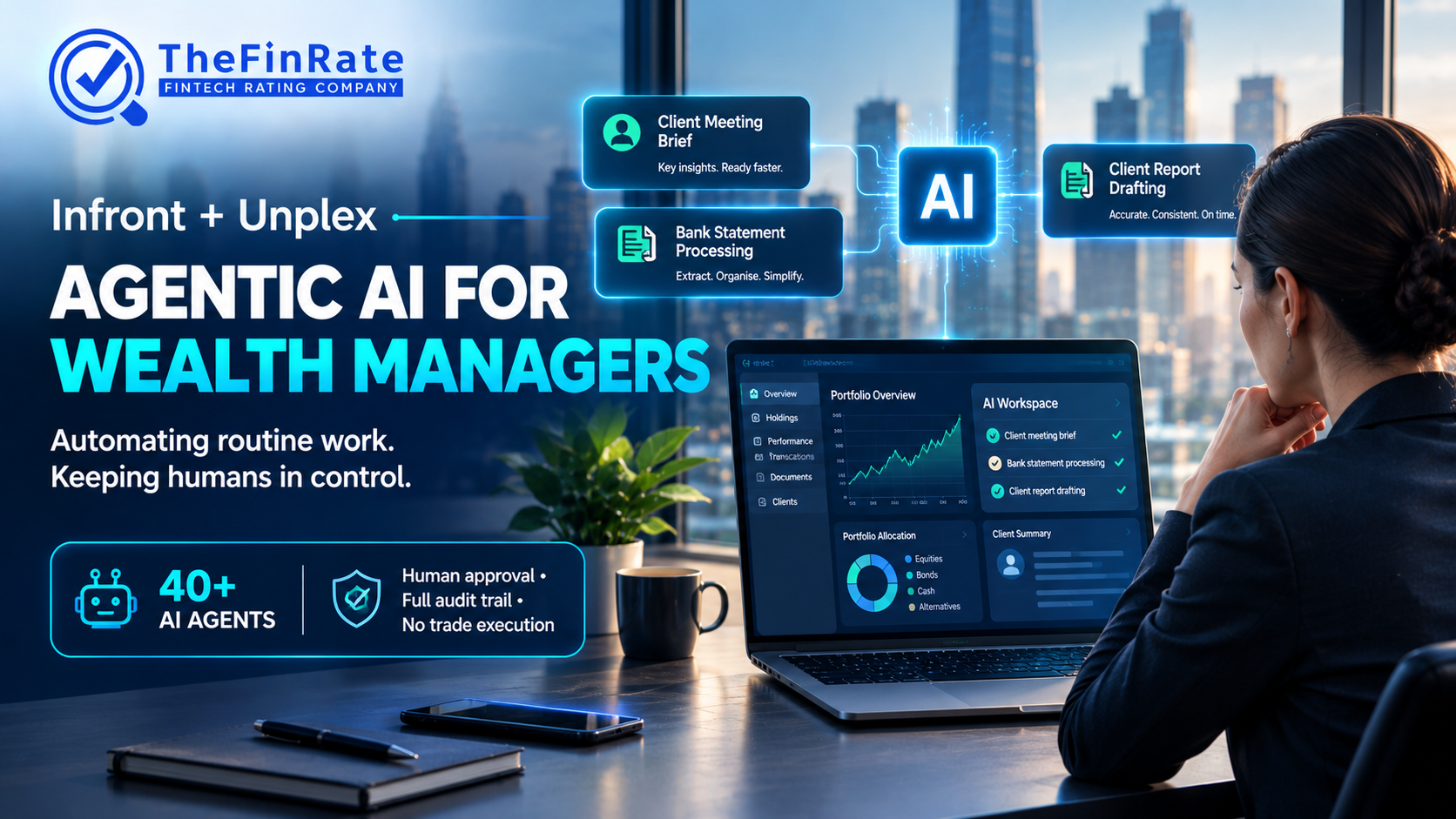
The partnership integrates AI agents into Infront’s Assetmax and Infront Portfolio Manager platforms, automating routine wealth-management workflows while retaining human approval and audit controls.
Infront has partnered with Swiss technology company Unplex to bring agentic artificial intelligence (AI) into wealth managers’ existing portfolio management systems. Under the agreement, Infront will offer its AI Workspace, built on Unplex technology, as an add-on for Assetmax and Infront Portfolio Manager.
The workspace is designed to automate administrative and documentation-heavy tasks, including client meeting preparation, bank statement processing and drafting client reports. By connecting AI agents directly to portfolio management data, the companies aim to reduce manual work without requiring wealth managers to migrate to a separate system.
An initial group of users is already working with the product, with additional clients being onboarded, according to the announcement.
The partnership addresses a practical challenge for wealth managers: financial professionals often spend significant time gathering portfolio information, preparing client documentation and updating records instead of focusing on client relationships and investment decisions.
For Infront, the agreement extends its strategy of embedding AI into its investment technology products. For Unplex, it brings its agentic automation capabilities into established portfolio management workflows used by wealth managers across Europe.
Crucially, the companies are positioning the workspace as a tool for controlled operational automation, not as a system that independently makes investment decisions or executes transactions.
How Infront’s AI Workspace Works
The Infront AI Workspace combines Infront’s portfolio management data and integrations with Unplex’s agentic automation technology. Rather than functioning solely as a conversational chatbot, the workspace is designed to carry out defined, multi-step tasks using information held in the systems wealth managers already use.
The distinction between a conventional AI assistant and an agentic workspace is important. A chatbot may answer a question about a client’s portfolio, but an agent can be configured to gather the relevant information, organise it, prepare a document and move the task through a defined workflow.
For example, preparing for a client meeting may involve retrieving current portfolio positions, reviewing performance, gathering relevant client history and compiling discussion points. An AI agent can bring those elements together into a structured briefing for a relationship manager to review.
Similarly, processing a bank statement may involve extracting information from a document, identifying relevant transactions or holdings and preparing data for the appropriate workflow. Drafting a client report can require combining portfolio information with established reporting formats and firm-specific language.
By connecting these tasks to existing portfolio management systems, the workspace is intended to reduce repetitive information handling while keeping the underlying records within the established operational environment.
The product is offered as an add-on to Assetmax and Infront Portfolio Manager. This approach allows participating clients to access AI-driven workflows within their current technology setup rather than adopting an entirely separate portfolio management platform.
API and MCP Integrations Connect AI Agents to Portfolio Data
The workspace connects with Assetmax and Infront Portfolio Manager through dedicated application programming interfaces (APIs) and Model Context Protocol (MCP) integrations.
APIs allow software systems to exchange information and invoke specific functions. MCP provides a standardised way for AI applications to connect with external tools and data sources. Together, these integration methods can help AI agents access the information and capabilities needed to complete defined tasks.
The connected data can include client records, investment mandates, portfolio positions, transactions and performance information. Access to this context is important because wealth-management workflows depend on accurate, up-to-date records rather than isolated documents or manually exported spreadsheets.
For instance, a client meeting brief based on an outdated portfolio export could contain figures that no longer reflect the client’s current holdings. A workflow connected to the portfolio management system can instead retrieve the relevant information from the source system, subject to its configured permissions.
Infront’s existing portfolio platforms remain central to the process. The AI workspace is intended to work alongside them, using integrations to support operational tasks rather than replacing the core portfolio management infrastructure.
The use of MCP also reflects a wider industry movement towards connecting AI applications with business systems through standardised interfaces. Financial technology providers are exploring these integrations to make institutional data more accessible to AI tools while maintaining control over which information and functions are available.
However, connectivity alone does not guarantee accuracy or regulatory compliance. Firms still need to configure access permissions, validate generated outputs, manage sensitive information and ensure that workflows operate within their internal policies.
Which Wealth-Management Tasks Can Be Automated?
The partnership focuses on recurring activities that consume time but still require accurate information, consistent documentation and professional oversight.
Client meeting preparation: AI agents can gather portfolio positions, performance information and relevant client history to produce a briefing for an adviser or relationship manager. This can reduce the time spent switching between systems before a meeting.
Bank statement processing: Agents can help extract and organise information from bank statements, supporting workflows that would otherwise require manual review and data entry. Any extracted information still needs appropriate validation before it is relied upon.
Client report drafting: The workspace can prepare draft reports using portfolio data and established reporting structures. Human review remains important to confirm that figures, explanations and client-specific details are correct before a report is finalised or delivered.
These use cases share a common characteristic: they involve gathering information, processing it and producing a structured output. They can therefore be candidates for automation without handing over the professional judgement that sits at the heart of wealth management.
The potential benefit is not simply faster document production. It is the opportunity to give advisers and portfolio professionals more time for client communication, financial planning and decisions that depend on experience and context.
The realised benefit will depend on how reliably the workflows perform, how well they integrate with each firm's processes and how much review is still required.
Human Oversight Remains Central to the Model
In wealth management, automation must be balanced against the need for accountability. Client information can be sensitive, portfolio data must be accurate and external communications can carry financial and regulatory implications.
According to the partnership announcement, the portfolio management system remains the system of record, the workspace does not execute transactions, and employees review and approve outputs. The system also maintains an audit trail of the steps taken.
These controls are designed to keep professional responsibility with the firm and its employees. AI agents may prepare information and draft documentation, but they are not intended to make independent investment decisions or execute trades through this workspace.
This distinction separates operational automation from autonomous portfolio management. The former can streamline the preparation and handling of information; the latter would involve a different level of responsibility and risk if an AI system were permitted to make investment decisions or initiate transactions independently.
Audit trails can also help firms reconstruct how a result was produced, which information was used and what actions took place during a workflow. That can be valuable when investigating errors, reviewing internal processes or demonstrating how a document was prepared.
Nevertheless, an audit trail does not eliminate the possibility of incorrect outputs. Wealth managers still need effective review procedures, access controls, testing and clear accountability for approving client-facing material.
Swiss and EEA Data Residency Addresses a Key Concern
The companies have highlighted data residency and security as important features of the workspace. According to the announcement, the environment is hosted in Switzerland, with data processed exclusively in Switzerland and the European Economic Area (EEA). Unplex also holds ISO/IEC 27001:2022 certification.
These provisions are relevant because wealth managers handle personal information, financial records and details about clients’ assets and investment mandates. Introducing AI into these workflows requires firms to understand where information is stored and processed, which providers can access it and how data is protected.
Data residency can help firms meet their internal requirements and assess the implications of using external technology providers. ISO/IEC 27001 certification indicates that an organisation has a certified information security management system within the relevant certification scope; it should not be interpreted as a blanket guarantee that every product, workflow or deployment is risk-free.
Firms will still need to review contractual terms, data-processing arrangements, access permissions, subprocessors and their own regulatory obligations before deploying the workspace. They should also establish how sensitive information is handled when AI models or external services are involved.
The broader issue extends beyond where data is hosted. Wealth managers need to understand how information flows between the portfolio system, the AI workspace and any connected services, as well as how outputs can be checked against their original sources.
For regulated firms, these controls are part of determining whether an AI product is suitable for real operational use rather than a limited demonstration.
Why Agentic AI Is Relevant to Wealth Management
Wealth management combines data-intensive operations with work that depends heavily on human relationships and judgement. Advisers need to understand client circumstances, monitor portfolios, respond to changing market conditions and maintain detailed records of their interactions.
At the same time, a considerable amount of supporting work involves repetitive steps: collecting information, checking records, preparing meeting notes, drafting letters and documenting reviews.
Agentic AI offers a way to automate parts of those processes by coordinating multiple actions rather than responding to one prompt at a time. When connected to a firm's existing systems, an agent can retrieve relevant information, follow a defined sequence of steps and prepare an output for review.
This could help wealth managers improve the consistency of documentation and reduce the operational burden associated with recurring tasks. It may also make it easier for teams to prepare client materials using a common structure, provided the system is configured to follow the firm's standards.
However, financial services require a cautious approach. Generated content can contain errors, source data can be incomplete, and an agent may misunderstand an instruction or encounter an unusual case. Firms need to establish where automation is appropriate, when a task must be escalated and which decisions must remain with a qualified employee.
The Infront–Unplex partnership reflects an approach in which AI is integrated into a controlled workflow with defined boundaries, rather than being treated as an unrestricted substitute for professional expertise.
Infront’s Broader Strategy for AI in Financial Technology
Infront supplies market data and investment technology across Europe, serving wealth managers, banks, asset managers, insurers and other financial professionals.
The company says its platform supports more than 3,500 businesses and 70,000 financial professionals across Europe. Its business spans data intelligence, portfolio management and advisory, as well as trading and investor solutions.
The AI Workspace partnership fits into a wider strategy to incorporate AI into these product areas. In June 2026, Infront announced AI capabilities for wealth managers, including an MCP server and an agentic workspace initially being piloted with Assetmax customers. The company said the modules were planned as add-ons for Assetmax customers from the fourth quarter of 2026.
The newer partnership with Unplex provides further context on the technology behind the workspace and its integration into Infront’s portfolio management products.
For Infront, embedding AI into existing systems could make its software more useful for day-to-day operational work, rather than limiting its role to data presentation and portfolio administration. It also allows the company to build on existing customer relationships and integrations.
The wider opportunity for financial software providers is to move from supplying tools that display information to offering workflows that help professionals act on it. The challenge is to do so without weakening the controls and reliability expected of systems used by financial institutions.
What the Partnership Means for Unplex
Unplex develops agentic automation technology for regulated and documentation-intensive sectors, including wealth management and legal services.
Its role in the partnership is to provide the technology underlying the AI Workspace, while Infront brings its portfolio management products, integrations and relationships with investment-industry customers.
The arrangement gives Unplex a route into established wealth-management workflows through Infront’s existing platforms. For customers, the partnership offers access to AI-driven automation within software they already use, subject to availability, onboarding and the relevant product configuration.
The collaboration also illustrates how AI providers may reach regulated industries through partnerships with established software companies. Rather than requiring each customer to build an AI integration from scratch, a technology provider can work with a platform vendor to incorporate automation into existing workflows.
That model can simplify deployment, but it does not remove the need for due diligence. Firms must still assess the technology provider, the integration architecture, the scope of permissions and the controls applied to their data and business processes.
What to Watch as Adoption Expands
The next stage will be practical deployment across additional clients and workflows. Several factors will determine whether the workspace delivers lasting value.
First, accuracy will be critical. Wealth managers need confidence that generated briefs and reports reflect the correct client records, portfolio positions and transactions.
Second, integration quality will matter. The more reliably the workspace connects with the firm's existing data and processes, the less manual correction may be required.
Third, governance must remain effective as use expands. Firms will need to review access permissions, audit records, approval procedures and exception handling as they introduce additional agents or automate more tasks.
Finally, productivity gains need to be assessed against real workflows. Time saved in preparing a document may be offset if employees must repeatedly correct its contents or reconcile information across systems. Measuring accuracy, review time and operational outcomes will therefore be as important as counting the number of tasks automated.
The partnership announcement signals a move towards embedding agentic AI into wealth-management software. Its longer-term significance will depend on whether the technology can deliver reliable results within the constraints of regulated financial operations.
Comments
No comments yet. Be the first to share your thoughts.
Leave a comment