
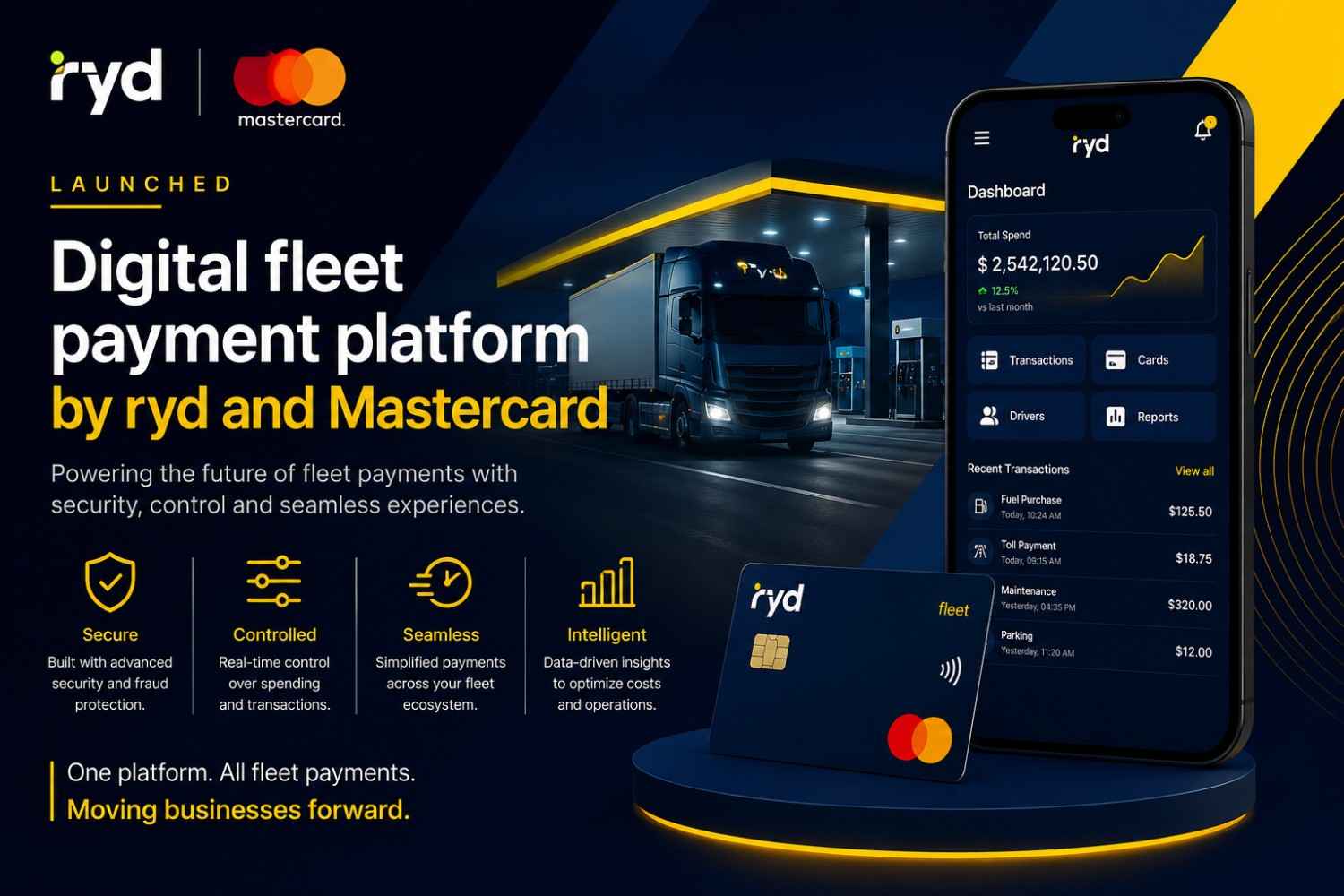
A new digital fleet payment platform from Ryd and Mastercard is set to modernise how businesses manage vehicle payments and mobility expenses.
The partnership combines Mastercard’s global payment infrastructure with Ryd’s connected mobility technology. As a result, businesses may gain faster and more flexible fleet payment solutions.
Moreover, the launch reflects growing demand for digital fleet management tools as companies continue shifting toward connected mobility services.
In addition, businesses are increasingly looking for ways to reduce manual expense management while improving operational efficiency. Therefore, digital payment platforms linked to mobility services are becoming more important across the transportation and fintech sectors.
Why digital fleet payment platforms are growing
The market for digital fleet payment platforms has expanded rapidly in recent years. Traditionally, many fleet operators relied on fuel cards, paper receipts, and manual reporting systems.
However, those systems often created:
- Delayed expense tracking
- Limited payment visibility
- Manual reconciliation work
- Higher administrative costs
Consequently, businesses began adopting digital fleet payment solutions that offer real-time transaction management and automated reporting.
Furthermore, connected mobility services are increasing the demand for integrated payment systems across commercial transportation.
How the Ryd and Mastercard platform works
The new fleet payment solution aims to simplify payments connected to:
- Fuel purchases
- Vehicle charging
- Fleet expenses
- Mobility services
Instead of relying on traditional payment methods, businesses can use a connected digital system for fleet transactions.
Moreover, the platform may help companies manage vehicle-related spending more efficiently.
Because the system is integrated with Mastercard’s payment network, businesses may also benefit from broader payment acceptance and secure transaction processing.
As a result, fleet operators could reduce administrative complexity and improve expense visibility.
Digital fleet payment platform improves operational efficiency
One major advantage of the digital fleet payment platform is improved operational efficiency.
Businesses managing vehicle fleets often face challenges related to:
- Expense tracking
- Driver payments
- Receipt collection
- Reporting delays
However, digital systems automate many of these processes.
For example, automated transaction recording can reduce manual accounting work. Similarly, real-time expense visibility helps businesses monitor spending more accurately.
Consequently, companies may improve cost control while reducing operational friction.
Mastercard expands mobility and payment infrastructure
The launch also highlights Mastercard’s continued expansion into mobility-related payment infrastructure.
In recent years, payment companies have increasingly focused on:
- Connected transportation
- Embedded payments
- Mobility commerce
- Digital vehicle services
Because mobility ecosystems are becoming more digital, payment providers see growing opportunities in fleet and transportation payments.
Furthermore, connected payment systems are expected to play a larger role as electric vehicles and smart mobility services expand globally.
Therefore, partnerships like this reflect wider trends across fintech and mobility sectors.
Fleet payment solutions support digital business mobility
Modern businesses increasingly rely on digital tools to manage transportation and logistics operations.
As a result, demand for connected fleet management payments continues growing.
Today’s businesses want systems that provide:
- Faster payments
- Real-time expense tracking
- Automated reconciliation
- Better financial reporting
Therefore, digital fleet payment platforms are becoming part of broader enterprise mobility strategies.
Moreover, automation can help reduce errors and simplify financial workflows for fleet operators.
Comparison between traditional fleet payments and digital platforms
| Feature: Traditional | l Fleet Payments, Digital | l Fleet Payment Platform |
|---|---|---|
| Expense tracking | Manual | Automated |
| Payment visibility | Limited | Real-time |
| Reporting process | Slower | Faster |
| Administrative workload | Higher | Reduced |
| Payment flexibility | Restricted | More flexible |
This comparison highlights why businesses are increasingly adopting digital fleet payment systems.
Mobility payment platforms support electric vehicle growth
The rise of electric vehicles is also increasing demand for modern mobility payment systems.
Unlike traditional fuel payments, EV ecosystems require connected charging and digital payment capabilities.
As a result, mobility payment platforms are evolving to support:
- EV charging payments
- Connected vehicle services
- Smart mobility infrastructure
- Real-time digital transactions
Consequently, businesses operating mixed fleets may benefit from unified payment systems.
Furthermore, payment automation could become increasingly important as mobility ecosystems become more data-driven.
Risks linked to digital fleet payment systems
Although digital fleet payment platforms offer many benefits, businesses must still manage several risks.
Key risks include:
- Cybersecurity threats
- Payment fraud
- Data privacy concerns
- System integration complexity
Because fleet systems handle financial and operational data, strong security controls remain essential.
Moreover, businesses must ensure compliance with payment regulations and data protection standards.
Therefore, secure infrastructure and fraud prevention systems are critical for long-term adoption.
Fintech and mobility industries continue to converge
The partnership between Ryd and Mastercard reflects the growing convergence between fintech and mobility technology.
Today, payment systems are becoming embedded into:
- Vehicles
- Charging systems
- Transportation apps
- Fleet management tools
As a result, mobility is increasingly becoming a payment-driven ecosystem.
Furthermore, businesses are demanding integrated solutions that combine payments, operations, and reporting into a single platform.
Consequently, fintech companies are expanding deeper into transportation and logistics markets.
Future outlook for digital fleet payment platforms
The future of the digital fleet payment platform market appears strong as businesses continue to digitise transportation operations.
Several industry trends are expected to drive future growth:
- Expansion of connected vehicles
- Increased EV adoption
- Growth in embedded payments
- Rising demand for automation
Moreover, companies are expected to prioritise operational efficiency and real-time financial visibility.
As a result, digital mobility payment systems could become standard across commercial transportation sectors.
Final Thoughts on Ryd and Mastercard’s fleet payment platform
The launch of the new digital fleet payment platform by Ryd and Mastercard highlights how fintech and mobility services are becoming increasingly connected.
By combining digital payments with fleet management tools, the partnership aims to simplify business mobility operations and improve payment efficiency.
Moreover, the platform reflects wider industry shifts toward automation, connected transportation, and integrated financial infrastructure.
Ultimately, digital fleet payment systems may play a major role in the future of commercial mobility and transportation management.
Comments
No comments yet. Be the first to share your thoughts.
Leave a comment