
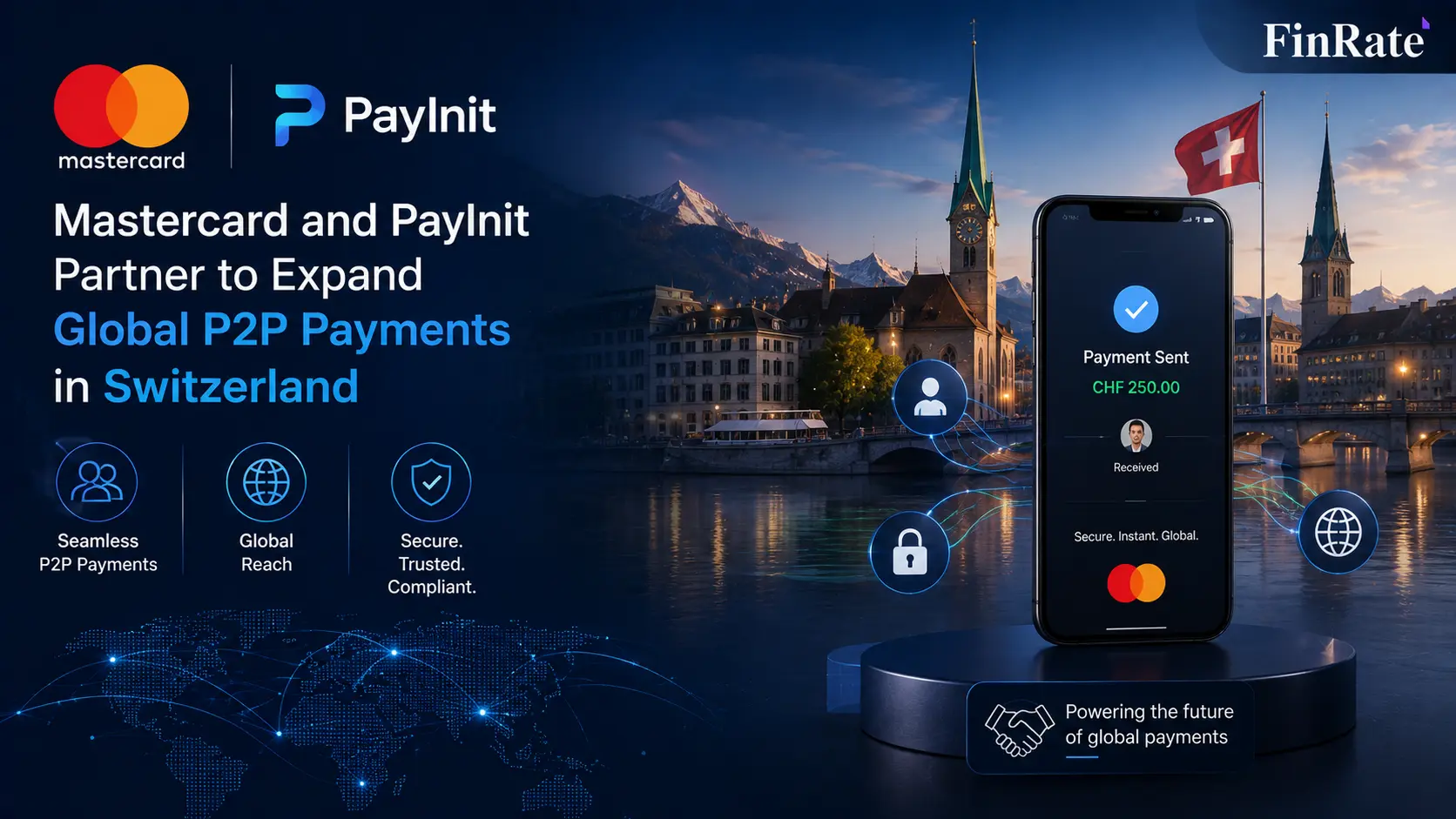
Mastercard and PayInit Partner to Expand Global P2P Payments in Switzerland
Mastercard and Swiss payment infrastructure provider PayInit AG are joining forces to make person-to-person payments more interoperable, easier to use and globally connected for consumers in Switzerland.
Mastercard has announced a new initiative with PayInit AG, the Swiss industry infrastructure for global card-based peer-to-peer (P2P) transfers, and technology provider Opentech.
The partnership will enable Swiss banks and payment providers to offer P2P transfers directly through their existing digital channels. Consumers will be able to send money using familiar identifiers such as a mobile phone number or email address, without needing to exchange card or account details.
The initiative combines PayInit’s shared Swiss infrastructure with Mastercard’s global payment capabilities. It is designed to extend domestic P2P payment experiences beyond Switzerland while allowing participating financial institutions to maintain their existing customer relationships.
Building a More Connected P2P Payment Network
P2P payments have become a standard feature of digital banking, but cross-border transfers can still involve multiple systems and complicated payment processes.
The Mastercard and PayInit initiative aims to reduce some of that complexity by connecting Swiss issuers through a common infrastructure.
PayInit AG was established by Viseca Payment Services SA and Cornèr Bank Ltd. to provide an open, scheme-compliant infrastructure for card-based P2P payments. Through the platform, participating issuers can integrate P2P transfers into their own mobile and digital banking experiences.
Opentech provides the underlying technology through its OpenPay Send platform, while Mastercard supplies the global payment infrastructure.
This model means banks do not need to build separate integrations for each payment service. Instead, they can connect to a shared infrastructure while continuing to manage the customer-facing experience.
Mastercard Move Adds Global Reach
Two Mastercard capabilities are central to the new service.
Mastercard Move provides global money movement capabilities designed to support transfers across markets, payment types and borders.
Mastercard Credential Services can simplify payments by allowing senders to use recipient identifiers such as phone numbers and email addresses rather than entering traditional payment credentials.
Together, these technologies are intended to make P2P transfers easier for consumers while giving participating financial institutions access to broader payment connectivity.
The service can support transfers between Swiss users and recipients in other markets, expanding the potential reach of card-based P2P payments beyond domestic transactions.
Sending Money Through Existing Banking Apps
The consumer experience is designed to remain inside the banking applications people already use.
A customer can select a P2P payment option, enter the recipient’s mobile number or email address, and initiate the transfer. The transaction is then routed through participating issuers and the PayInit infrastructure, with Mastercard’s payment capabilities supporting the movement of funds.
The approach could help make cross-border payments feel more similar to domestic peer-to-peer transfers.
For financial institutions, the shared infrastructure also reduces the need to develop and maintain multiple payment connections independently.
Swiss Infrastructure Meets Global Payment Rails
PayInit’s model is intended to complement existing domestic payment solutions rather than replace them.
By combining a locally governed infrastructure with Mastercard’s international network, the initiative gives Swiss issuers a way to participate in a broader P2P ecosystem while retaining control of their customer relationships.
Mastercard Switzerland and Liechtenstein Country Manager Daniela Massaro said consumers increasingly expect money transfers to be as simple as sending a message, whether the recipient is nearby or abroad.
PayInit AG Chairman Michael Walther said the platform is designed to give Swiss issuers an open and shared infrastructure for global card-based P2P transfers.
The partnership reflects a wider shift in digital payments toward interoperability, account-to-account simplicity and embedded money movement.
As consumers increasingly expect instant and convenient transfers, payment providers are looking for ways to connect domestic payment experiences with global networks. Mastercard and PayInit’s Swiss initiative is one example of how that infrastructure could evolve.
What It Means for Swiss Consumers and Banks
For consumers, the biggest change could be convenience. Sending money may no longer require knowing a recipient’s card or bank account details.
For banks and payment providers, the shared model offers another route to introduce global P2P capabilities without building an entirely new payment infrastructure from the ground up.
The initiative also keeps financial institutions at the center of the customer relationship. Banks can integrate the service into their own digital channels while relying on PayInit and Mastercard for the underlying connectivity.
The partnership positions Switzerland as an interesting market for the next stage of P2P payments: locally governed, interoperable and connected to global payment networks.
Key Details
- Mastercard, PayInit AG and Opentech are collaborating on global P2P payments in Switzerland.
- Consumers can send money using a mobile phone number or email address.
- Mastercard Move provides global money movement capabilities.
- Mastercard Credential Services supports simplified recipient identification.
- PayInit provides an open, shared infrastructure for Swiss issuers.
- The service is designed to complement existing domestic payment solutions.
- Participating banks can integrate P2P capabilities into their existing digital channels.
Mastercard and PayInit AG join forces to bring interoperable, global P2P payments to Switzerland
Comments
No comments yet. Be the first to share your thoughts.
Leave a comment