
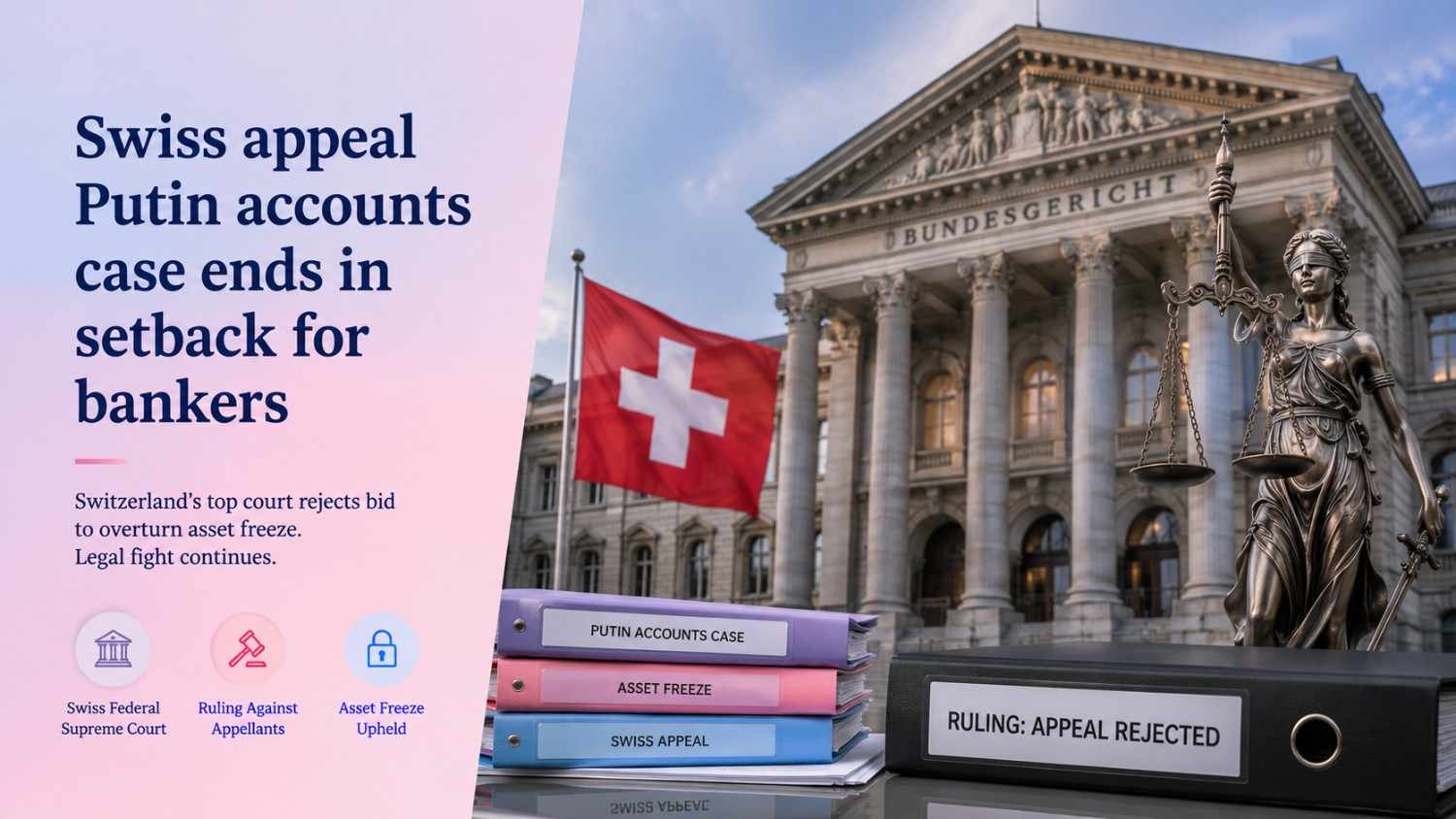
The latest Swiss appeal Putin accounts case has drawn attention across the financial sector after reports indicated that bankers lost an appeal linked to accounts associated with a longtime friend of Russian President Vladimir Putin.
Moreover, the ruling highlights the continuing legal and regulatory pressure surrounding banking relationships connected to politically exposed individuals and sanctioned networks.
As a result, compliance, risk management, and regulatory oversight remain central concerns for global financial institutions.
Furthermore, the case reflects the broader impact of sanctions enforcement and financial transparency requirements on international banking operations.
Swiss appeal Putin accounts ruling increases compliance focus
The recent Swiss appeal Putin accounts decision is reinforcing discussions around banking compliance and regulatory accountability.
Several important issues include:
- Enhanced due diligence requirements
- Politically exposed person monitoring
- Sanctions compliance controls
- Financial transparency obligations
- Regulatory risk management
Because financial institutions face growing scrutiny regarding customer relationships, banks are strengthening compliance frameworks and internal controls.
Consequently, legal disputes involving high-profile clients continue attracting significant regulatory attention.
Moreover, global banking standards are becoming increasingly strict.
Putin-linked bank accounts remain under scrutiny
The wider discussion around Putin-linked bank accounts continues generating legal and regulatory interest across multiple jurisdictions.
Several factors contribute to this attention:
- International sanctions enforcement
- Financial transparency rules
- Anti-money laundering requirements
- Political exposure assessments
Because regulators expect banks to identify and manage higher-risk relationships carefully, institutions are under pressure to demonstrate strong oversight processes.
As a result, cases involving politically connected individuals often receive heightened scrutiny.
Furthermore, compliance failures can lead to reputational and financial consequences.
Swiss banking appeal highlights legal accountability
The latest Swiss banking appeal demonstrates how courts continue evaluating banking decisions connected to sensitive financial relationships.
Several important considerations include:
- Customer due diligence procedures
- Internal compliance documentation
- Risk assessment standards
- Regulatory reporting obligations
Because Switzerland remains a major global financial centre, legal decisions involving banks often attract international attention.
Consequently, financial institutions are closely monitoring developments that may influence future compliance expectations.
Moreover, banking litigation continues shaping industry best practices.
Russian sanctions banking pressure continues
The broader Russian sanctions banking environment remains a major challenge for international financial institutions.
Several ongoing pressures include:
- Sanctions screening requirements
- Customer verification standards
- Transaction monitoring obligations
- Cross-border compliance risks
Because sanctions regulations continue evolving, banks must regularly update internal systems and compliance procedures.
As a result, regulatory teams are investing heavily in risk management technology and monitoring tools.
Furthermore, sanctions compliance remains one of the most important operational priorities for global banks.
Comparison between standard and high-risk banking oversight
| Feature | Standard Customer Accounts | High-Risk Accounts |
|---|---|---|
| Due diligence | Standard | Enhanced |
| Monitoring frequency | Regular | Higher |
| Compliance review | Routine | Intensive |
| Regulatory scrutiny | Moderate | Strong |
| Documentation requirements | Basic | Extensive |
This comparison explains why banks apply stricter controls to relationships involving politically exposed or higher-risk individuals.
Moreover, regulatory expectations continue increasing globally.
Swiss financial litigation impacts banking practices
The wider Swiss financial litigation landscape continues influencing banking governance and compliance strategies.
Several important effects include:
- Stronger risk controls
- Improved documentation standards
- Greater legal oversight
- Enhanced regulatory cooperation
Because financial litigation can expose operational weaknesses, banks often use such cases to improve internal procedures.
Consequently, legal rulings frequently shape future compliance frameworks.
Moreover, risk management remains a core banking priority.
Banking compliance case reflects industry-wide challenges
The latest banking compliance case highlights challenges facing institutions operating in a complex international regulatory environment.
Several major concerns include:
- Managing sanctions risks
- Monitoring politically exposed persons
- Meeting transparency obligations
- Maintaining regulatory compliance
Because financial regulations continue becoming more demanding, banks are expanding compliance teams and technology investments.
As a result, operational costs linked to regulatory oversight continue rising.
Furthermore, financial institutions must balance customer service with increasingly complex compliance requirements.
Global banks strengthen risk management systems
The outcome of the Swiss appeal Putin accounts case is likely to encourage further investment in compliance and risk management infrastructure.
Several priorities include:
- AI-powered monitoring systems
- Enhanced transaction screening
- Automated compliance checks
- Improved customer risk profiling
Because regulators expect stronger oversight, financial institutions are modernising compliance operations.
Consequently, technology is becoming increasingly important within banking risk management.
Moreover, digital compliance tools continue expanding across the financial sector.
Future outlook for Swiss appeal Putin accounts implications
The future impact of the Swiss appeal Putin accounts ruling may extend beyond the specific legal dispute.
Several trends may continue:
- Stronger compliance expectations
- Increased sanctions enforcement
- Greater transparency requirements
- Expanded regulatory oversight
Additionally, international banks are expected to maintain a strong focus on sanctions compliance and customer due diligence.
Because geopolitical risks continue affecting financial markets, regulatory scrutiny is likely to remain elevated.
As a result, banking institutions may continue strengthening governance and risk controls.
Final Thoughts
The latest Swiss appeal Putin accounts ruling highlights the growing importance of compliance, transparency, and regulatory accountability within global banking.
As sanctions enforcement and financial oversight continue expanding, banks face increasing pressure to manage high-risk relationships carefully.
Moreover, legal disputes involving politically exposed individuals remain closely watched by regulators and financial institutions worldwide.
Ultimately, the case reflects broader efforts to strengthen trust, accountability, and resilience across the international banking system.
Bankers lose appeal over Swiss bank accounts held by Putin’s cellist friend | Reuters
Comments
No comments yet. Be the first to share your thoughts.
Leave a comment