
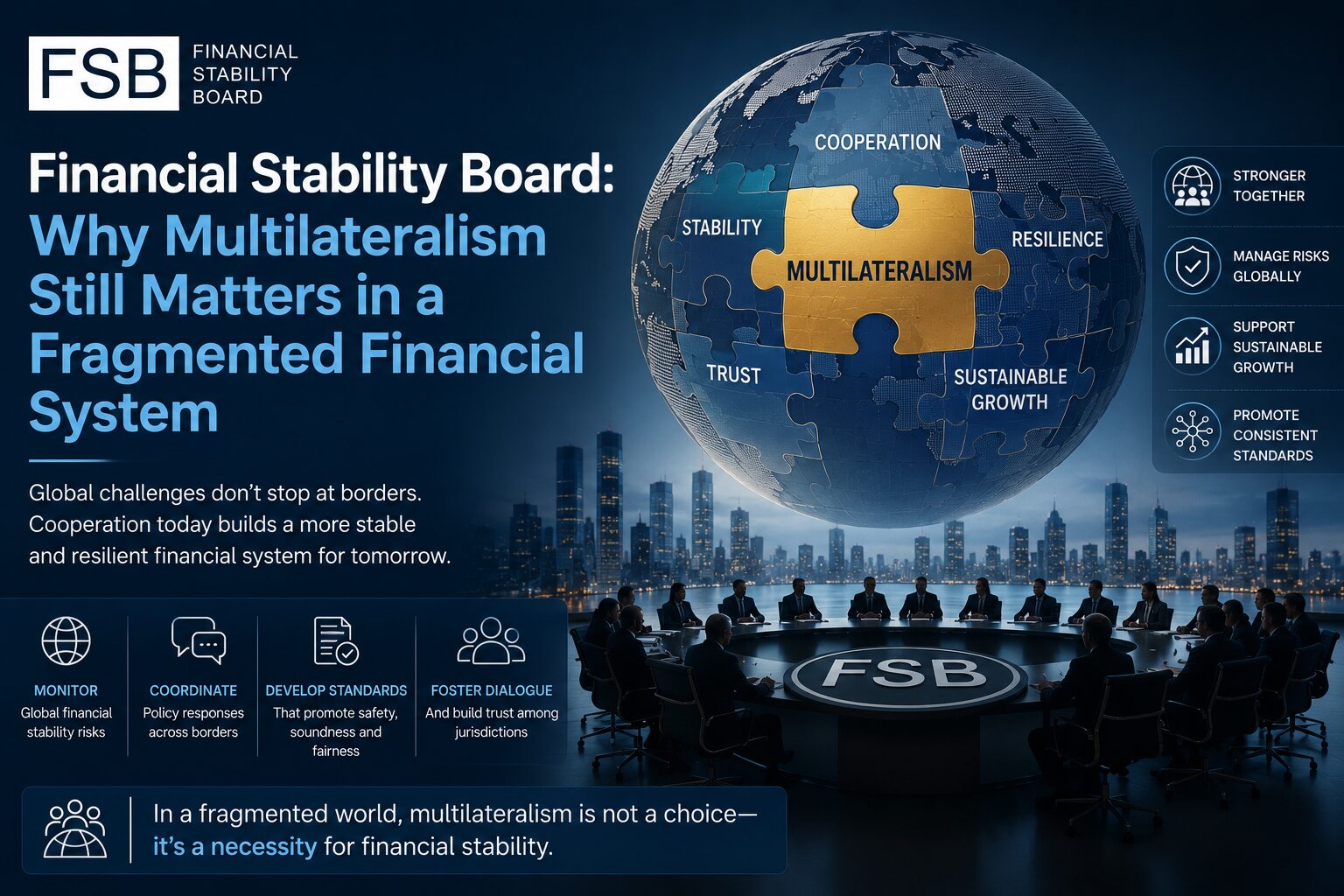
Banking Risk Management Financial Stability Board: Why Multilateralism Still Matters in a Fragmented Financial System
Global finance is inherently multinational. Cash moves across borders faster than governments can react, capital markets are highly integrated, and non-local concentrations of risk are the norm rather than the exception. At the same time, there is no single global regulator. The system is held together by a network of international organisations, with the Financial Stability Board (FSB) acting as the coordinating body. The FSB was formed to ensure that individual governments and central banks act collectively in the face of systemic threats.
The FSB is an international regulatory agency that oversees the management of risks to the global financial system and coordinates responses among major economies. It is important to note that it does not make laws or directly regulate financial institutions. The FSB promotes the adoption of globally consistent regulatory standards and facilitates their implementation by individual countries and regulators. The FSB’s approach to fostering multilateralism, utopia reflects the need to achieve a balance between international consistency and local flexibility.
System architecture
The FSB performs its coordinating function in several ways. First, the organization analyses potential sources of disruption through its Standing Committee on Assessment of Vulnerabilities and similar groups. Second, the FSB collaborates closely with regulators and other international organizations to develop policies that facilitate consistent, uniform implementation of financial regulations.
Third, the FSB monitors the implementation process and ensures that national regulators adhere to international standards, with FSB recommendations serving as the critical reference point. Finally, the organization typically undertakes specific initiatives related to prominent systemic risks. These include cross-border payments, nonbank financial intermediation, crypto-assets, operational resilience, and financial market leverage. In summary, the FSB operates under a model of global coordination while empowering individual countries to execute regulatory actions domestically.
Critical insights
The FSB’s work program for 2026 demonstrates how the organization responds to changing conditions. In particular, the FSB published a Cross-border Payments Progress Report in October and is set to host an international payments summit in March 2026.
Additional priorities include artificial intelligence, digital assets, private credit, and regulatory modernization. The FSB’s 2025 Annual Report highlighted significant achievements, including progress in nonbank financial intermediation, crypto-assets, operational resilience, and cross-border payments reforms.
At the same time, the FSB noted challenges in implementing international standards and initiated a systemic review of the causes and consequences of implementation fragmentation. Finally, the FSB continues to priorities reducing the risks associated with regulatory arbitrage between jurisdictions. Unlike many other international organizations, the FSB lacks a unifying metric that reflects its overall performance.
Instead, the number of countries that actively participate in the FSB processes and the degree of regulatory convergence that the organization helps to achieve serve as performance indicators. In essence, the value of the FSB initiative grows with the international financial system fragmentation.
Context
The FSB occupies a unique position in the international financial system. Its influence extends to central banks, ministries of finance, and regulatory agencies that oversee banking, capital markets, payments, insurance, and nonbank finance.
As a result, the FSB’s guidance is critically important for banks, insurance companies, asset managers, private equity firms, stable coin issuers, payment settlement infrastructures, and cross-border financial services providers. In addition, many emerging-market banks and asset managers rely on the FSB recommendations to navigate the international financial system.
Challenges
One challenge posed by the FSB is speed. Financial markets and instruments evolve at a rapid pace, while the FSB typically responds to emerging risks after they materialize. In addition, international regulatory coordination is complicated by inconsistent interpretations of international standards and significant differences in national legal frameworks.
As a result, international regulatory convergence typically occurs slowly and is often limited to specific areas of finance. Finally, the FSB must grapple with the discrepancy between policymakers’ support for international regulatory coordination and their simultaneous desire to maintain jurisdictional flexibility.
Risks
Operational risk
Operational resilience is one of the FSB’s top priorities due to financial institutions’ (FIs) growing reliance on cloud-based services, technology suppliers, and payment infrastructures. In particular, FIs face the risk of business interruption and loss of control that may arise from using technology platforms operated by third parties.
Financial risk
- The FSB continues to monitor several financial risks, including private credit, repo markets, nonbank leverage, and stable coins. In particular, FIs are concerned with the possibility of interconnected defaults triggered by large-scale corporate defaults and weaknesses in stablecoin redemptions.
- Fraud/unauthorized transactions risk
- Cross-border payments and noncash transactions involve the risk of fraud and unauthorised transactions. In particular, FI clients and users may suffer from cyber-enabled crimes, including data theft, ransomware, extortion, and other digital attacks.
Trends
The FSB’s 2026 Work Program reflects the organization’s growing emphasis on risk surveillance, implementation, and monitoring.
In particular, the FSB is prioritizing cross-border payments, operational resilience, artificial intelligence, stable coins, regulatory implementation, and reform progress surveillance. Notably, technology is becoming an integral part of financial stability management. In particular, the FSB is incorporating considerations related to technology-enabled risks across its regulatory initiatives.
This includes enhanced scrutiny of emerging technologies such as artificial intelligence, distributed ledger technology, stablecoins, and open banking infrastructures. Another trend is the FSB’s commitment to promoting practical multilateral approaches that allow for jurisdictional flexibility in applying international regulatory standards. The focus on implementation and monitoring is another important trend that reflects the FSB’s concerns about the international regulatory coordination process.
Contrarian views
A common misconception about the Financial Stability Board (FSB) is that it acts as a global financial regulator with the power to directly oversee markets and enforce rules. In reality, the FSB does not regulate financial institutions. Instead, it promotes financial stability by issuing policy recommendations, monitoring global financial risks, and encouraging cooperation among national regulators.
Another misconception is that all financial institutions must follow the same international regulatory standards, regardless of where they operate. In practice, these standards provide a common framework rather than a single set of rules. Individual countries implement them in ways that align with their own legal and regulatory systems while working toward similar financial stability goals.
The FSB’s 2026 Work Program also shows that its role extends beyond responding to past financial crises. Alongside strengthening financial resilience, the organization is supporting innovation in the global financial system. Its priorities include improving cross-border payments, advancing digital finance, and promoting the responsible use of artificial intelligence in financial services.
Facts
- Several projects that fall under the FSB umbrella provide valuable insight into the organization’s objectives and areas of interest. In particular, the FSB recognizes the importance of cross-border payments reform that seeks to make international money transfers faster, cheaper, and more transparent.
- The FSB is also concerned with the risks posed by crypto-assets and stable coins and works to establish international standards that would mitigate these risks.
- The FSB monitors nonbank financial intermediation closely due to the potential for systemic disruption that could arise from lax regulation of private credit, insurance, and similar financial instruments. Repo market intermediation is another area of the FSB’s interest due to the risks that repos pose to FI continuity and stability.
- FSB supports initiatives that seek to reduce regulatory arbitrage between jurisdictions by making it harder for firms to exploit regulatory discrepancies.
Conclusion
The FSB occupies a unique position in the international financial system as a coordinator of state-level regulators rather than a direct regulator of financial markets.
Several key insights relate to the FSB operations in 2026 and beyond. First, the FSB influences financial markets indirectly through regulatory guidance and surveillance rather than direct intervention. Second, the FSB promotes international regulatory convergence but recognizes the need for jurisdictional flexibility.
Third, the FSB monitors a wide range of risks, including operational, financial, and fraud-related risks. Fourth, technology plays an increasing role in financial stability and is a source of both opportunities and risks. Fifth, the FSB is concerned with achieving implementation consistency despite the lack of direct regulatory authority. Finally, the FSB has a multifunctional mandate that includes policy guidance, risk surveillance, and implementation monitoring.
Comments
No comments yet. Be the first to share your thoughts.
Leave a comment