
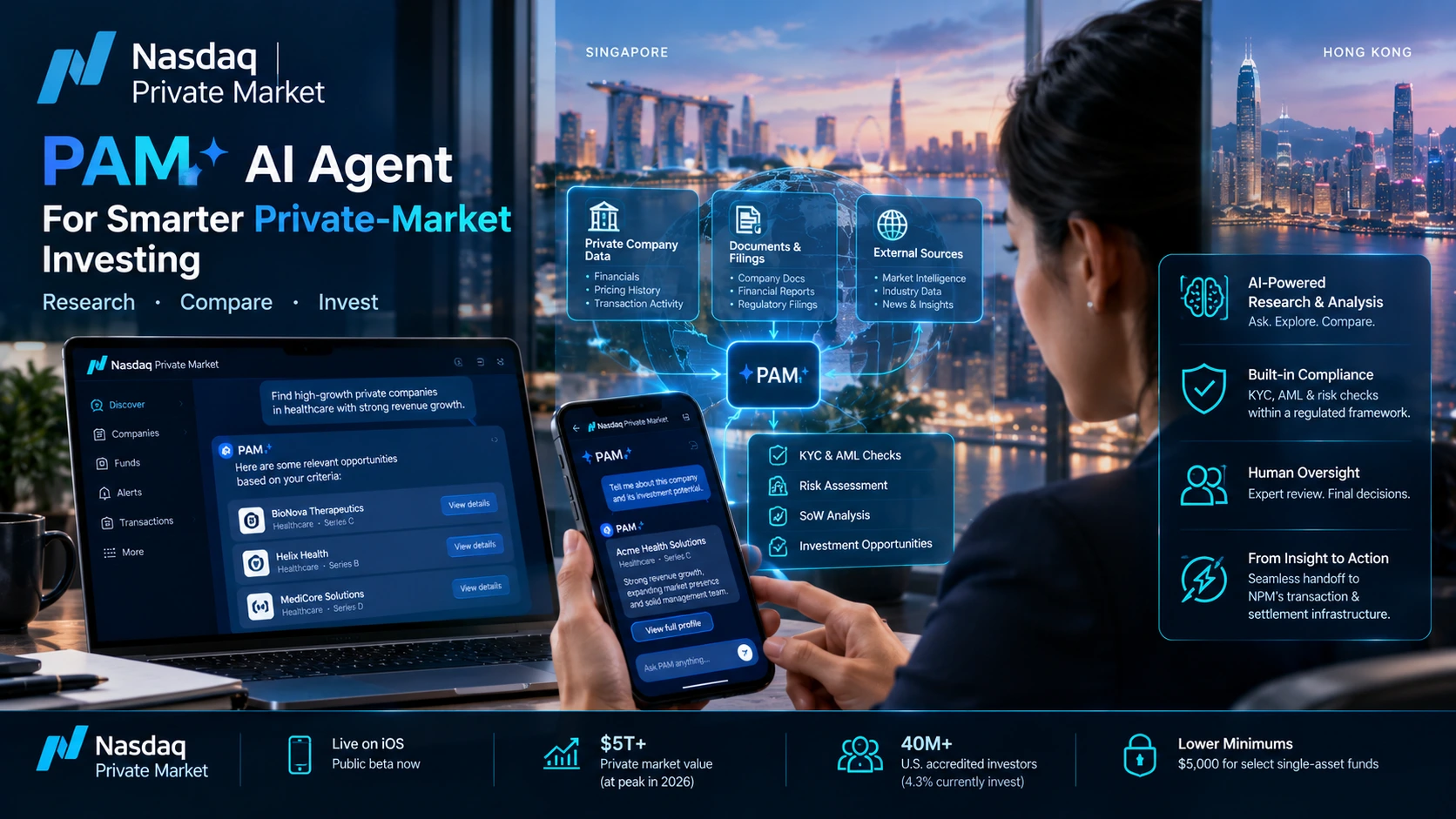
Nasdaq Private Market has launched PAM™, an AI-powered private-market investing agent built into its iOS app, giving eligible investors a new way to research private companies, compare opportunities, and navigate transactions. The public beta is live, with broader availability and functionality planned in phases.
PAM combines artificial intelligence with Nasdaq Private Market’s private-company data and transaction infrastructure. The agent can explain private-market concepts, answer questions about companies and funds, surface opportunities based on an investor’s stated interests, and guide users through transaction mechanics before handing off to NPM’s execution and settlement infrastructure.
The launch targets a market where access and information have traditionally been harder for individual investors to navigate.
PAM Brings AI Into Private-Market Investing
PAM is designed to function as a conversational interface for private-market research and transactions.
Investors can ask questions about companies and funds in plain language. The agent can also compare companies and identify opportunities that fit an investor’s stated goals. NPM says PAM can guide users through the mechanics of a deal before money moves and then hand off to its patented settlement infrastructure.
That creates a different experience from traditional private-market investing.
Investors have often needed specialized knowledge to evaluate private-company securities. Transaction processes can also involve company approvals, documentation, and settlement steps.
NPM wants PAM to bring more of that information into one interface.
The company’s current platform already allows users to follow private companies, set alerts, compare hundreds of companies, and submit bids or offers through its marketplace. PAM adds an AI layer to that existing infrastructure.
Private-Market Data Powers PAM
The underlying data is central to the product.
The Nasdaq Private Market says PAM draws on private-company information, including pricing history, transaction activity, and company fundamentals. The agent can access that information live when users ask questions about private companies.
That gives PAM a different role from a general-purpose chatbot.
Instead of relying only on broad public information, the agent operates within NPM’s private-market data environment.
The company says this can help investors understand private companies and secondary-market opportunities without requiring the same level of specialized financial knowledge typically associated with private markets.
NPM has been building that data infrastructure alongside its marketplace.
Its current platform says more than 700 private companies have traded on the marketplace and more than 1,200 institutional investors have been onboarded. NPM also reports more than $80 billion in secondary-market transactions.
PAM therefore sits on top of a broader private-market infrastructure business rather than operating as an isolated AI product.
The AI Agent Covers More Than Company Research
PAM is designed to work across multiple stages of the private-market investing journey.
At the research stage, users can ask questions and explore companies.
During evaluation, the agent can compare companies and explain private-market concepts.
When an opportunity becomes available, PAM can surface it based on an investor’s stated goals and interests. The agent can then explain the mechanics of the transaction before the user proceeds.
NPM says the system can eventually hand off directly into transaction execution through its infrastructure.
That makes PAM more than an educational tool.
The company is positioning the agent as a digital interface connecting discovery, analysis, and action.
Such a model could become increasingly relevant as financial platforms add AI agents that can handle more steps within investment workflows.
PAM Does Not Remove Investor Eligibility Requirements
Despite the announcement’s broader “for everyone” framing, private-market access still has regulatory limits.
Nasdaq Private Market’s current platform says investment access is available to accredited investors in supported jurisdictions. NPM’s institutional investor network also requires participants to meet applicable regulatory qualification standards and complete onboarding.
That means PAM can make the private-market experience easier to navigate without eliminating eligibility rules.
The distinction matters because private-company securities differ from publicly traded stocks.
Access can depend on the transaction structure, jurisdiction, investor status, and issuer requirements.
PAM simplifies the information and workflow layer. It does not change those underlying regulatory conditions.
NPM Lowers Some Fund Minimums to $5,000
Alongside the PAM launch, Nasdaq Private Market said it is lowering the minimum investment for certain single-asset funds to $5,000. The company says that is intended to reduce a barrier that historically pushed some private-company fund participation toward larger investment amounts.
The change is separate from the AI agent but supports the same broader objective.
PAM can help investors research and understand opportunities. Lower minimums can reduce the capital required for certain eligible fund investments.
Together, the two initiatives create a more accessible digital experience within the existing private-market framework.
NPM still requires investors to meet applicable eligibility requirements.
The lower minimum, therefore, should not be interpreted as unrestricted access to private-company investments.
Private Markets Are Becoming More Digital
The PAM launch reflects a wider transition in private markets.
Private-company investing has traditionally involved relationships, direct outreach, spreadsheets, documents, and multiple administrative steps.
Technology platforms have gradually digitized those processes.
Nasdaq Private Market already operates infrastructure for company-sponsored liquidity programs, private-share transactions, a marketplace for private-company stock and funds, and private-market data and intelligence.
PAM adds an AI interface to those capabilities.
That could change how users interact with the market.
Instead of searching separately across different information sources, an investor can use natural-language questions to explore a company and its potential transaction opportunities inside the NPM environment.
The bigger change may be the move from search-based investing to conversational investing.
AI Could Change Private-Market Discovery
Public-market investors already use apps that provide screening tools, financial data, and automated alerts.
Private markets have historically offered less standardized information.
NPM is attempting to close part of that gap through proprietary data and AI.
The company says PAM can compare private companies and provide explanations in plain language. It can also notify users about opportunities and pricing activity through the wider NPM platform.
That could make private-market research more continuous.
An investor does not have to wait until a broker or intermediary contacts them about an opportunity. NPM’s platform can monitor companies and provide alerts when relevant activity appears.
PAM adds a conversational layer to that monitoring.
The result is a private-market experience that increasingly resembles the digital workflows investors already use in public markets, while retaining the different access and transaction requirements of private securities.
NPM Already Has the Settlement Infrastructure Behind PAM
One of PAM’s more significant characteristics is its connection to NPM’s existing settlement technology.
Nasdaq Private Market says its patented system coordinates the post-trade process for private-company securities, including transfer notices, documentation, and tax reporting.
The company received U.S. Patent No. 12,572,980 from the United States Patent and Trademark Office in March 2026 for its private-company securities clearing and settlement platform.
That infrastructure gives PAM a path from conversation to transaction.
An investor can ask a question, explore an opportunity, and then move into a structured transaction process within the same broader ecosystem.
The combination is important because AI investment tools often stop at research.
PAM is designed to extend further into execution.
Nasdaq Private Market Targets a $5 Trillion Private Market
NPM says the private market exceeded $5 trillion in valuation at its peak earlier in 2026. The company also cites research showing that more than 40 million Americans qualify as accredited investors, while only 4.3% of them currently invest in private markets.
NPM argues that the gap reflects barriers involving information, access, specialized knowledge, and transaction complexity.
PAM is intended to address the information and workflow side of that problem.
The company describes the agent as a way to turn private-market participation into something users can explore through conversation.
However, the actual opportunity set remains dependent on available supply, investor eligibility, and issuer approval.
The technology can simplify access to information. It cannot guarantee that a particular private company will be available for investment.
PAM Fits NPM’s Broader AI Strategy
The launch also follows NPM’s broader investment in private-market data and intelligence.
In July, Nasdaq Private Market introduced Daq, a platform designed to address private-market data challenges.
PAM builds on that broader data strategy.
The company is creating separate layers for market data, investment infrastructure, and AI-driven user interaction.
That approach could become important as private markets generate more trading activity and investors demand faster access to information.
AI can act as the interface, while proprietary data and transaction infrastructure provide the underlying system.
Risks and Limitations Remain
AI does not remove the risks associated with private-market investing.
Private-company securities can have limited liquidity, complex transfer restrictions, and less standardized disclosure than public equities.
NPM’s own platform emphasizes that transactions may require issuer approval and formal transfer documentation.
PAM can help users understand these processes, but investors still need to evaluate the underlying opportunity and applicable risks.
The technology also does not guarantee accuracy or investment outcomes.
Its role is to provide information, context, and workflow assistance within the NPM environment.
That distinction becomes particularly important as AI agents move closer to executing financial transactions.
The more directly an agent participates in an investment process, the more important the surrounding data quality, eligibility checks, and transaction controls become.
PAM Represents a New Interface for Private Markets
Nasdaq Private Market’s launch of PAM marks another step in the digitization of private-company investing.
The product combines an AI agent with private-market data and existing transaction infrastructure.
Users can ask questions, compare companies, receive opportunity alerts, and navigate transaction processes through a conversational interface.
For NPM, the strategy goes beyond making an investment app easier to use.
The company is attempting to create an AI-native interface for a market that has historically depended heavily on intermediaries and manual processes.
The public beta is already live on iOS, with additional availability planned.
Private-market investing will still require the appropriate investor status and transaction eligibility. Yet PAM could change how eligible investors discover and navigate these opportunities.
The larger significance lies in the combination of AI, private-market data, and transaction infrastructure.
Rather than simply telling investors about private companies, PAM is designed to help them move from question to research to opportunity to transaction within a single digital environment.
Comments
No comments yet. Be the first to share your thoughts.
Leave a comment