
Artificial intelligence is creating new opportunities across capital markets, from investment research and portfolio analytics to trading and compliance. But as financial institutions integrate AI into their operations, the infrastructure supplying these systems with reliable market information is attracting greater scrutiny.
A new study by Crisil Coalition Greenwich and SIX suggests that market data providers will face rising expectations around data quality, speed, accessibility, and cost as financial firms expand their use of AI. The research surveyed 73 buy-side and sell-side institutions across the United States, the United Kingdom, and Europe.
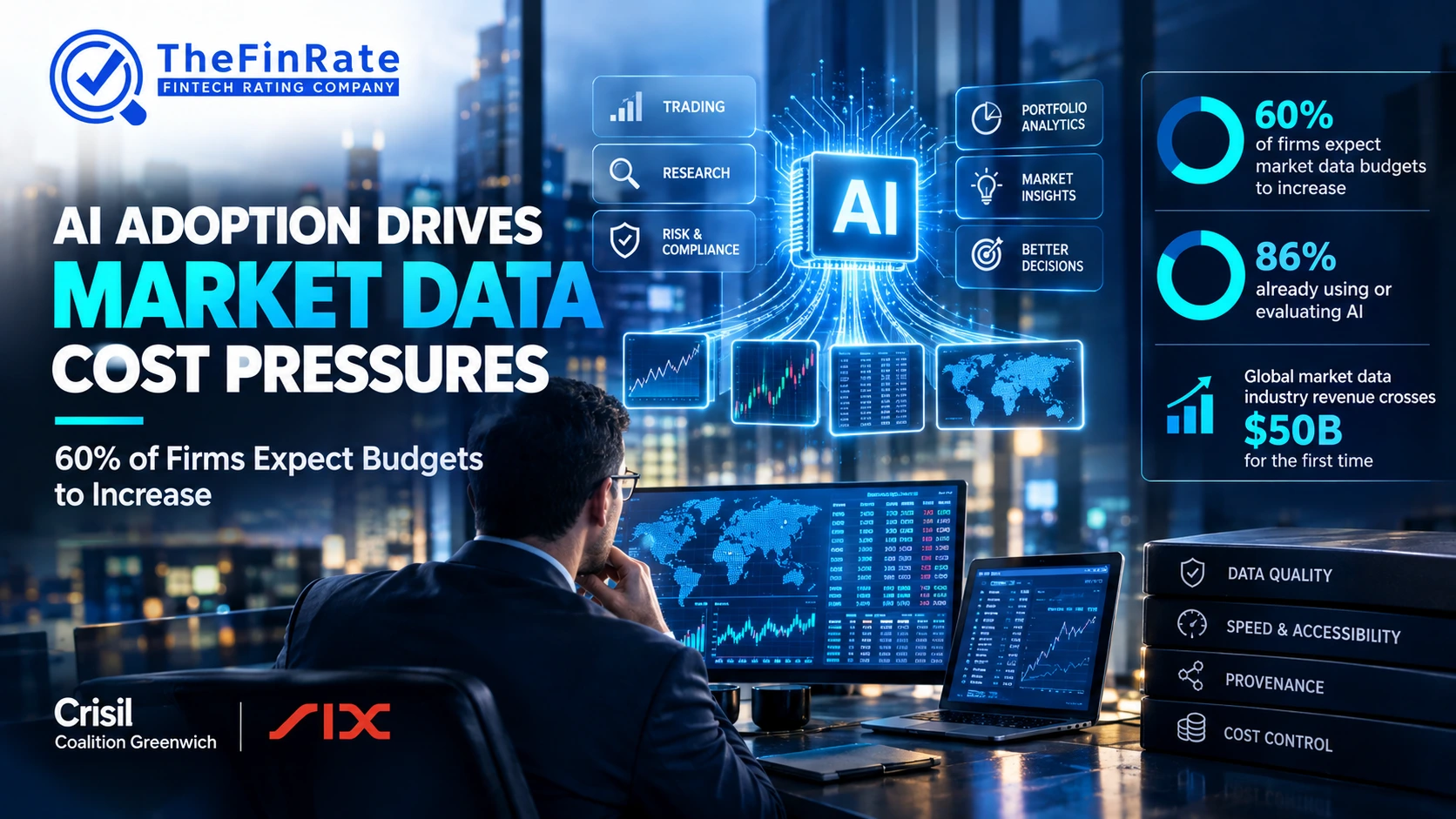
One of its key findings is that 60% of respondents expect their market data budgets to increase. The study also found that 86% of surveyed firms are already using or evaluating AI in their workflows, underscoring the growing connection between financial data infrastructure and AI adoption.
The findings arrive as global market data industry revenues have crossed $50 billion for the first time, according to separate research from Expand Research, a BCG company. Together, the developments highlight a growing challenge for banks, asset managers, investment firms, and trading businesses: extracting value from AI while managing the cost and complexity of the financial information that powers it.
AI Is Changing How Financial Firms Consume Market Data
Market data has long been essential to financial services, with banks, brokers, and investment managers relying on pricing information, exchange feeds, company disclosures, and reference data to support decisions. AI is expanding the range of ways firms can use that information, from processing large volumes of documents and identifying patterns to supporting risk monitoring and compliance analysis.
These applications can require information to be accessed, processed, and refreshed differently from traditional workflows. Rather than relying only on analysts reviewing dashboards, institutions may connect data directly to software applications and AI-powered systems, creating new operational demands for formats, reliability, and context.
The fourth annual study collected responses between May and June 2026 from 65 buy-side and eight sell-side firms in the US, UK, and Europe, including asset managers, wealth managers, private banks, investment banks, and broker-dealers. Several findings stand out: 88% believe providers can help ensure the accuracy and reliability of AI, 73% identify high-quality and comprehensive data as important to adoption, 62% highlight transparent sourcing and methodology, and 78% are willing to pay for lower latency. These findings indicate that institutions want dependable data that can be accessed efficiently and integrated into sophisticated technology environments, rather than simply more information. The willingness to pay for lower latency also shows that cost control does not mean choosing the cheapest provider, since reliability and speed remain central to trading and other time-sensitive applications.
Why AI Could Increase Market Data Spending
AI adoption does not automatically translate into higher market data bills for every institution, since the effect depends on the systems deployed, the data licensed, and the provider's pricing model. Still, several factors could put upward pressure on spending.
Traditional workflows center on human users accessing data through terminals or reports, but AI introduces additional consumers of that information, including automated research tools and software agents. As more systems access data, firms may need to review existing agreements and usage limits, though whether this raises fees depends on individual contracts.
Real-time data also remains important: 56% of respondents use it throughout the trading day, with trade execution the leading use case at 67%. AI applications running alongside trading and risk systems may require timely information, increasing the importance of low latency delivery, though not every application needs live feeds, since research tasks can often rely on delayed data, so firms need to match the service to the use case rather than defaulting to the fastest feed.
Data quality is becoming a strategic requirement in its own right. An AI system can process information quickly and produce a convincing answer, but that output can still mislead if the underlying data is incomplete or poorly contextualized. Investing in better data adds expense, but poor-quality information creates costs of its own through rework, incorrect analysis, and extra oversight. Licensing and governance also need to adapt, since market data agreements distinguish between types of users and permitted uses, and AI raises new questions about reuse within automated systems. It would be inaccurate to assume every AI implementation triggers additional licensing charges, but reviewing contractual permissions is becoming part of responsible deployment.
A $50 Billion Industry Backdrop
The cost debate is unfolding against the backdrop of a large, established financial information industry. Expand Research reported that global market data industry revenues exceeded $50 billion in 2025 for the first time, reflecting demand for information used in trading, investment decisions, and risk management. Even incremental shifts in spending can matter at this scale, though the $50 billion figure is an industry revenue estimate rather than a measure of spending caused specifically by AI, and the two studies use different methodologies that should not be treated as a single forecast.
Providers Face Higher Expectations, and Provenance Matters More
The study suggests data providers will increasingly compete on quality, delivery flexibility, and demonstrable value. Vendors and redistributors remain an important source of market data, used by 67% of respondents, while 60% also buy directly from exchanges. Delivery models are changing too: streaming APIs are used by 84%, and 86% expect more direct cloud access to market data over the next three to five years. Providers offering flexible access, transparent sourcing, and strong governance may be best positioned to meet these shifting requirements.
Data provenance, the ability to understand where information originated and how it was processed, is becoming particularly important as AI systems connect more directly to financial information. An AI-generated analysis may combine multiple datasets and market signals, and if a firm cannot establish the origins of those inputs, it may struggle to assess the output's reliability. The study found 58% are considering or already engaged with the Model Context Protocol, a framework that helps AI applications connect with external tools and data sources, with 57% of those already using or testing an MCP server. Easier access does not remove the need for controls, though, since firms still need appropriate permissions, security, and monitoring to avoid misinterpretation.
European market structure adds another layer of demand, with 70% of respondents considering a European consolidated tape provider to improve visibility across fragmented markets, with anticipated benefits for investor confidence and pan-European trading activity.
What Financial Institutions Should Do Next
For banks, investment managers, and other capital markets firms, rising data budgets make it important to audit which teams and applications consume each dataset, match data quality to the actual use case rather than default to premium feeds, and measure whether AI tools genuinely improve research or decision-making against their data and governance costs. Strengthening provenance, access controls, and provider relationships around pricing and reliability rounds out the list. These steps will not eliminate rising costs, but they can help firms separate essential investment from avoidable duplication.
As AI becomes more embedded in capital markets, the competitive advantage may belong to firms that manage both the intelligence of their systems and the economics of the data behind them.
Comments
No comments yet. Be the first to share your thoughts.
Leave a comment