
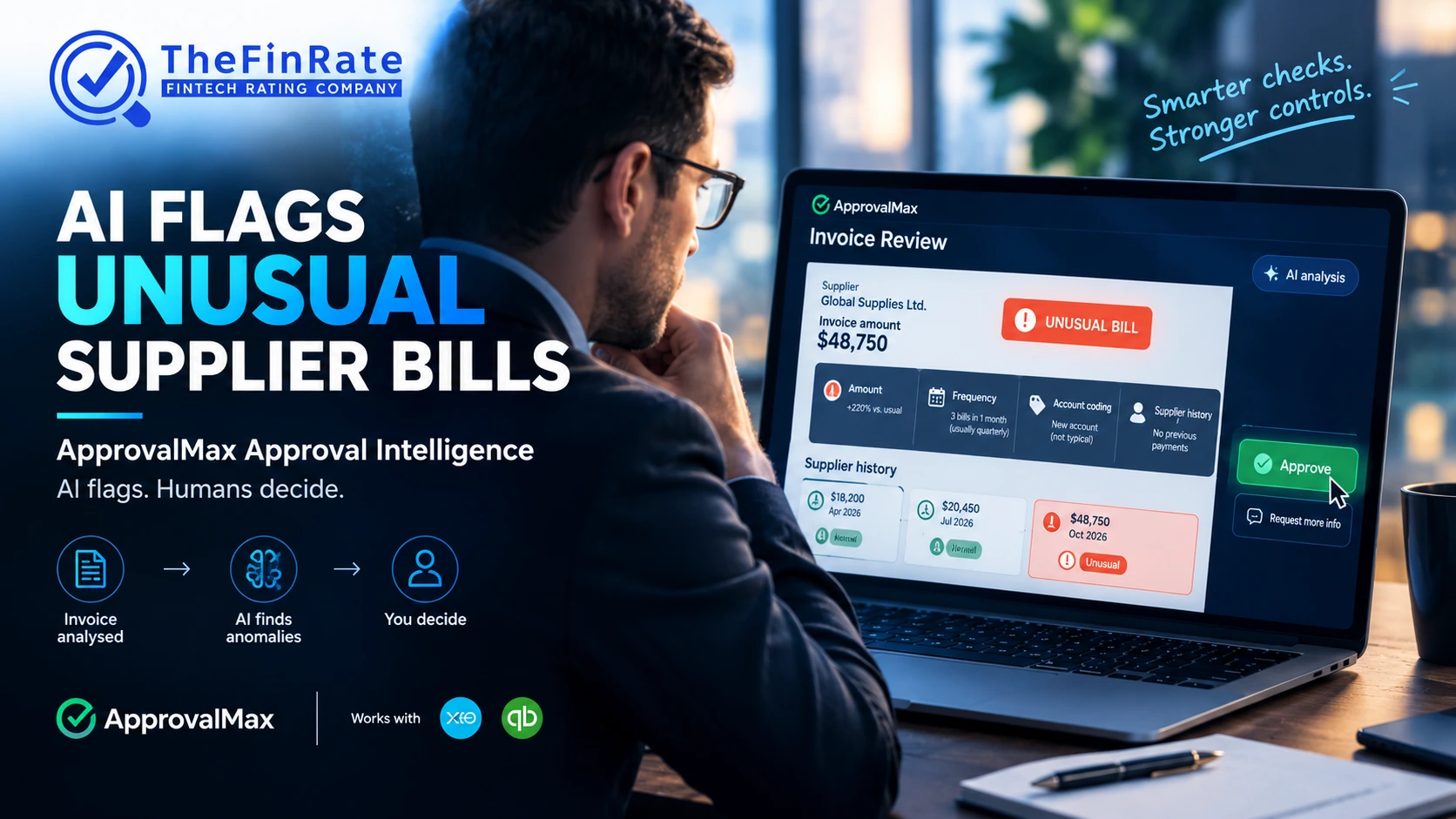
A supplier invoice arrives for an amount significantly higher than usual. Another vendor sends three bills in a month despite normally billing quarterly. A payment request comes from a supplier the business has never paid before. Each case could be legitimate, but each still deserves a closer look.
For accounts payable teams handling dozens of invoices under time pressure, spotting these warning signs often means switching between approval screens, accounting records, and historical transactions. That manual investigation can make consistent checks harder to maintain.
ApprovalMax is addressing this challenge with Approval Intelligence, a new AI layer built into its approval workflow platform for businesses using Xero and QuickBooks Online. The company says the capability brings supplier history checks directly into the bill approval process, helping approvers identify unusual patterns without having to search for the relevant information themselves.
The approach is notable for what it leaves unchanged. AI highlights potential anomalies, but the human approver retains full responsibility for the decision.
ApprovalMax Targets a Blind Spot in Accounts Payable
Accounts payable automation has already helped businesses streamline invoice routing, approval limits, reminders, and accounting system synchronization. Yet automating the workflow does not necessarily ensure that every invoice receives the same level of scrutiny.
An invoice may follow the correct approval route and still contain an unexpected price increase, an unusual billing frequency, or an unfamiliar accounting classification. These details often become apparent only when the current bill is compared with a supplier's previous transactions, and that comparison takes time. An approver may need to leave the bill, open accounting records, locate earlier invoices, and determine whether the latest request fits the supplier's established pattern.
That process grows harder when approval queues are busy, staff are unfamiliar with a supplier, or experienced finance employees are absent. ApprovalMax's new capability aims to cut that manual investigative work by bringing historical context directly into the approval screen, flagging patterns that may warrant attention rather than relying on individual memory.
How Approval Intelligence Works
Approval Intelligence introduces two AI agents into ApprovalMax's accounts payable workflows: Approval Agent and Search Agent.
The approval agent checks bills against previous bills from the same supplier and highlights patterns that appear unusual, using a traffic light approach intended to help approvers identify which bills may need closer review. Its checks include unusual amounts that fall outside a supplier's normal charging pattern, unexpected billing frequency where a typically quarterly supplier sends several invoices within a short period, unusual account coding that a supplier's previous bills do not normally use, new suppliers with no prior payment history, and cases where no anomalies are detected at all.
These signals provide context, not proof of wrongdoing. A higher invoice could reflect a legitimate price increase or a larger order, while more frequent bills could simply result from a change in delivery schedule. The purpose is to help the approver recognize that a bill differs from the available history and decide whether further investigation is appropriate. ApprovalMax also says the system provides a breakdown showing the details that need attention, helping an approver understand why a bill was flagged rather than relying solely on a color-coded indicator.
Search Agent, meanwhile, lets users search approval history and related records using plain language questions instead of manually selecting filters. A user can ask which bills were approved for a particular supplier last quarter, for instance, or which bills are still awaiting approval from a named colleague. The search agent interprets the request and applies the relevant filters automatically, making historical information easier to retrieve. Together, the two agents address different tasks: Approval Agent proactively surfaces unusual bills during review, while Search Agent helps users investigate transactions or past approvals on demand.
Human Accountability Remains Central
A key feature of Approval Intelligence is that it does not take the final approval decision away from the responsible person. Approval Agent flags unusual patterns and explains what may require attention, but it does not independently approve or reject a bill, and ApprovalMax says existing workflows, approvers, and approval limits remain unchanged.
That distinction matters as businesses introduce AI into processes that directly affect spending and reporting. An AI system can help identify an exception, but deciding whether it is acceptable may need information beyond transaction history, such as a changed contract or a revised billing arrangement. Human review remains necessary to weigh these circumstances against the organization's own policies.
The model effectively separates information gathering from decision-making. AI helps an approver identify what looks unusual, while the approver stays responsible for determining what happens next, giving finance leaders a practical way to introduce AI assistance without automatically delegating financial authority to a model.
Why Supplier History Checks Matter for Financial Controls
Supplier history analysis can support several aspects of accounts payable control. Comparing an invoice with a supplier's earlier bills may reveal a price change or amount that deserves explanation before payment proceeds, and unusual transaction frequency can prompt a review even when the pattern turns out to be entirely legitimate. A first-time supplier does not automatically represent a risk, but the absence of prior payment history is still relevant context for an approver who may need to verify onboarding details.
These checks can also support more consistent reviews across a team, since experienced employees may remember typical supplier charges while newer staff may lack that knowledge. Even so, they should complement rather than replace established controls such as supplier verification, purchase order matching, and segregation of duties. A historical pattern is not a guarantee of legitimacy, since fraud may resemble previous transactions while a legitimate bill may differ significantly from past invoices, so AI-generated signals remain one source of evidence within a broader control process.
Availability and the Bigger Picture
ApprovalMax has announced Approval Intelligence for customers using Xero and QuickBooks Online. According to the company's product information, Approval Agent is available on Advanced and Premium plans, while Search Agent is available across all plans. The approval agent currently focuses on bills, and existing approval workflows, approvers, and limits remain in place. Businesses considering the feature should confirm the applicable subscription and configuration options with ApprovalMax directly.
The launch reflects a broader direction in finance software: using AI to surface relevant information at the moment a decision is made, rather than simply adding a general purpose chatbot to an existing product. ApprovalMax's Approval Intelligence illustrates a bounded approach to that goal, placing supplier history signals within the bill approval workflow and giving approvers a way to find historical records using natural language.
The system does not eliminate the need for review, guarantee that every irregularity will be detected, or determine whether an unusual invoice is legitimate. Its value is more focused: reduce the manual work required to recognize patterns and help the person responsible make a more informed decision.
Approval Intelligence's central proposition is straightforward. Bring the supplier's history to the approver, flag what looks unusual, and leave the decision with the person accountable for it.
Comments
No comments yet. Be the first to share your thoughts.
Leave a comment